

Chapter 01 / 11
What menopause HRT is
Perimenopause is the transition leading up to menopause. Hormone levels change and fluctuate, and periods may become irregular. Symptoms can begin during this transition; you don't need to have reached your final period to discuss them with a clinician. [1]
Natural menopause is reached after 12 consecutive months without a period, when there isn't another explanation for the missing periods. After that, you're postmenopausal. Surgery or medical treatment can also bring on menopause, and those situations need their own clinical assessment. [1,2]
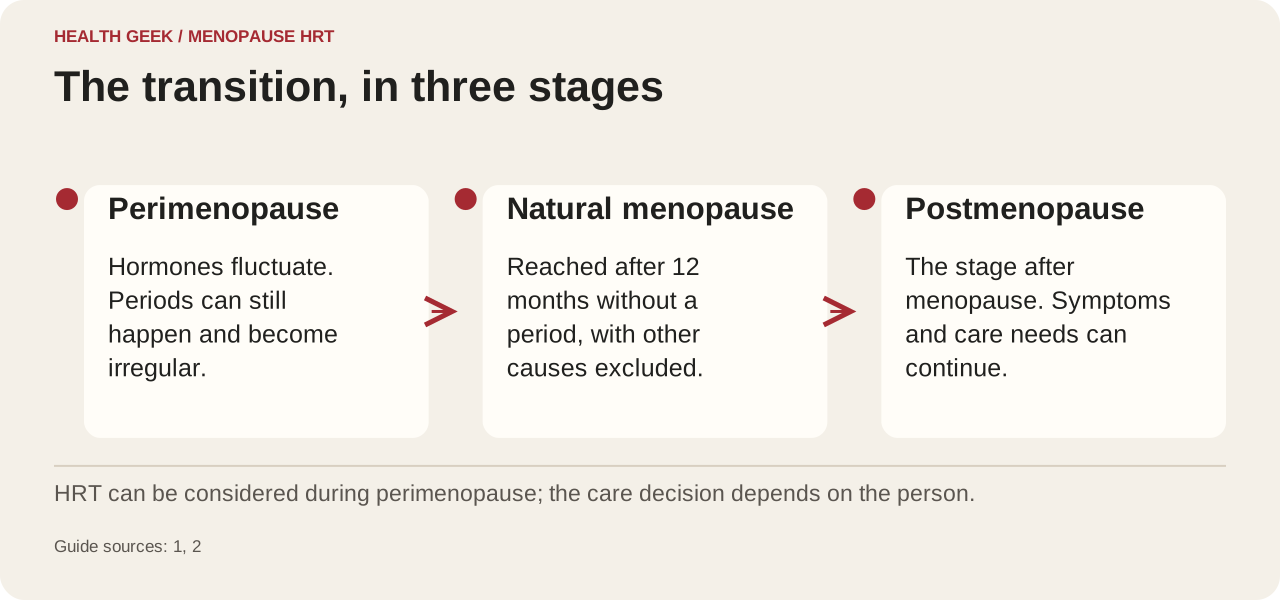
Read this graphic as text
Perimenopause. Hormones fluctuate. Periods can still happen and become irregular.
Natural menopause. Reached after 12 months without a period, with other causes excluded.
Postmenopause. The stage after menopause. Symptoms and care needs can continue.
The ovaries produce hormones including estrogen and progesterone. Estrogen has several roles in the body, including effects on the reproductive system and bone. Progesterone helps regulate the uterine lining. During the menopause transition, changes in these hormones can contribute to symptoms. That doesn't mean every new symptom is caused by menopause. [1–3]
Menopause HRT supplies hormones to treat selected symptoms. You may also see it called hormone therapy, HT or menopausal hormone therapy (MHT). These names refer to the same broad treatment category. [2,3]
Estrogen is the main hormone used for hot flashes and menopause-related vaginal symptoms. Some treatment plans also need a progestogen, the name for progesterone and medicines with a similar protective effect on the uterine lining. The combination depends partly on whether you have a uterus and whether the estrogen acts throughout the body or mainly in vaginal tissue. [2,3]
Those differences matter because the right treatment starts with what you're asking it to help.
Chapter 02 / 11
What HRT can help with
Hot flashes, night sweats and interrupted sleep
Systemic hormone therapy is the most effective treatment for menopause-related hot flashes and night sweats. These symptoms are sometimes called vasomotor symptoms, or VMS, in medical information. [2]
If night sweats are waking you, treating them can help with the sleep disruption they cause. You may be looking for a night when you can stay asleep instead of repeatedly waking with heat and sweating. Hormone therapy can also improve sleep in some circumstances, with the effect depending on the symptoms and treatment. [2]
It helps to separate the night problem from the day problem. Tell the clinician whether you're waking with sweats, having trouble sleeping for another reason, or still feeling exhausted despite sleeping. Those descriptions point to different questions, even when they occur together.
Vaginal dryness and sex that hurts
Menopause-related changes in vaginal tissue can cause dryness, irritation and pain with sex. You may see this discussed as genitourinary syndrome of menopause (GSM), a term that includes vaginal and urinary changes associated with menopause. [2]
Low-dose vaginal estrogen treats relevant vaginal symptoms directly. When these are the main concern and there isn't another reason for systemic treatment, local therapy is an option to discuss. You don't need to have prominent hot flashes for vaginal symptoms to deserve attention. [2,7]
If you want sex but stop because it hurts, comfort is the immediate treatment goal. Relieving dryness-related pain is different from increasing sexual desire. Painful sex also has other possible causes, so describing where and when it hurts helps the clinician decide whether an examination or another treatment is needed. [2,10]
You can say plainly: “I want to have sex, but the pain makes me stop.” That gives the conversation a more useful starting point than assuming you need a general hormone boost.
Energy, motivation and mood
Wanting enough energy to finish the day is a real reason to seek help. So is finding that activities you used to choose willingly now take effort to make yourself do. Those concerns belong in the appointment, even when they don't fit neatly into a hot-flash checklist.
HRT isn't a general treatment for restoring energy or drive. If night sweats are disrupting sleep, addressing them may help that part of the problem. Persistent fatigue still needs an assessment of its own, especially if it continues after the symptoms being treated have improved. [2,10]
Mood needs similar care. Estrogen has shown benefit for depressive symptoms in some perimenopausal women, but HRT isn't a general treatment for depression or anxiety. The clinician needs to assess low mood directly, including how long it has lasted, what it is keeping you from doing and any previous mental-health history, rather than assuming an estrogen shortage. [2]
A useful plan should tell you which symptom it is targeting and what the clinician will do if the problem that matters to you remains.
Brain fog and memory concerns
Trouble concentrating or finding a word can make an ordinary conversation harder. Bring those changes up rather than leaving them out because you're unsure whether they count as menopause symptoms.
HRT is not recommended as a treatment to improve thinking and memory or prevent dementia. A clinician can consider the changes alongside sleep, mood, medications and other possible explanations. The goal is to understand what is happening, not to assume that every memory concern calls for hormones. [2,10]
Bone health
Hormone therapy also prevents bone loss and reduces fracture risk in appropriate patients. [2,3,10]
What meaningful progress looks like
Before treatment, choose a few things you can actually notice: how often night sweats wake you, whether vaginal discomfort is easing, or whether the daily problem that brought you to care is changing. Your response may differ from someone else's. The follow-up discussion should consider both symptom changes and the parts of life you're trying to resume.

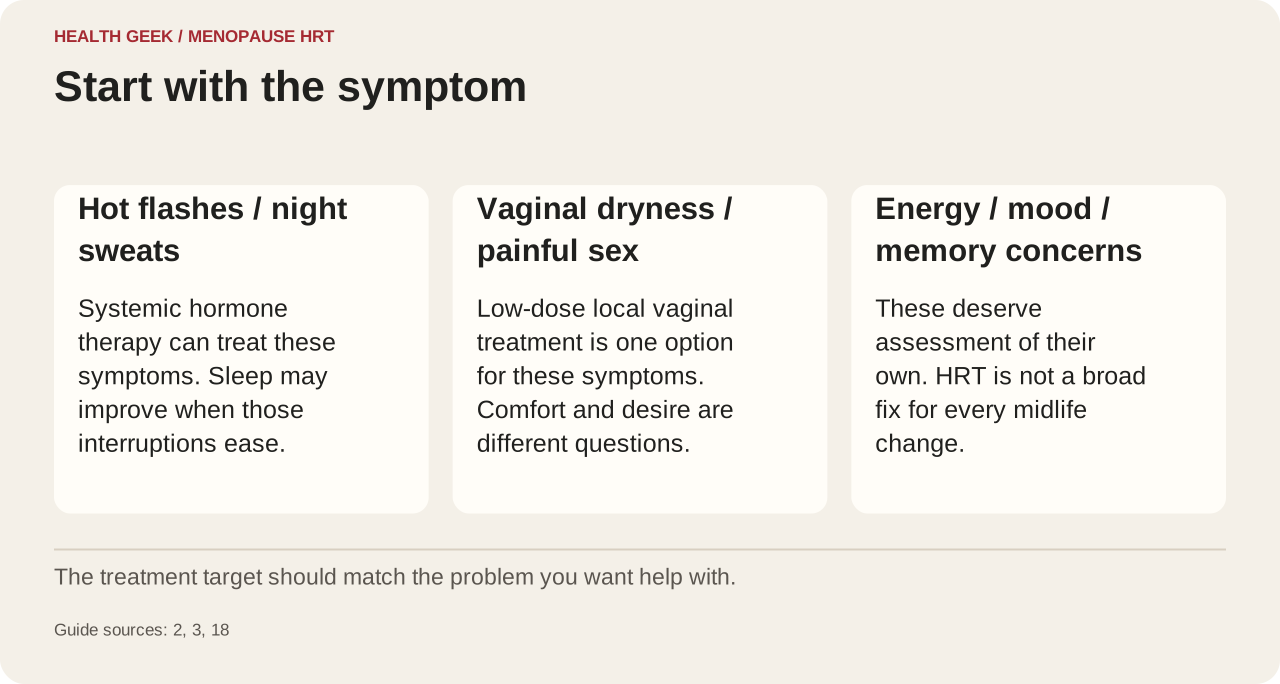
Read this graphic as text
Hot flashes / night sweats. Systemic hormone therapy can treat these symptoms. Sleep may improve when those interruptions ease.
Vaginal dryness / painful sex. Low-dose local vaginal treatment is one option for these symptoms. Comfort and desire are different questions.
Energy / mood / memory concerns. These deserve assessment of their own. HRT is not a broad fix for every midlife change.
Once the symptom target is clear, the treatment names and forms become much easier to sort out.
Chapter 03 / 11
Hormones, forms and treatment routines
The hormone, the physical form and the treatment's reach are separate facts. A gel applied to skin can deliver estrogen throughout the body. A vaginal product can mainly treat nearby tissue. The word “gel” or “ring” alone doesn't tell you what it does. [2,6,7]
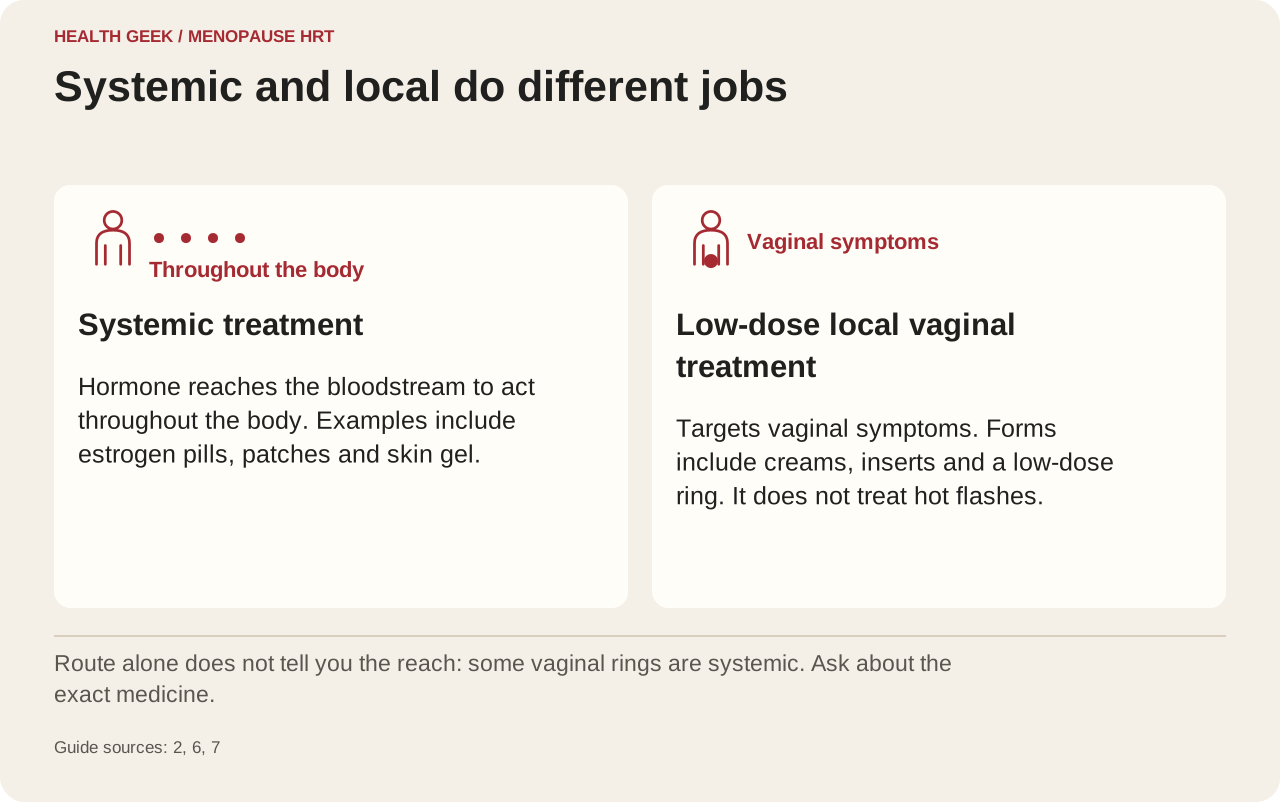
Read this graphic as text
Systemic treatment. Hormone reaches the bloodstream to act throughout the body. Examples include estrogen pills, patches and skin gel.
Low-dose local vaginal treatment. Targets vaginal symptoms. Forms include creams, inserts and a low-dose ring. It does not treat hot flashes.
Systemic estrogen
Systemic means the medicine reaches the body through the bloodstream. Estrogen pills, patches, skin gels and sprays are systemic options. A pill is swallowed; a patch is worn on the skin; a gel or spray is applied to the skin. These forms are used for symptoms such as hot flashes and night sweats. The route affects the routine and is part of the benefit-risk discussion. [2,3]
Divigel is one example: an FDA-approved estradiol gel applied to skin for moderate to severe hot flashes due to menopause. Estradiol is a form of estrogen. Divigel's skin application does not make it a local vaginal treatment. [6]
Why some plans include progesterone
If you have a uterus and use systemic estrogen, your plan generally needs a progestogen at a dose and schedule that protects the uterine lining. Estrogen without that protection can stimulate the lining and increase endometrial cancer risk. Endometrial refers to the lining of the uterus. [2,6,8]
Prometrium is an FDA-approved oral progesterone capsule. One of its labeled uses is preventing excessive uterine-lining growth in postmenopausal women with a uterus who are taking a type of estrogen called conjugated estrogen. That is a specific product use, not proof that any progesterone cream provides equivalent protection. [5]
Some products combine the hormones. Bijuva contains estradiol and progesterone in one oral capsule and is approved for moderate to severe hot flashes due to menopause in adult women with a uterus. Its labeled use is for postmenopausal treatment. [8]
These products illustrate the choices. They aren't recommendations for a particular reader, and discussing HRT during perimenopause doesn't mean every named product is approved for every perimenopausal use.
Low-dose local vaginal treatment
Local treatment is aimed mainly at the vaginal tissues rather than treating hot flashes throughout the body. Low-dose vaginal estrogen comes in forms including creams, tablets, inserts and a ring. Cream, tablets and inserts are placed in the vagina; a ring remains there for its prescribed interval. [2]
With low-dose vaginal estrogen, an added progestogen is generally not required. That guidance applies to low-dose local treatment, not every product used vaginally. Review the exact medicine with the clinician, and have any unexpected bleeding assessed. [2]
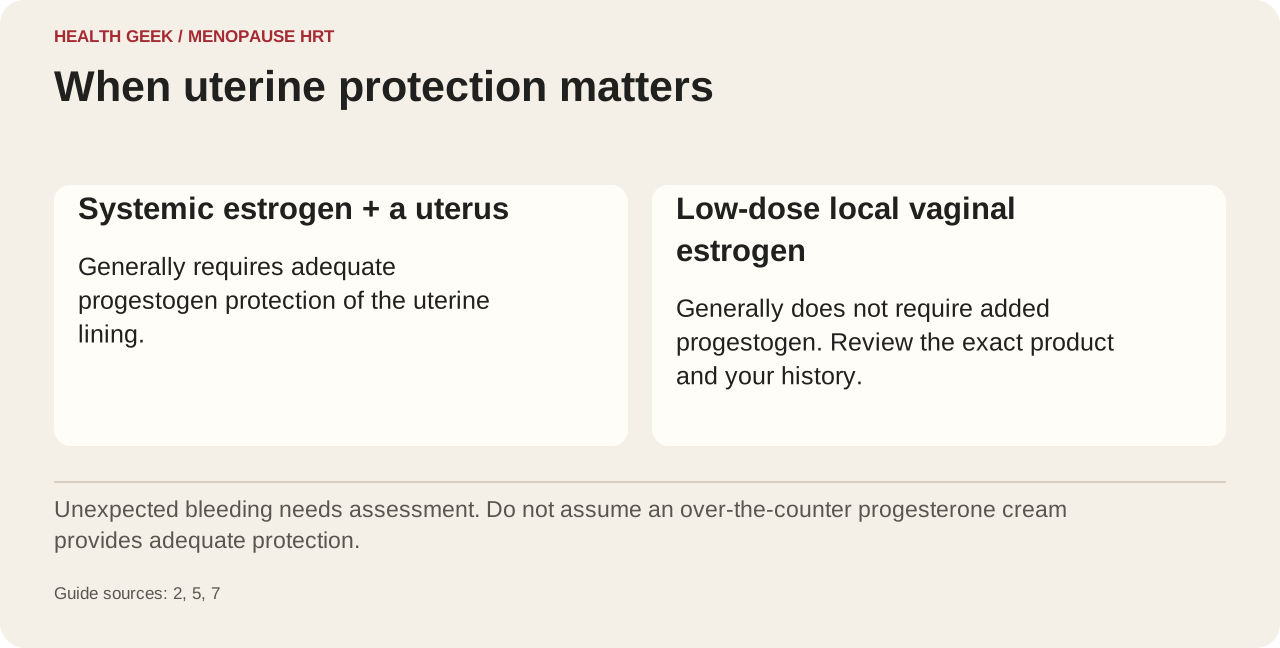
Read this graphic as text
Systemic estrogen + a uterus. Generally requires adequate progestogen protection of the uterine lining.
Low-dose local vaginal estrogen. Generally does not require added progestogen. Review the exact product and your history.
Estring is an FDA-approved estradiol vaginal ring for moderate to severe menopause-related vaginal dryness and pain with intercourse. It is a local treatment and stays in place for three months before replacement if treatment continues. Other vaginal rings can deliver systemic estrogen, so “vaginal ring” does not always mean local therapy. [2,7]
- Treatment example
- Divigel
- Hormone and route
- Estradiol, skin gel
- Treatment job
- Systemic treatment for moderate to severe menopausal hot flashes
- What the form involves
- Skin application with product-specific drying and contact precautions
- Treatment example
- Prometrium
- Hormone and route
- Progesterone, oral capsule
- Treatment job
- Labeled uterine-lining protection with conjugated estrogen in postmenopausal women with a uterus
- What the form involves
- A separate prescribed capsule schedule
- Treatment example
- Bijuva
- Hormone and route
- Estradiol plus progesterone, oral capsule
- Treatment job
- Moderate to severe menopausal hot flashes in adult women with a uterus, within its postmenopausal use
- What the form involves
- Both hormones in one capsule
- Treatment example
- Estring
- Hormone and route
- Estradiol, vaginal ring
- Treatment job
- Local treatment for menopause-related vaginal dryness and painful intercourse
- What the form involves
- A ring worn for a three-month interval
The examples have different approved uses and instructions. Decide which symptom to treat with the clinician, then learn the routine for the exact product prescribed. [5–8]
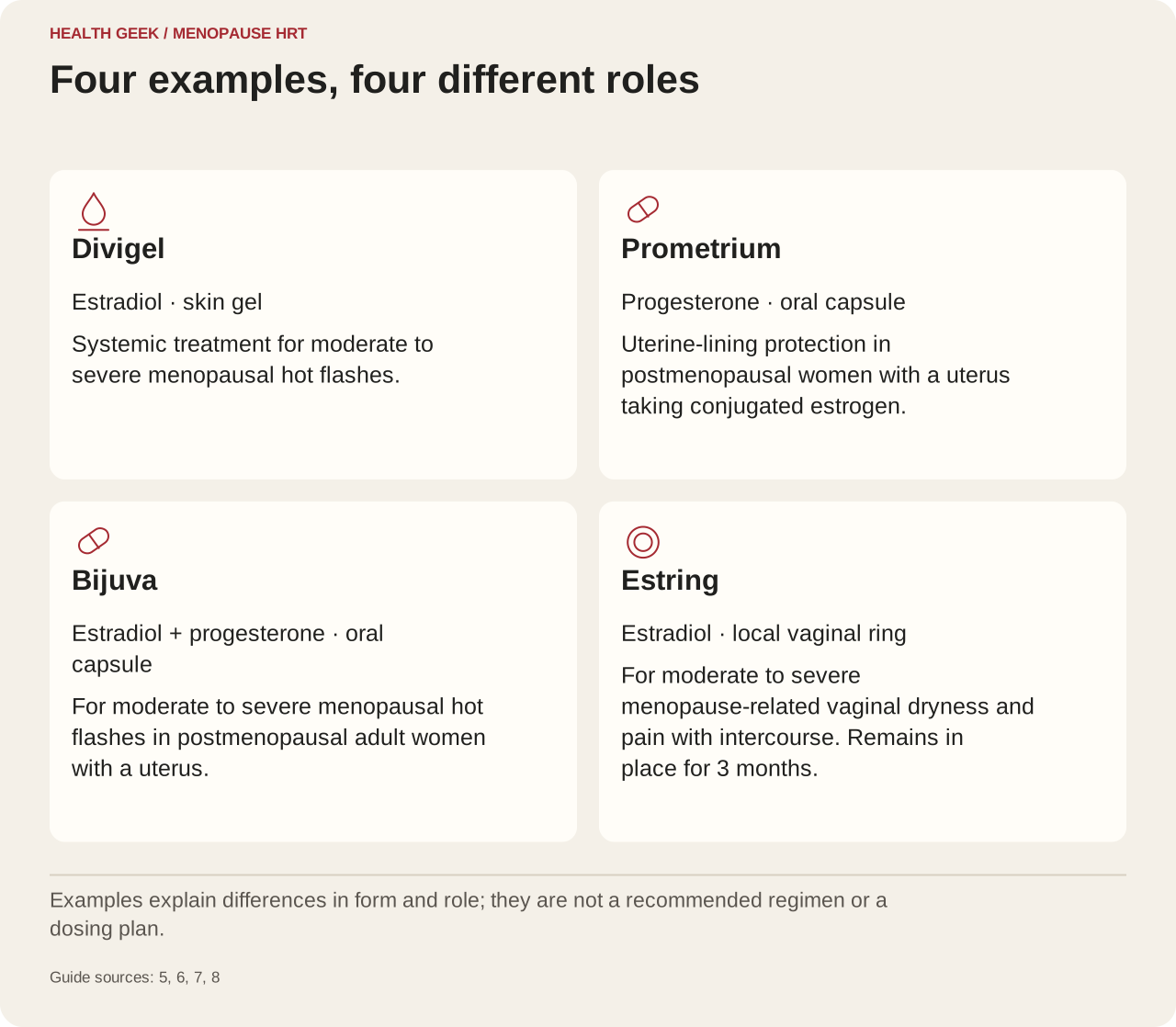
Read this graphic as text
Divigel. Estradiol · skin gel Systemic treatment for moderate to severe menopausal hot flashes.
Prometrium. Progesterone · oral capsule Uterine-lining protection in postmenopausal women with a uterus taking conjugated estrogen.
Bijuva. Estradiol + progesterone · oral capsule For moderate to severe menopausal hot flashes in postmenopausal adult women with a uterus.
Estring. Estradiol · local vaginal ring For moderate to severe menopause-related vaginal dryness and pain with intercourse. Remains in place for 3 months.
Bioidentical does not mean compounded
Bioidentical describes hormones with the same chemical structure as hormones the body makes. Some FDA-approved estradiol and progesterone medicines are bioidentical. The term doesn't mean a medicine must be compounded, or that it is automatically safer. [9]
Compounding means a preparation is made for a particular prescription rather than supplied as an FDA-approved finished medicine. Compounded hormone preparations are not FDA-approved. A label using familiar hormone names doesn't give the finished preparation the approval or review of an approved product. [9]
Estriol is another estrogen sometimes included in compounded preparations. FDA has not approved an estriol-containing drug. An offer described as “natural” or “bioidentical” still needs a clear explanation of exactly what it contains, why it is being proposed and whether the finished medicine is FDA-approved. [9]
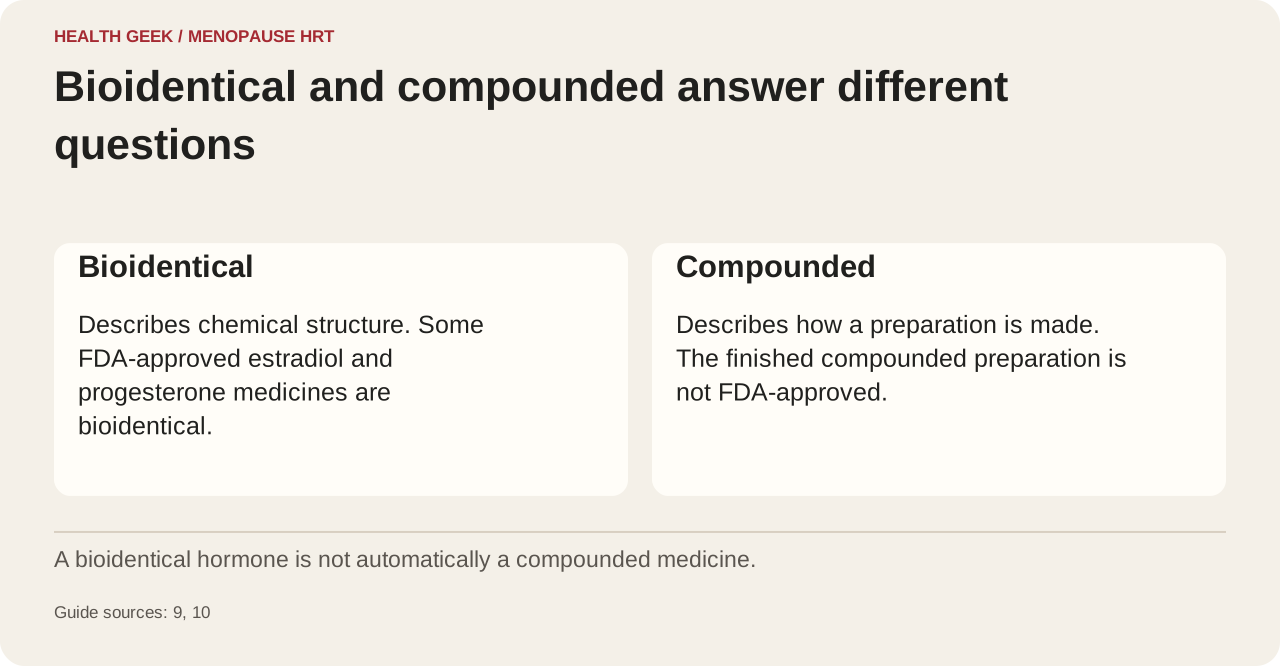
Read this graphic as text
Bioidentical. Describes chemical structure. Some FDA-approved estradiol and progesterone medicines are bioidentical.
Compounded. Describes how a preparation is made. The finished compounded preparation is not FDA-approved.
Chapter 04 / 11
Whether HRT could be appropriate for you
A useful assessment connects the symptom you want treated with your medical history. It also leaves room for another explanation when the symptoms don't point clearly to menopause.
Expect to discuss your periods and bleeding pattern, the symptoms and when they began, medications and supplements, allergies, and relevant personal and family health history. Tell the clinician whether you have a uterus, have had reproductive surgery, could be pregnant or need contraception. These details affect the treatment discussion. [1,2,5,6,8]
You don't have to wait until periods stop to seek help. But irregular periods alone don't establish that all of your symptoms are hormonal, and a normal hormone result doesn't automatically settle the question either. [1]
Tests depend on the question
Hormone levels fluctuate during perimenopause. A single test is often less useful than people expect, and blood tests aren't automatically required to recognize the transition. A clinician may request testing when the history is unclear, menopause occurs unusually early, or another cause needs investigation. [1]
Ask what a proposed test is meant to establish and how its result would change care. That is more useful than trying to reach a particular hormone number on your own.
Starting and continuing are different decisions
For many healthy women with bothersome symptoms who are younger than 60 or within 10 years of menopause onset, the benefit-risk balance of hormone therapy is favorable when there are no medical reasons they shouldn't use it. Those are clinical decision factors, not a rule that age alone makes treatment right. [2]
Starting systemic treatment for the first time later requires a different risk discussion. Continuing an existing treatment also needs regular reassessment, but it is a different decision from starting HRT for the first time later in life. A birthday alone doesn't supply the entire answer. [2]
Early menopause, menopause after surgery, cancer-related care and other complex histories can change the reasons for treatment and the available options. Tell the clinician about that context rather than using a general guide to decide eligibility. [2]
HRT is not contraception. Pregnancy is still possible during perimenopause. Discuss birth control separately if you need it. [1]
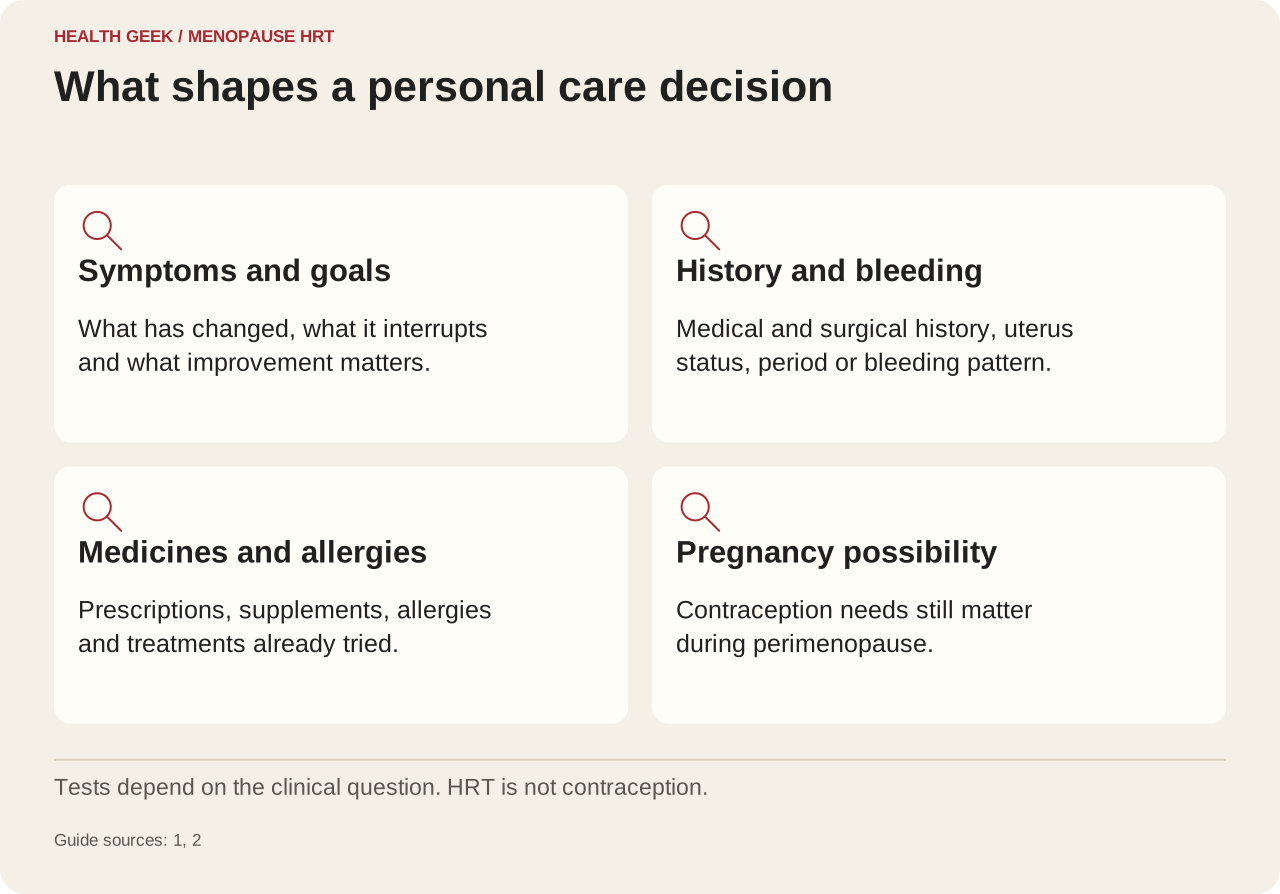
Read this graphic as text
Symptoms and goals. What has changed, what it interrupts and what improvement matters.
History and bleeding. Medical and surgical history, uterus status, period or bleeding pattern.
Medicines and allergies. Prescriptions, supplements, allergies and treatments already tried.
Pregnancy possibility. Contraception needs still matter during perimenopause.
The next part of the decision is whether the expected relief is worth the risks for your particular treatment and history.
Chapter 05 / 11
Making sense of risks and side effects
You may want relief and still worry about trading your current symptoms for a more serious problem. That concern deserves a specific answer. “HRT is safe” and “HRT is dangerous” are both too broad to explain your own choice.
Risk depends on the hormone combination, dose, route, how long it is used, when it is started and your health history. A local vaginal treatment and systemic estrogen are not interchangeable exposures. The relevant discussion is about the medicine being considered, not one risk number applied to all HRT. [2]
The risks to discuss
Systemic treatment requires a discussion of blood clots, stroke, cardiovascular disease and breast cancer where relevant to the treatment and your health history. Estrogen used without adequate uterine protection is a separate endometrial-cancer concern for someone with a uterus. Your clinician should explain which risks matter most in your case and how the proposed treatment changes the balance. [2,3,6,8]
Product labels identify contraindications, situations in which the medicine should not be used. Important examples in hormone product labels include unexplained genital bleeding, certain cancers, a history of blood clots or clotting disorders, prior stroke or heart attack, liver disease and known or suspected pregnancy. Check the contraindications for the prescribed product with the clinician; this list isn't a self-screening substitute for clinical review. [5–8]
Allergies matter too. Prometrium capsules contain peanut oil, and its label says not to use the product if you are allergic to peanuts. That warning is specific to Prometrium and shouldn't be assumed to describe every progesterone formulation. [5]
What changed in the FDA warnings in 2026
In February 2026, FDA approved labeling changes for an initial group of six menopausal hormone therapy products. The changes removed certain risk statements from the boxed warnings. A boxed warning is a prominently displayed warning in prescribing information. [3,4]
The change does not mean the medicines became risk-free. Risks can remain in the Warnings and Precautions sections, and an endometrial-cancer boxed warning remains relevant for systemic estrogen-only products. Check the current information for the exact medicine with the clinician or pharmacist rather than relying on an old headline or assuming that every HRT label changed at once. [3,4,6]
Side effects and symptoms that need care
Possible side effects vary by product. Examples include breast tenderness, headache, nausea, spotting or bleeding, and irritation where a skin or vaginal product is used. Oral progesterone can cause drowsiness or dizziness. Reporting an effect helps the clinician decide whether it calls for a change, further assessment or stopping the medicine. [5–8]
Don't assume new bleeding is just a routine adjustment. Unexplained bleeding, particularly bleeding after menopause, needs evaluation. [2,5–8]
Seek urgent medical help for symptoms such as sudden chest pain or shortness of breath, a painful or swollen leg, sudden weakness or difficulty speaking, or sudden vision changes. These can signal serious problems described in hormone product warnings. Follow the prescribed medicine's emergency and contact instructions. [5–8]
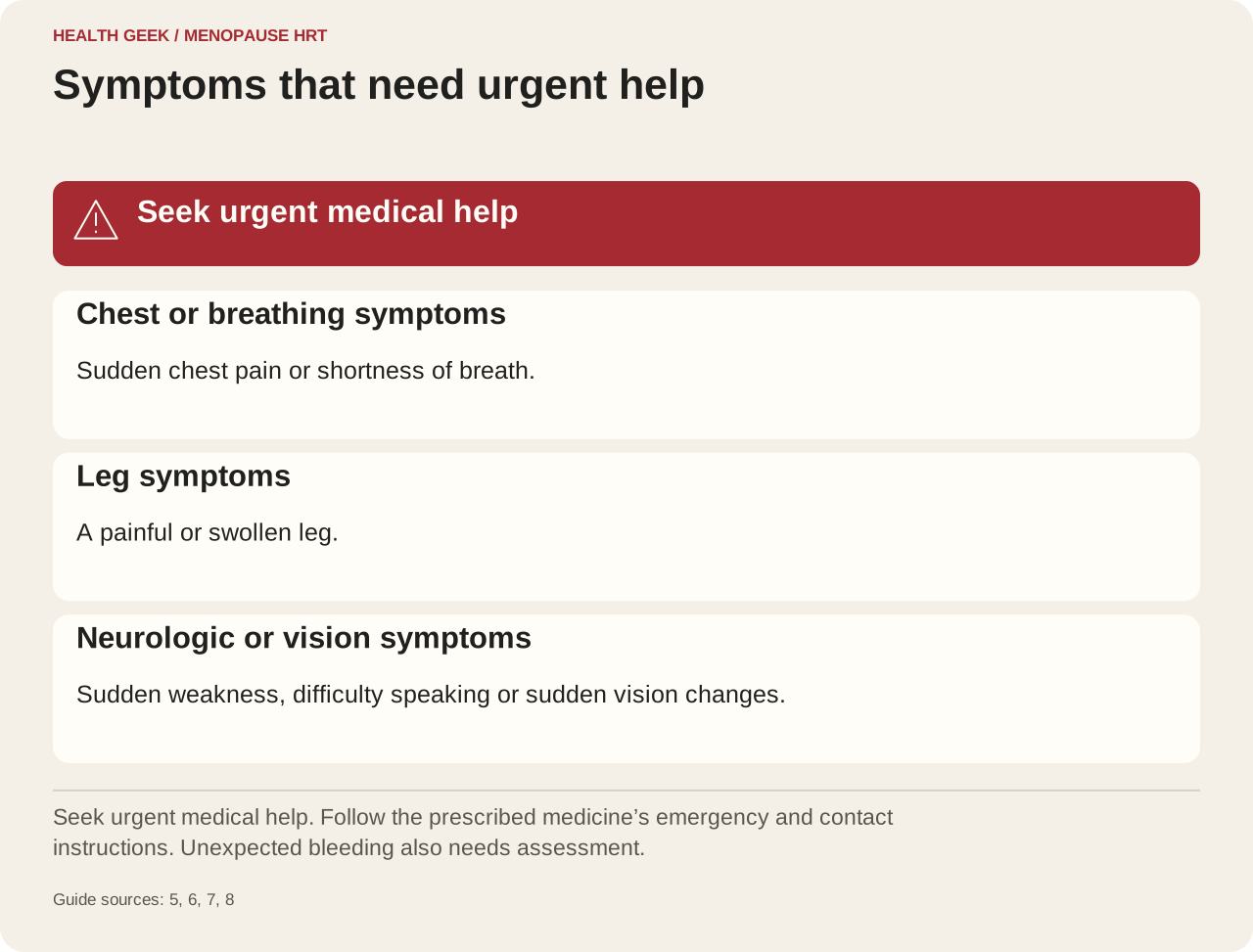
Read this graphic as text
Chest or breathing symptoms. Sudden chest pain or shortness of breath.
Leg symptoms. A painful or swollen leg.
Neurologic or vision symptoms. Sudden weakness, difficulty speaking or sudden vision changes.
A workable treatment decision includes a plan for what to report and who to contact. You shouldn't have to choose between silently tolerating a problem and figuring out changes to the prescription yourself.
Chapter 06 / 11
Other ways to treat the symptoms
Deciding against systemic HRT doesn't mean the only option is to put up with the symptoms. Alternatives should be matched to the same symptom target.
Hot flashes and night sweats
Nonhormonal prescription options include certain antidepressant medicines and other medicines used for hot flashes. Fezolinetant and elinzanetant are newer nonhormonal options approved for moderate to severe hot flashes due to menopause. They don't supply estrogen, but each has its own safety requirements. [9,11–13]
Fezolinetant (Veozah) carries an FDA warning about rare serious liver injury. Liver blood tests are required before starting and during treatment. The clinician should explain the testing plan and the symptoms that require stopping the medicine and seeking care. [13]
Elinzanetant (Lynkuet) has its own liver-testing requirements and warnings, including effects on alertness such as sleepiness. It must not be used during pregnancy. Its label also warns about seizures. Tell the clinician about any seizure history, and seek medical attention right away for a seizure or loss of consciousness. Ask about your other medicines, driving or other activities requiring attention, and the monitoring plan for the current prescription. [11,12]
Nonhormonal isn't a synonym for risk-free. The useful comparison is whether the particular option offers worthwhile relief with risks and requirements you can accept.
Vaginal discomfort
Vaginal moisturizers are used regularly for dryness; lubricants reduce friction during sexual activity. [18] These have a different role from local prescription treatment. If discomfort persists, ask about low-dose vaginal estrogen or other prescription options, such as vaginal prasterone or oral ospemifene. These alternatives also have their own suitability and safety considerations. [2]
Pain that makes you stop wanted sex deserves assessment even if an over-the-counter product hasn't helped. You don't need to keep trying through pain to establish that it matters.
Low sexual desire and testosterone
Persistent low desire that causes distress is a separate concern from sex that hurts because of dryness. Some postmenopausal women may be considered for testosterone treatment after evaluation for hypoactive sexual desire disorder (HSDD), the clinical term for that low-desire condition. [10]
There is no FDA-approved testosterone product for women in the United States. Its use for women is off-label, meaning outside the approved product use. This is a specialist treatment discussion, not routine menopause treatment for energy, motivation or general wellbeing. [10,14]
Habits that support care
Regular physical activity, attention to sleep and other health habits still matter. A cooler sleeping environment may make a sweaty night more manageable. These practical measures can sit alongside treatment, but they aren't automatically equivalent substitutes for medicines that treat bothersome hot flashes or vaginal symptoms. [9,10]
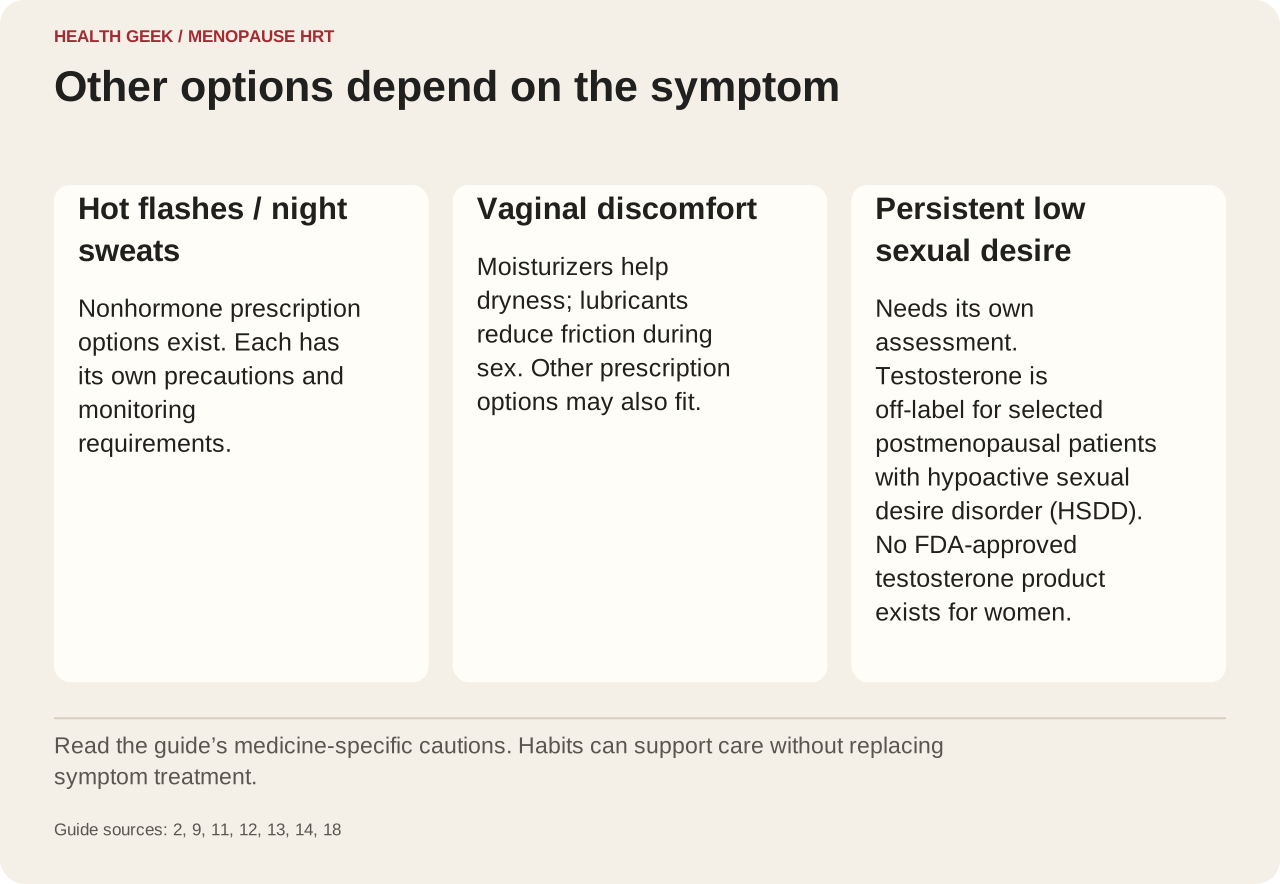
Read this graphic as text
Hot flashes / night sweats. Nonhormone prescription options exist. Each has its own precautions and monitoring requirements.
Vaginal discomfort. Moisturizers help dryness; lubricants reduce friction during sex. Other prescription options may also fit.
Persistent low sexual desire. Needs its own assessment. Testosterone is off-label for selected postmenopausal patients with hypoactive sexual desire disorder (HSDD). No FDA-approved testosterone product exists for women.
Whatever approach you consider, there still needs to be a way to discuss it, assess fit and follow up. That care conversation may begin online.
Chapter 07 / 11
What online menopause care makes easier
An online appointment lets you discuss symptoms from home without making the trip to a clinic. If getting to a visit means travel and time away from the rest of your day, removing that trip can make seeking care more manageable. [15]
Telehealth can also support follow-up conversations and messaging, depending on the service. After a treatment change, a remote discussion may spare you another journey just to explain what has improved and what hasn't. Access to a clinician outside your immediate area may broaden your choices, subject to where the service operates. [15]

Those are practical benefits of the care route. The service still needs to offer the assessment and continuing care your situation requires.
- Online care can be useful for
- Discussing symptoms, medical history and treatment options remotely
- In-person care may still be needed for
- An examination that can't be done through a screen
- Online care can be useful for
- Reviewing progress and concerns without travel
- In-person care may still be needed for
- Local blood tests or other investigations
- Online care can be useful for
- Messaging the care team when the service offers it
- In-person care may still be needed for
- Evaluation or referral for findings that need hands-on care
Some people prefer an in-person conversation. Others value starting from home. A service that arranges local evaluation when needed can be more useful than one that leaves you unsure where to go next. Ask how that connection works before committing. [15]
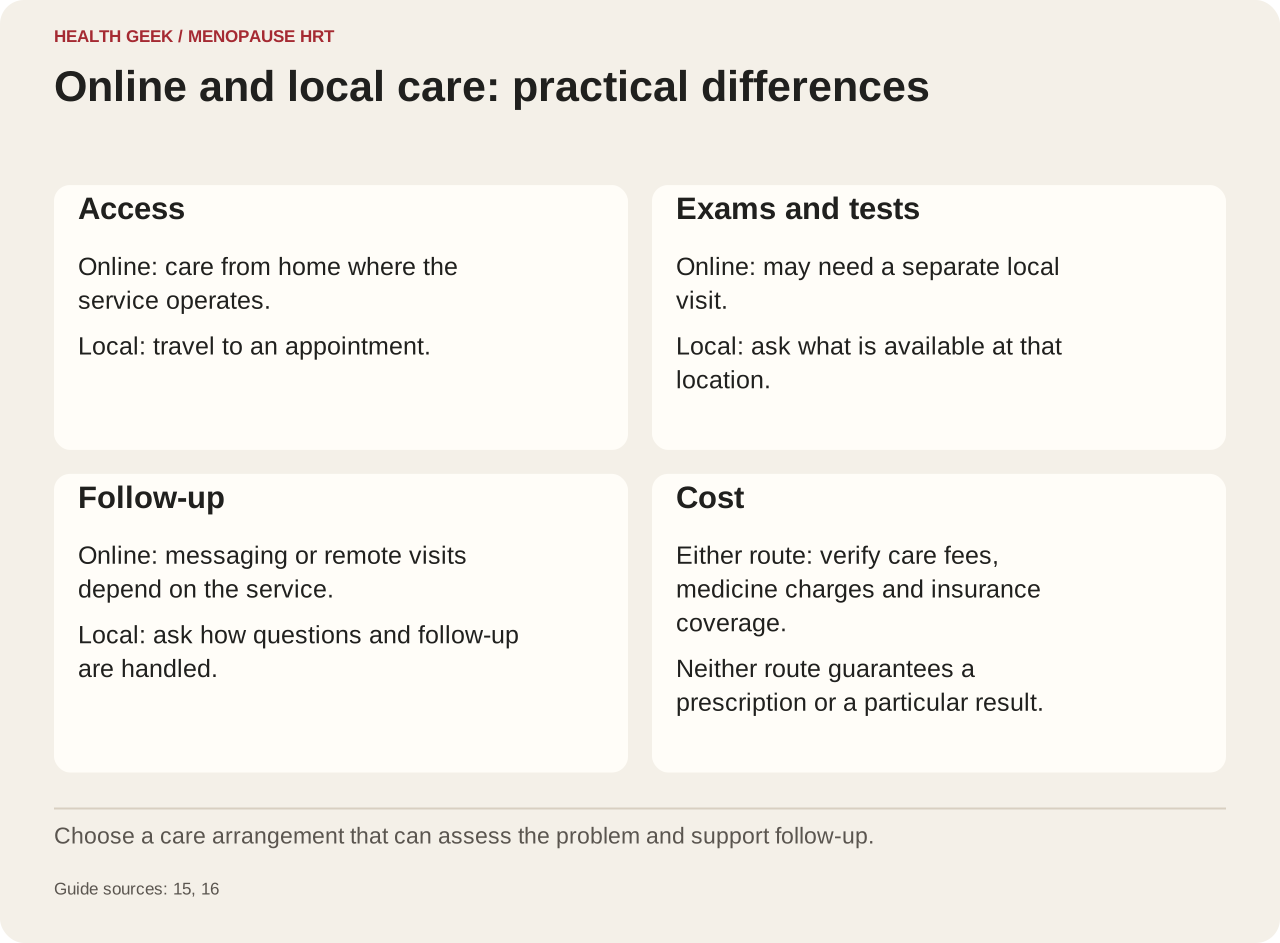
Read this graphic as text
Access. Online: care from home where the service operates. Local: travel to an appointment.
Exams and tests. Online: may need a separate local visit. Local: ask what is available at that location.
Follow-up. Online: messaging or remote visits depend on the service. Local: ask how questions and follow-up are handled.
Cost. Either route: verify care fees, medicine charges and insurance coverage. Neither route guarantees a prescription or a particular result.
Chapter 08 / 11
Getting started through telehealth
The exact process varies, but these are the parts to understand before choosing a service.
- Check that it serves your situation and location. Confirm that it treats your menopause-stage concerns, operates where you live and offers access to an appropriately licensed clinician. Check whether the first appointment is by video, phone or another assessment format, and what is charged.
- Prepare the health and symptom information. Bring your bleeding or period pattern, medical and surgical history, allergies, medicines and supplements. Describe the problem in ordinary terms, including what it interrupts.
- Complete the clinical assessment. The clinician reviews the information, discusses possible explanations and decides whether more testing, an examination or another clinician is needed.
- Discuss the treatment decision. This includes the symptom target, options, personal risks, practical routine and follow-up. A prescription is an outcome of an appropriate assessment, rather than something guaranteed by completing an intake form.
- Confirm how a prescription is filled. If medication is prescribed, the service may send the prescription to a local pharmacy or arrange delivery through its pharmacy process. Verify the actual arrangement and the separate medicine charge.
- Leave with instructions and a way to follow up. Know how to use the prescribed product, which concerns to report, how to reach the care team and when your response will be reviewed. [1,2,15–17]
If the assessment points to a local examination or another option, ask for a clear next step. A useful visit can result in further evaluation rather than hormones.
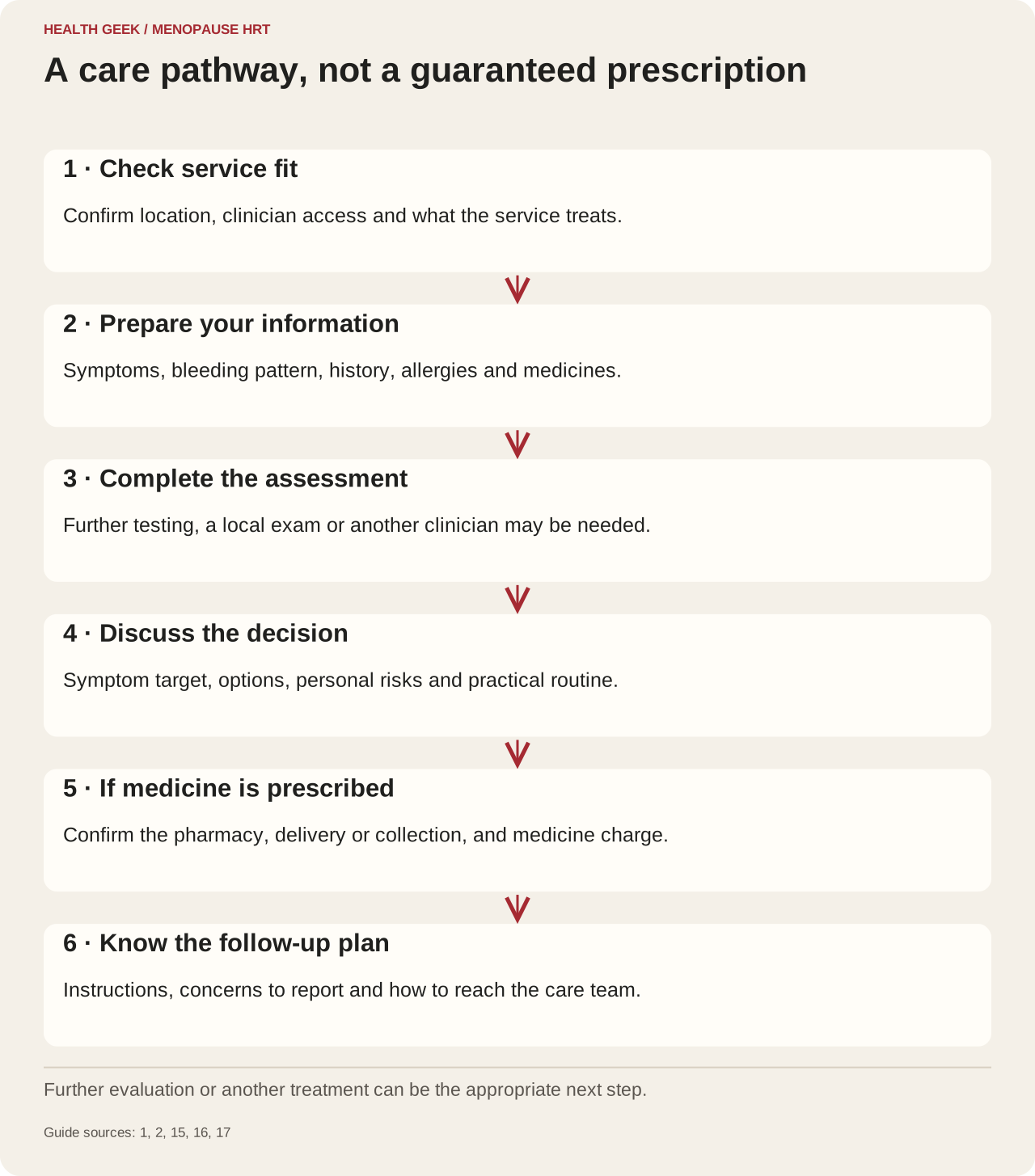
Read this graphic as text
1 · Check service fit. Confirm location, clinician access and what the service treats.
2 · Prepare your information. Symptoms, bleeding pattern, history, allergies and medicines.
3 · Complete the assessment. Further testing, a local exam or another clinician may be needed.
4 · Discuss the decision. Symptom target, options, personal risks and practical routine.
5 · If medicine is prescribed. Confirm the pharmacy, delivery or collection, and medicine charge.
6 · Know the follow-up plan. Instructions, concerns to report and how to reach the care team.
Know who does what
The platform supplies the appointment or messaging system. The clinician assesses and prescribes. The pharmacy dispenses the medicine and answers medication questions. The manufacturer, or a compounding pharmacy for a compounded preparation, makes it. Some organizations provide more than one of these functions, but an attractive website doesn't establish all of them.
For an online pharmacy, FDA advises checking that it requires a prescription, provides a U.S. address and phone number, has a licensed pharmacist available and is licensed by a state board of pharmacy. A website that sells prescription medicine without a prescription is a warning sign. [17]
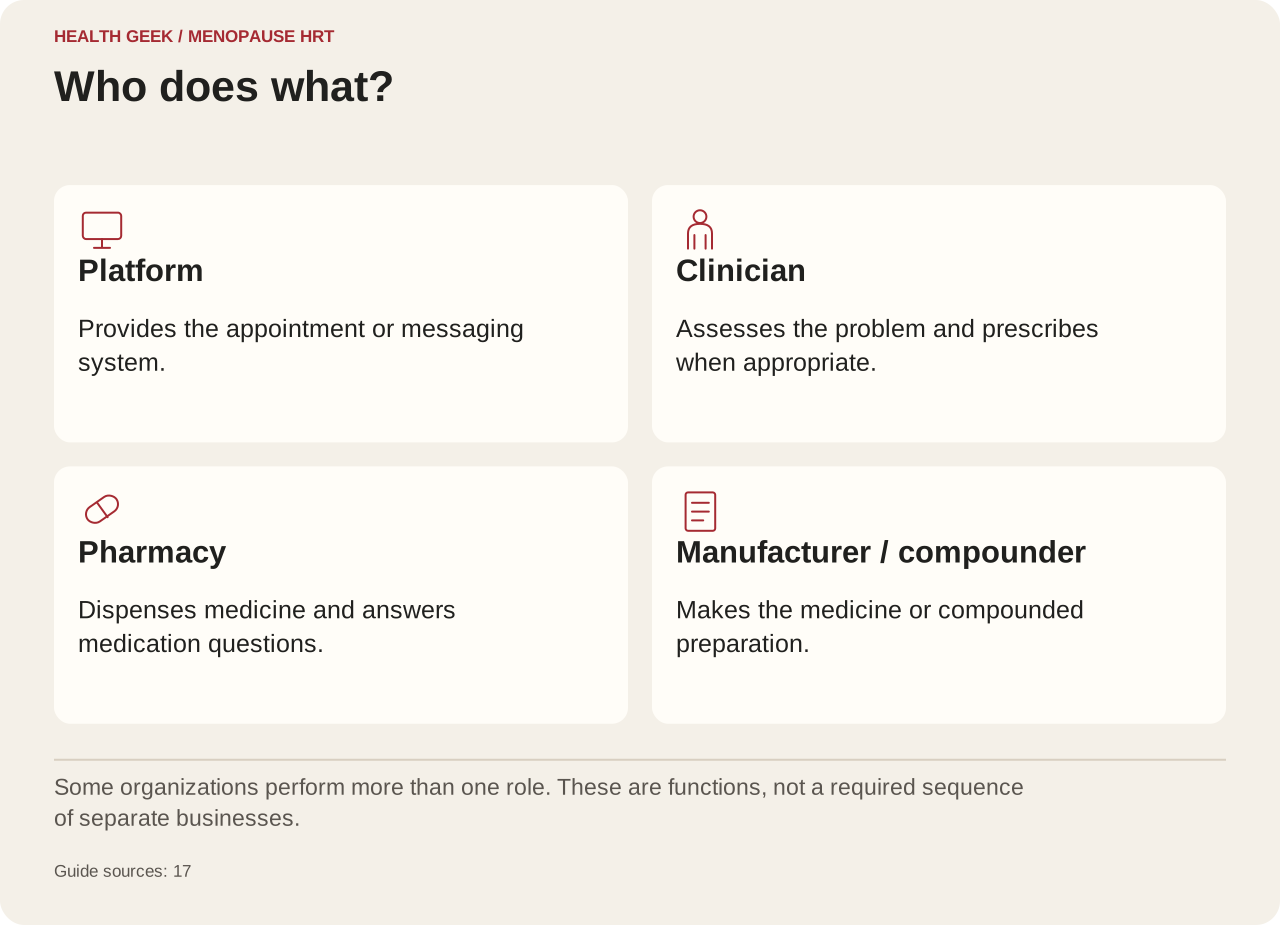
Read this graphic as text
Platform. Provides the appointment or messaging system.
Clinician. Assesses the problem and prescribes when appropriate.
Pharmacy. Dispenses medicine and answers medication questions.
Manufacturer / compounder. Makes the medicine or compounded preparation.
Chapter 09 / 11
Using treatment and keeping it under review
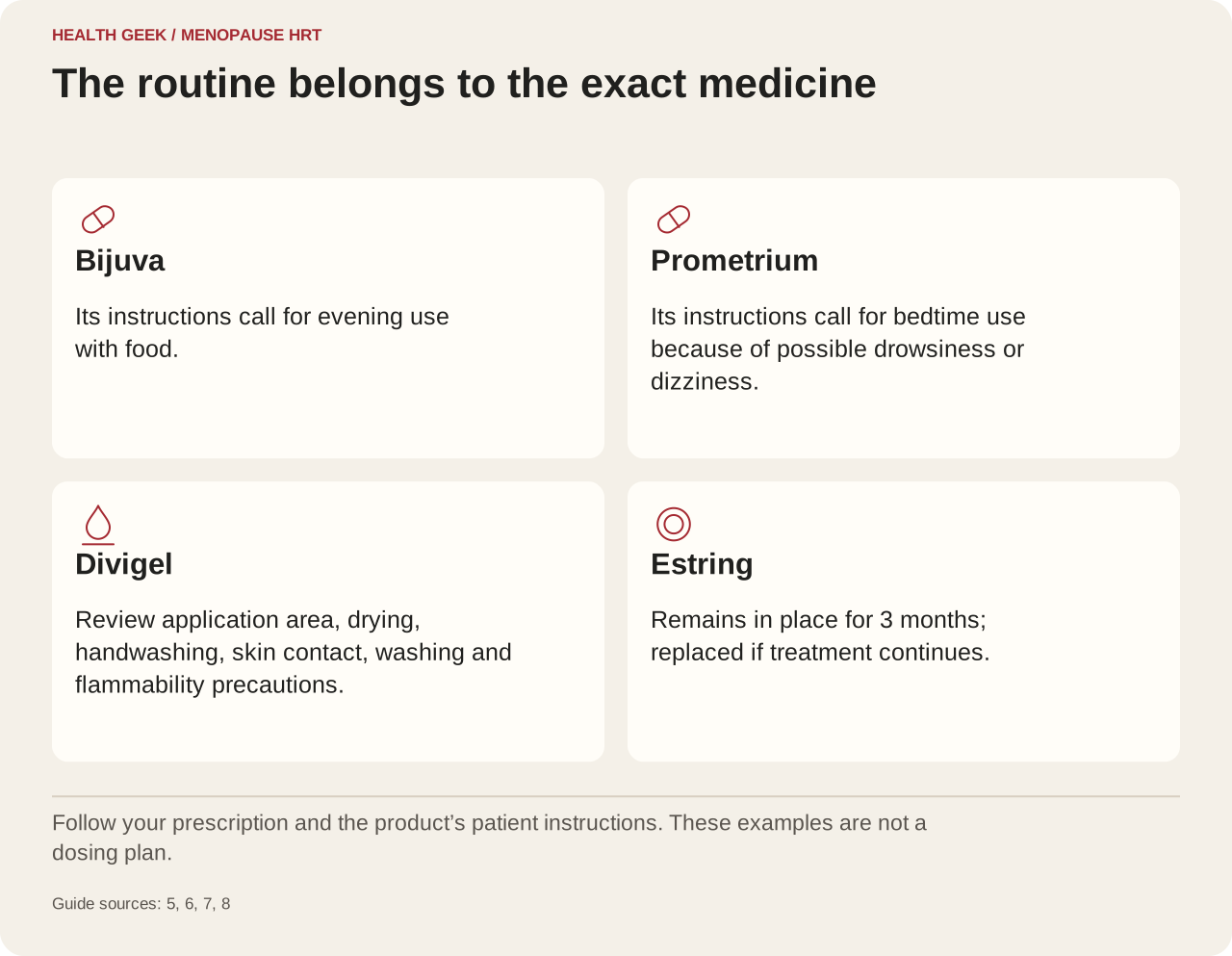
The everyday routine belongs to the exact medicine, not just the hormone name. Read its patient instructions and ask the pharmacist to explain anything that is unclear. The examples below show why the form matters; they aren't a dosing plan.
Oral capsules
Bijuva's patient instructions call for taking the capsule in the evening with food. Prometrium's instructions call for bedtime use because it can cause drowsiness or dizziness. The prescribed schedule also depends on why the medicine is being used. Don't substitute the routine for one capsule for another. [5,8]
Skin gel
Divigel has specific directions about the application area, letting the gel dry, washing your hands and preventing other people from contacting the application site. It also has precautions about washing the area and flammability before the gel dries. Have the instructions explained so you know how the application fits around dressing, washing and close contact. [6]
A local vaginal ring
Estring remains in place for three months. If treatment continues, the ring is replaced. Its instructions explain insertion and removal, and the clinician can help if you have difficulty. [7]
Read this graphic as text
Bijuva. Its instructions call for evening use with food.
Prometrium. Its instructions call for bedtime use because of possible drowsiness or dizziness.
Divigel. Review application area, drying, handwashing, skin contact, washing and flammability precautions.
Estring. Remains in place for 3 months; replaced if treatment continues.
Follow-up should look at the problem you came with
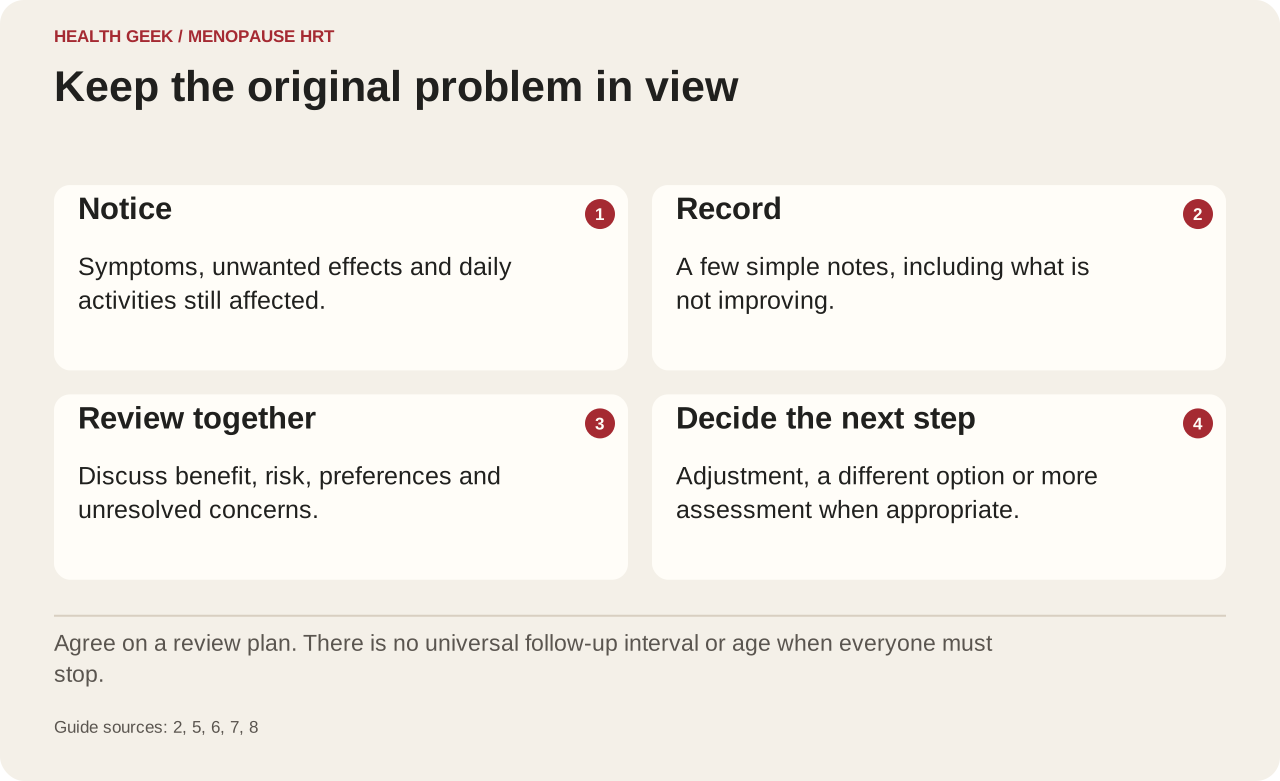
Keep simple notes on the symptoms being treated and any unwanted effects. For night sweats, that might mean how often they wake you. For vaginal discomfort, note whether dryness and pain are changing. Also record what remains difficult in daily life, so an improved symptom count doesn't hide an unresolved concern.
The clinician may adjust the treatment, change the form or suggest further assessment. Agree on a review plan for the prescription rather than expecting one universal follow-up interval. [2,5–8]
Read this graphic as text
Notice. Symptoms, unwanted effects and daily activities still affected.
Record. A few simple notes, including what is not improving.
Review together. Discuss benefit, risk, preferences and unresolved concerns.
Decide the next step. Adjustment, a different option or more assessment when appropriate.
How long treatment continues
Duration depends on continuing benefit, risk and preferences. There isn't a universal age at which everyone must stop HRT, and starting treatment doesn't automatically mean taking it for life. Reassessment considers whether the original symptoms still need treatment and whether your history or risks have changed. [2]
Symptoms can return after stopping hormone therapy. Discuss a stopping plan with the clinician; there isn't one tapering method that every reader should follow. Continuing an established treatment and starting it for the first time later remain different decisions. [2]
Continuing care also has practical requirements, including the cost of appointments, refills and any tests. It helps to understand that whole arrangement before the first payment.
Chapter 10 / 11
Costs and choosing care
The appointment price and the medicine price may be separate. A program fee may or may not cover follow-up, messaging, tests or prescription costs. Insurance coverage also varies by service, plan and medication. Confirm the actual charges with the provider and coverage with your insurer. [16]
Ask for both the starting cost and the cost of continuing. A first appointment tells you little about affordability if you don't know what a refill or the next consultation will cost.
A total-cost worksheet
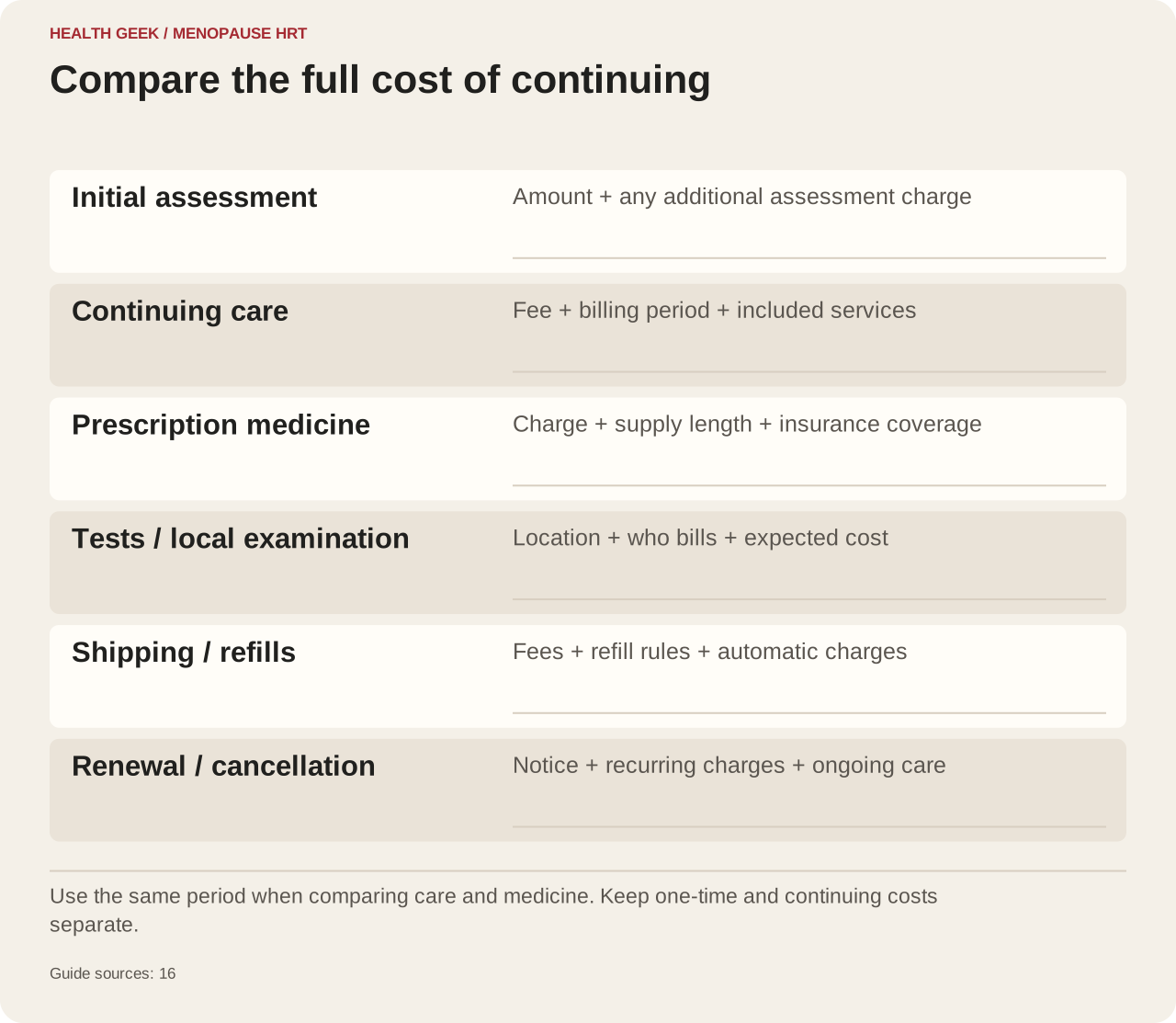
Fill this in using the provider's quote and your coverage information. Put “included” only where the service confirms it, and note the billing period beside every recurring charge.
- Cost to verify
- Initial assessment
- What to record
- Your out-of-pocket amount; whether additional assessment is charged separately
- Cost to verify
- Continuing appointments or program fee
- What to record
- Amount, billing frequency and what care is included
- Cost to verify
- Prescription medicine
- What to record
- Pharmacy charge, supply length, insurance coverage and any separate medicine needed
- Cost to verify
- Tests or local examination
- What to record
- Where these occur, who bills them and expected out-of-pocket cost
- Cost to verify
- Shipping and refills
- What to record
- Delivery fees, refill requirements and any automatic charges
- Cost to verify
- Renewal or cancellation
- What to record
- Notice requirements, when charges recur and what happens to ongoing care
For a fair comparison, use the same period for the care fees and medication supply. Keep one-time charges separate from continuing costs. You need an arrangement you can sustain, not just a small first payment.
Read this graphic as text
Initial assessment. Amount + any additional assessment charge
Continuing care. Fee + billing period + included services
Prescription medicine. Charge + supply length + insurance coverage
Tests / local examination. Location + who bills + expected cost
Shipping / refills. Fees + refill rules + automatic charges
Renewal / cancellation. Notice + recurring charges + ongoing care
Questions that help you choose care
- Does the clinician address your symptoms and explain the options, including another cause or treatment when appropriate?
- Is it clear who provides the care, where they are licensed to practice and which pharmacy fills prescriptions?
- Does the service explain how examinations, testing or specialist referrals are handled?
- What happens if symptoms persist or you have an unwanted effect, and what follow-up is included?
- Is the proposed medicine FDA-approved or compounded, and why is that choice being offered?
- Can you see the full starting and continuing charges before committing? [9,15–17]
The answers should make the arrangement understandable. A wide treatment menu or an appealing subscription price doesn't replace a clinician who takes the actual problem seriously.
Chapter 11 / 11
Prepare for a useful care conversation
You don't need a perfectly organized medical story. A few specific notes can help you explain what has changed and what you want help with.
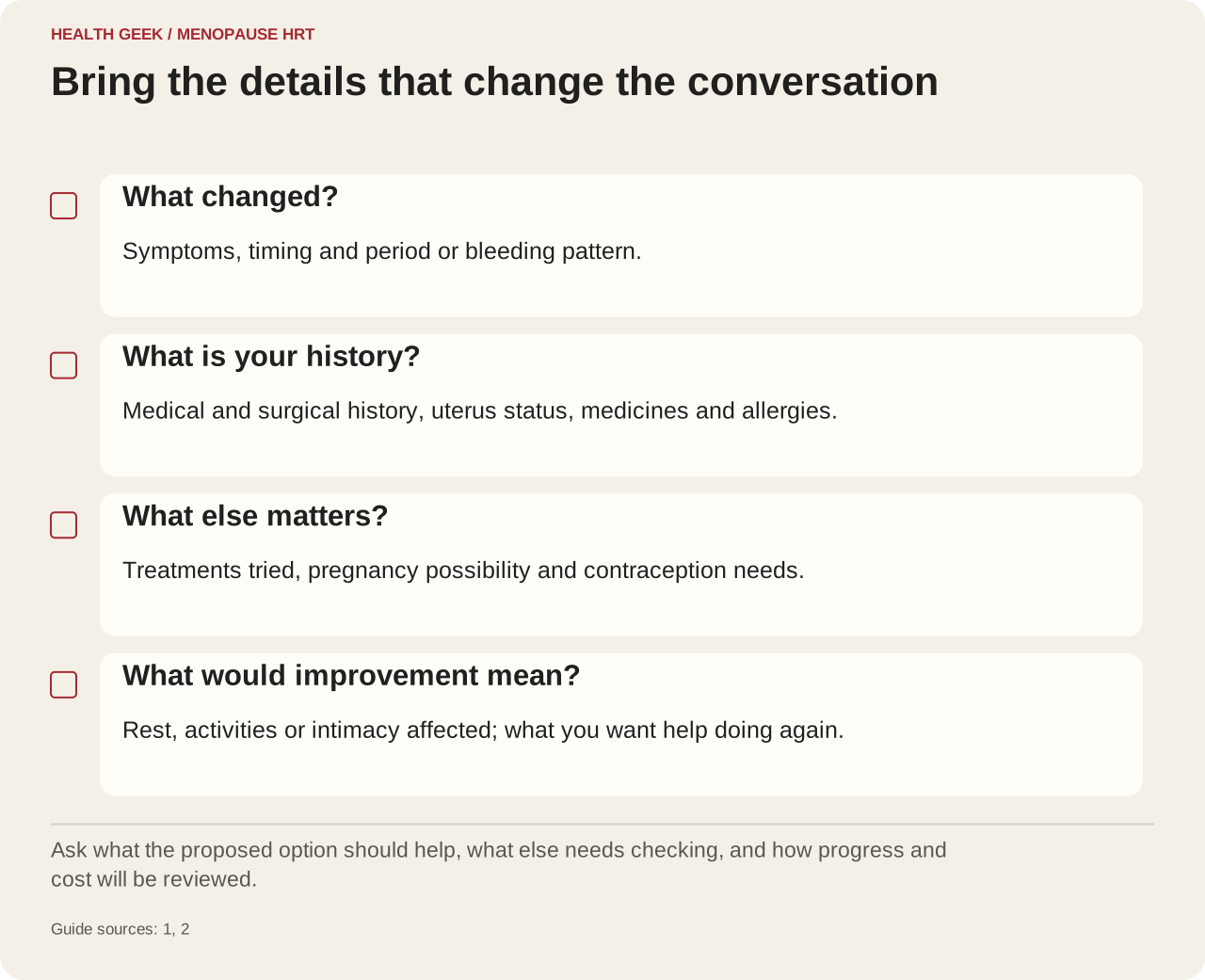
Bring these details
- Your period or bleeding pattern, including the last period if known.
- The symptoms, when they started and whether they are changing.
- Your medical and surgical history, including whether you have a uterus.
- Medicines, supplements, allergies and treatments you've already tried.
- Pregnancy possibility and any contraception needs.
- The activities, rest or intimacy affected, and what improvement would matter to you. [1,2]
Read this graphic as text
What changed?. Symptoms, timing and period or bleeding pattern.
What is your history?. Medical and surgical history, uterus status, medicines and allergies.
What else matters?. Treatments tried, pregnancy possibility and contraception needs.
What would improvement mean?. Rest, activities or intimacy affected; what you want help doing again.
Make the last item concrete. “I'm having night sweats” describes a symptom. “They keep waking me, and I want to sleep without those interruptions” explains the treatment goal. “Sex hurts enough that I stop” tells the clinician what needs addressing. If exhaustion or lost interest is the main concern, say that too, even if you're unsure whether menopause explains it.
Questions to take with you
- Which of my symptoms could be menopause-related, and what else needs checking?
- What would this treatment be expected to help, and what would we do if the main problem remains?
- How does my history affect the benefits and risks of the proposed option?
- What does using it involve, and which effects or changes should I report?
- How will we review progress, and what are the complete costs of continuing care?
Book a menopause-focused conversation with a clinician, online or in person, and take your notes. You don't have to arrive committed to HRT. Arrive ready to explain the parts of life you want back and to discuss a treatment plan aimed at the symptoms standing in the way.
Sources
- Office on Women's Health: Menopause basics.
- The Menopause Society: The 2022 hormone therapy position statement.
- FDA: Hormone replacement therapies can help women with bothersome menopausal symptoms.
- FDA: Labeling changes approved for menopausal hormone therapy products, February 12, 2026.
- FDA: Prometrium prescribing information, 2026.
- FDA: Divigel prescribing information, 2026.
- FDA: Estring prescribing information, 2026.
- FDA: Bijuva prescribing information, 2026.
- FDA: Menopause.
- The Menopause Society: Misinformation surrounding hormone therapy.
- FDA: Lynkuet drug trials snapshot.
- DailyMed: Lynkuet prescribing information, displaying revision August 2026.
- FDA: Veozah warning about rare serious liver injury.
- FDA: Testosterone information.
- HHS: Why use telehealth?.
- HHS: Paying for telehealth.
- FDA: How to buy medicines safely from an online pharmacy.
- The Menopause Society: The 2020 genitourinary syndrome of menopause position statement.