

Chapter 01 / 10
First, what are GLP-1 medicines?
GLP-1 is a hormone involved in appetite and blood-sugar regulation. Medicines that act on its receptor can help you feel full sooner and eat less, which may make an eating plan easier to stick with. Semaglutide, liraglutide and orforglipron act on the GLP-1 receptor. Tirzepatide acts on both GLP-1 and another receptor called GIP. They do not produce the same result for everyone, and a mechanism alone cannot tell you which treatment is right for you. [1–5]
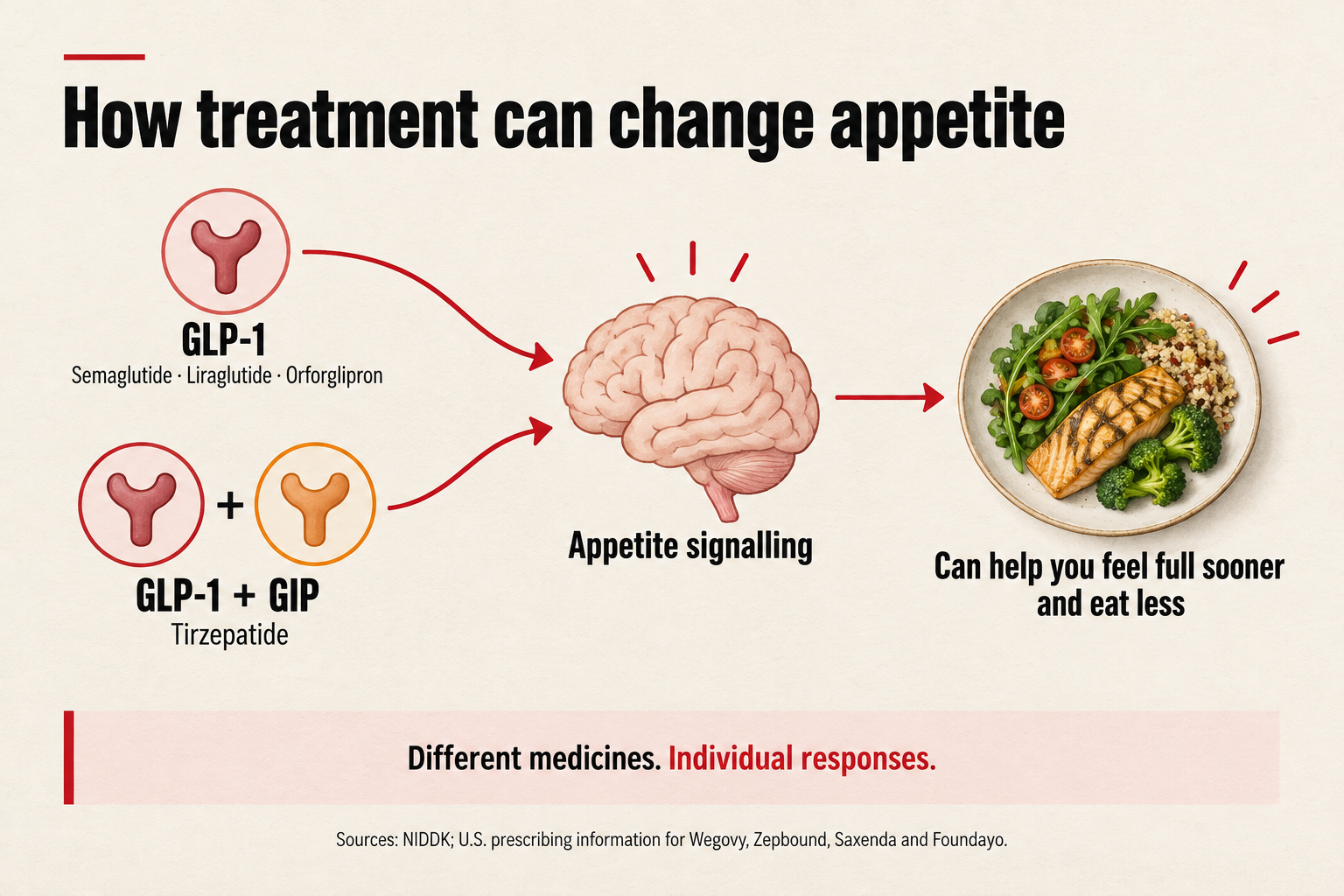
This family began in diabetes care. Researchers later studied particular medicines, doses and forms for weight management. Today it includes weekly injections, a daily injection and daily tablets. The treatment can be one part of long-term care alongside eating, activity and behavior support. If you've put in effort and still aren't getting where you want to go, it's reasonable to ask whether medicine could help. That is a question about options, not willpower. [1–5]
Chapter 02 / 10
Why use telehealth instead of your own doctor's office?
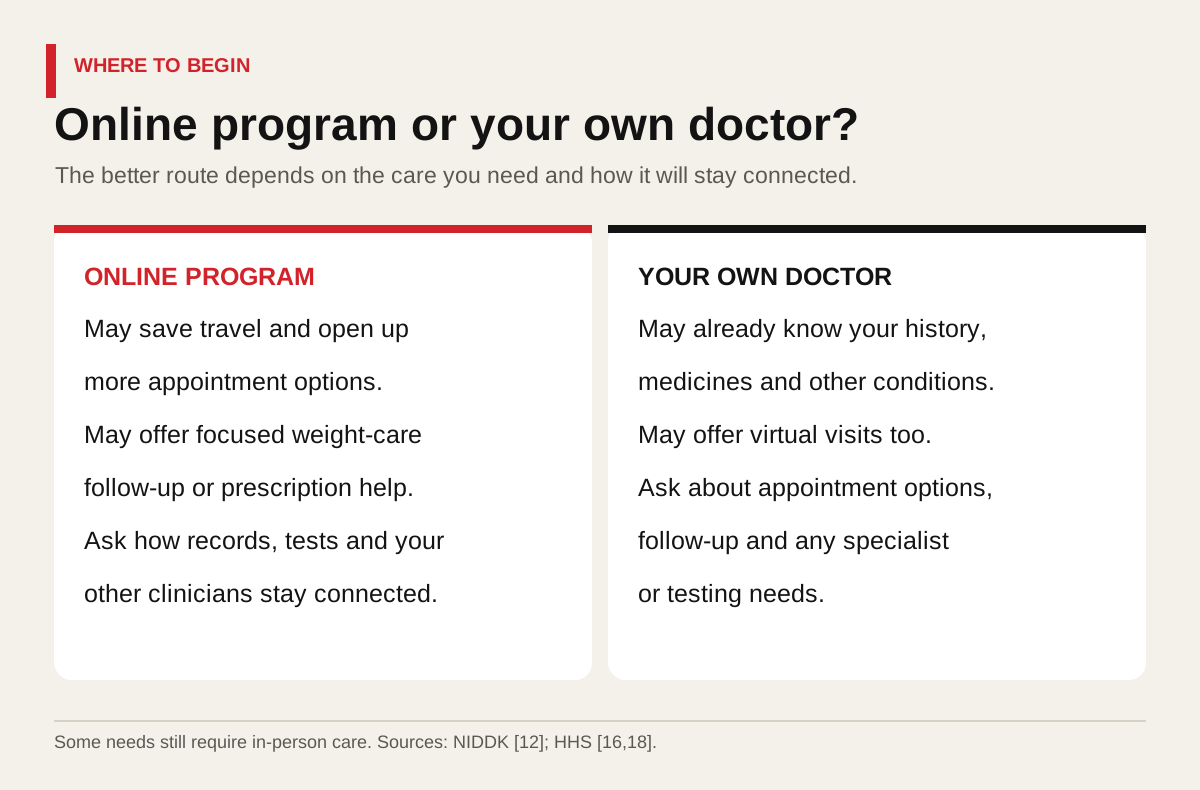
Telehealth can make the first conversation easier to arrange. Depending on the service, care may happen by video, phone, secure messages or sharing information remotely. It can spare you travel or time away from work, and may connect you with a clinician farther from home. You may also have more appointment options. Some needs still call for an in-person visit. [18]
Your own primary-care clinician may already know your health history, medicines and other conditions. A telehealth program may offer a more focused weight-management path, online follow-up or help coordinating a prescription. You can also ask whether your own doctor's practice offers virtual visits. What matters is having someone who can assess your health and follow your progress. With a separate online program, ask how its clinicians will get any records or tests they need and keep your other care team informed. [12,16,18]
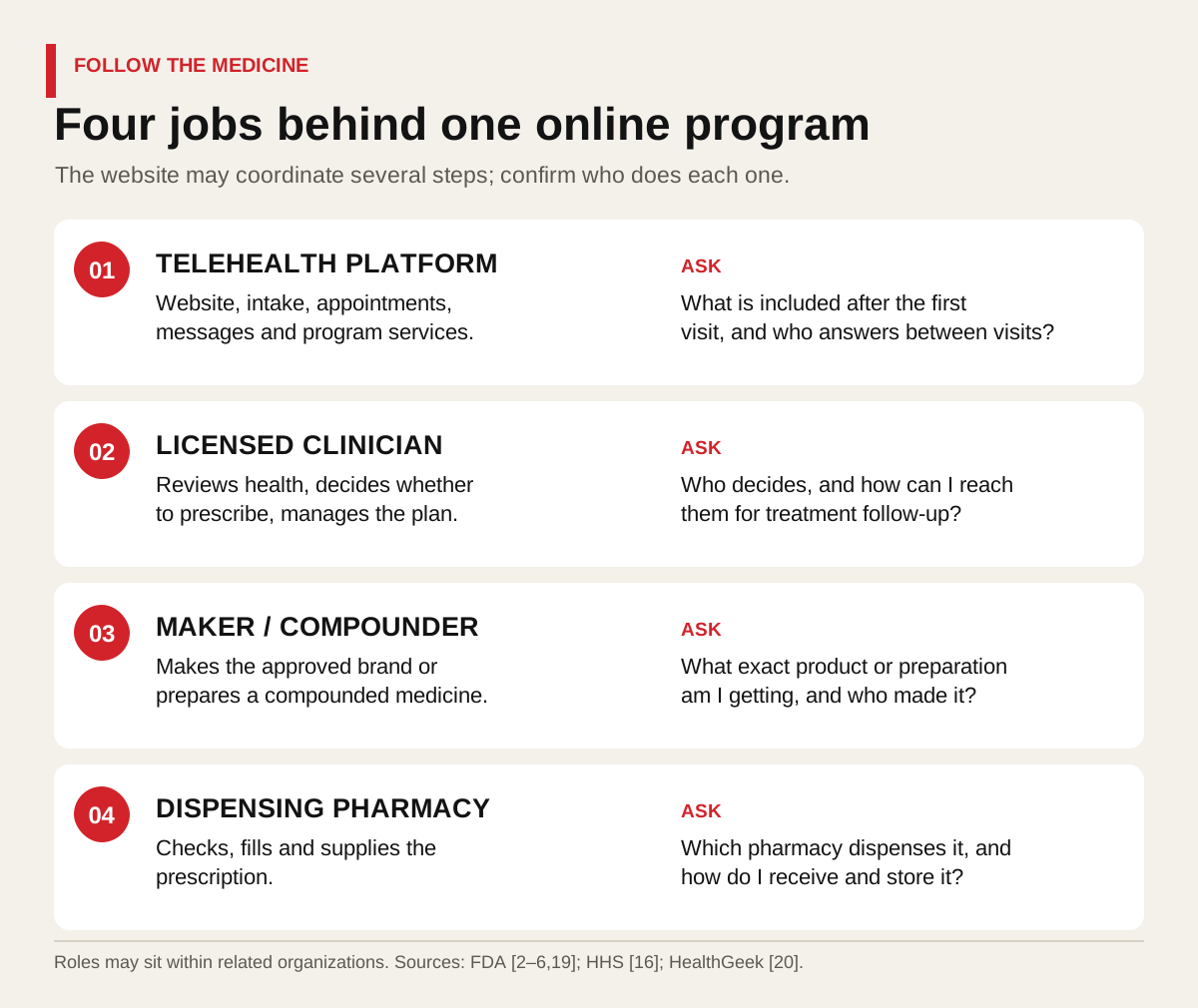
Before you compare programs, keep four jobs separate:
Read all 4 entries as text
WhoTelehealth platform
What they doRuns the website, intake, appointments, messaging and program services.
What to askWhat is included after the first visit, and who answers between visits?
WhoLicensed clinician
What they doReviews your health, decides whether to prescribe and manages the treatment plan.
What to askWho makes the prescribing decision, and how can I reach that clinician for follow-up?
WhoManufacturer or compounder
What they doMakes an approved branded medicine, or prepares a compounded medicine in an eligible setting.
What to askWhat exact product or preparation am I receiving, and who made it? [2–6,19]
WhoDispensing pharmacy
What they doChecks, fills and supplies the prescription.
What to askWhich pharmacy will dispense it, and how will I receive and store it? [15,19]
The company whose website you visit may arrange several of these steps. It isn't necessarily the company that makes your medicine. Find out who prescribes it, who makes it and which pharmacy sends it. [16,19]
Chapter 03 / 10
Which medicine would you actually receive?
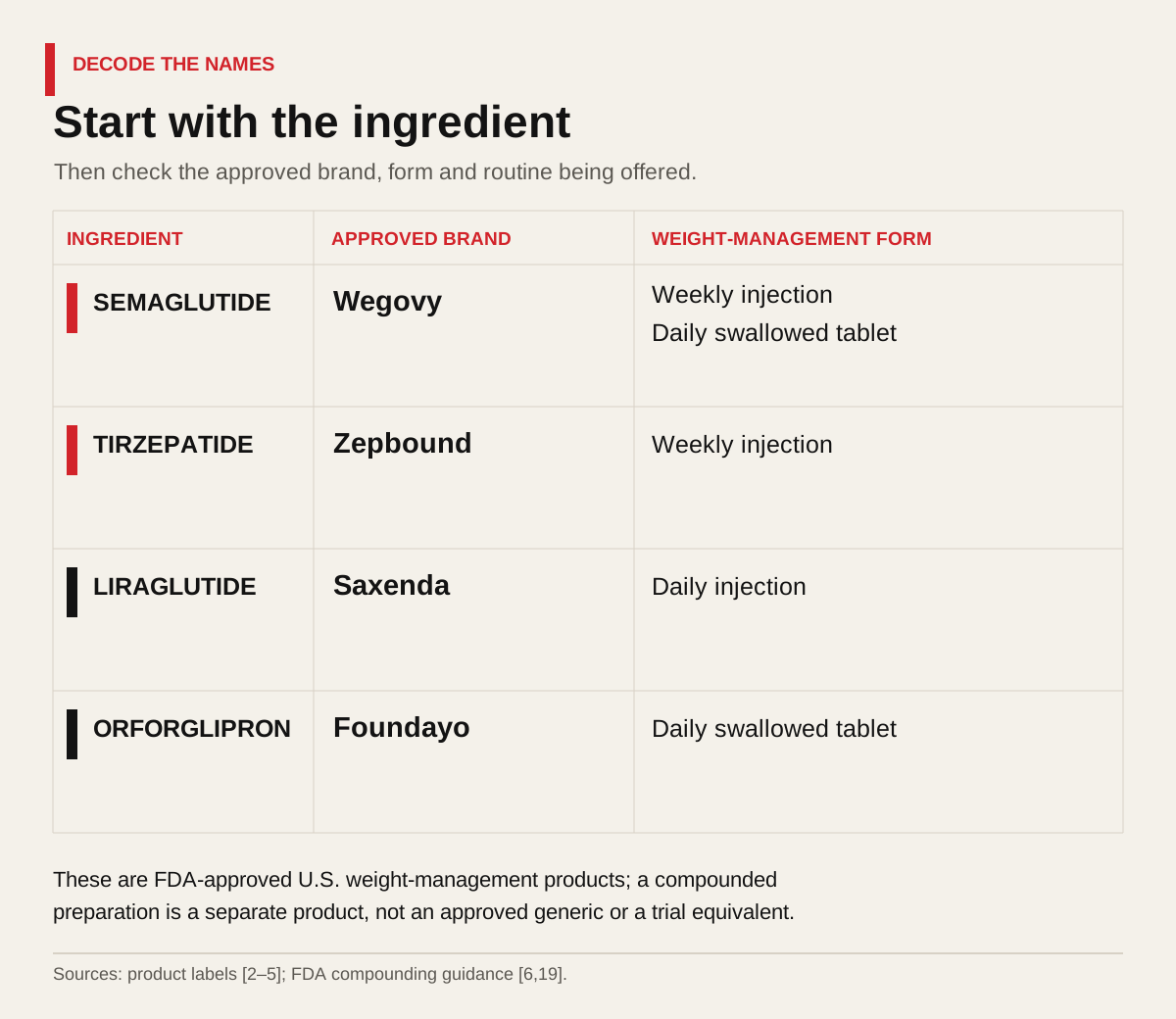
Four terms help clear up the names. The ingredient is the active drug. The brand is the product name. The form is how you take it. The indication is the use for which that product is approved. Semaglutide, for example, is an ingredient; Wegovy is an approved weight-management brand available as both an injection and a tablet. Same ingredient, different routines, with each form studied on its own. [2]
Semaglutide and tirzepatide: the two names to understand
Semaglutide acts on the GLP-1 receptor, helping regulate appetite and food intake. You may recognize it from Wegovy, an approved weight-management product. Its approved injection is weekly; its approved tablet is daily. The form changes how you take it and which evidence applies. [1,2]
Tirzepatide acts on both GLP-1 and GIP receptors. Zepbound is its approved weight-management brand, taken as a weekly injection. That second receptor is a meaningful difference in how the medicine works, but it doesn't tell you by itself which treatment will suit you. Your medical history, response, side effects and access also matter. [1,3]
Other options include liraglutide, a daily injection sold as Saxenda, and orforglipron, a daily tablet sold as Foundayo. These act on the GLP-1 receptor. You don't need to memorize every brand before having a useful conversation. Start with the ingredient and the exact form being offered. [1,4,5]
Read this graphic as text
- Semaglutide is the ingredient in approved Wegovy injection and tablet products. Tirzepatide is the ingredient in approved Zepbound injection. Other named options include liraglutide (Saxenda injection) and orforglipron (Foundayo tablet).
- Ingredient, brand, form and approved use are distinct. A compounded preparation is separately made and is not an FDA-approved generic of these branded products.
Branded, compounded and off-label: what changes?
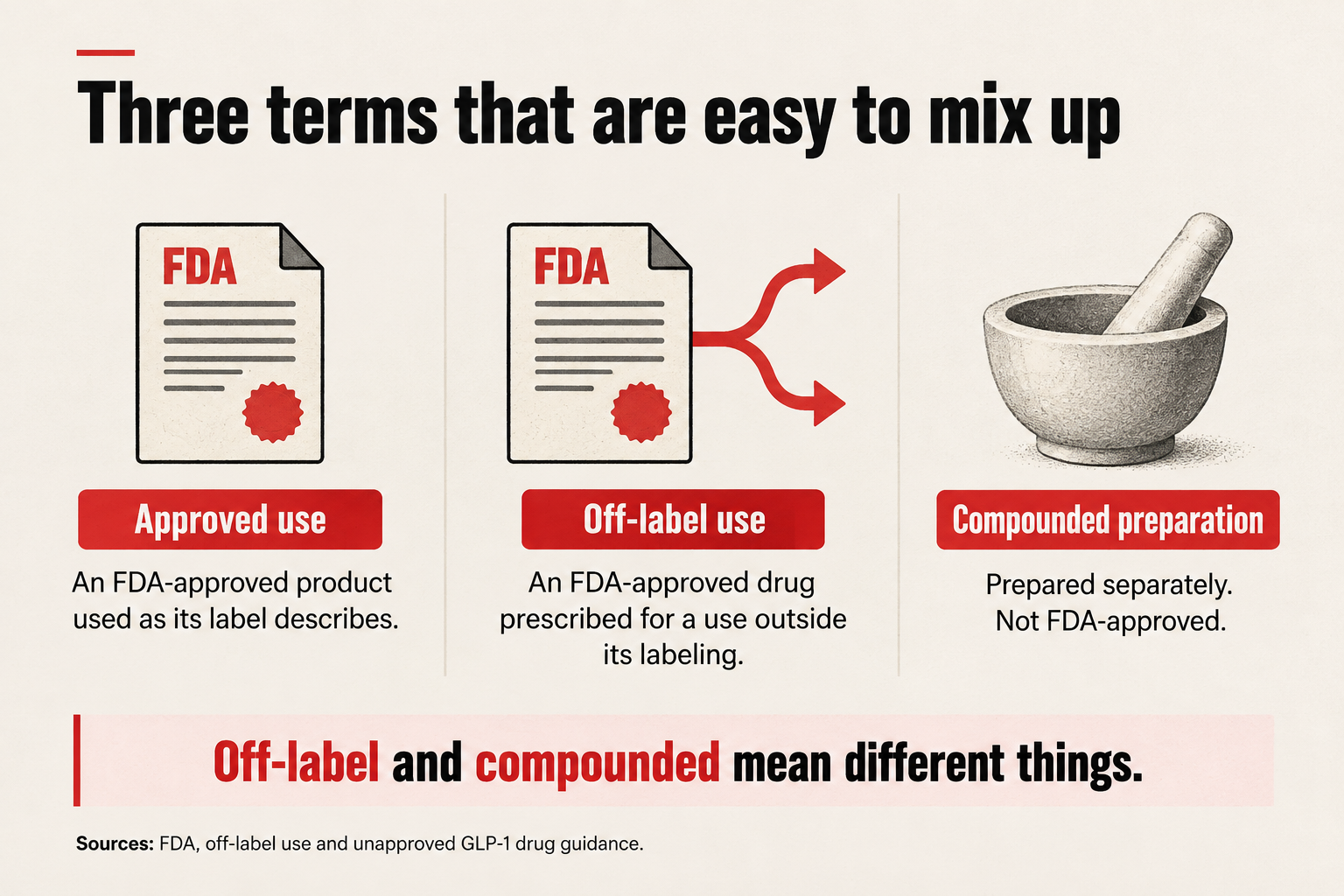
An online program may discuss an approved brand, an approved drug prescribed off-label, or a compounded medicine. Off-label describes how an approved drug is used outside its approved labeling. A compounded preparation may contain semaglutide or tirzepatide, the active ingredients in those branded medicines, but it is made separately. Sharing an active ingredient does not make the finished products equivalent: the formulation, concentration and way you take it can differ. Compounded medicines are not FDA-approved or reviewed before marketing for safety, effectiveness and quality. A compounded preparation is not an FDA-approved generic of a branded GLP-1 medicine. FDA has reported dosing errors with compounded GLP-1 products and says some semaglutide salt forms differ from the ingredient in approved products. Compounding may meet an individual medical need an approved drug cannot meet, but you should know exactly what is being proposed, who prepares it and which pharmacy dispenses it. [6,7,19]
Both approved branded and compounded medicines can appear in online care. That does not make them interchangeable. For instance, a trial of a manufactured Wegovy dose does not establish the result of a compounded semaglutide preparation. Ask for the ingredient, brand if any, form, dose plan and reason for choosing it. Before paying, check which charges cover the evaluation and what happens if no prescription is issued. [2,6,19]
Injections, tablets or under-the-tongue options?
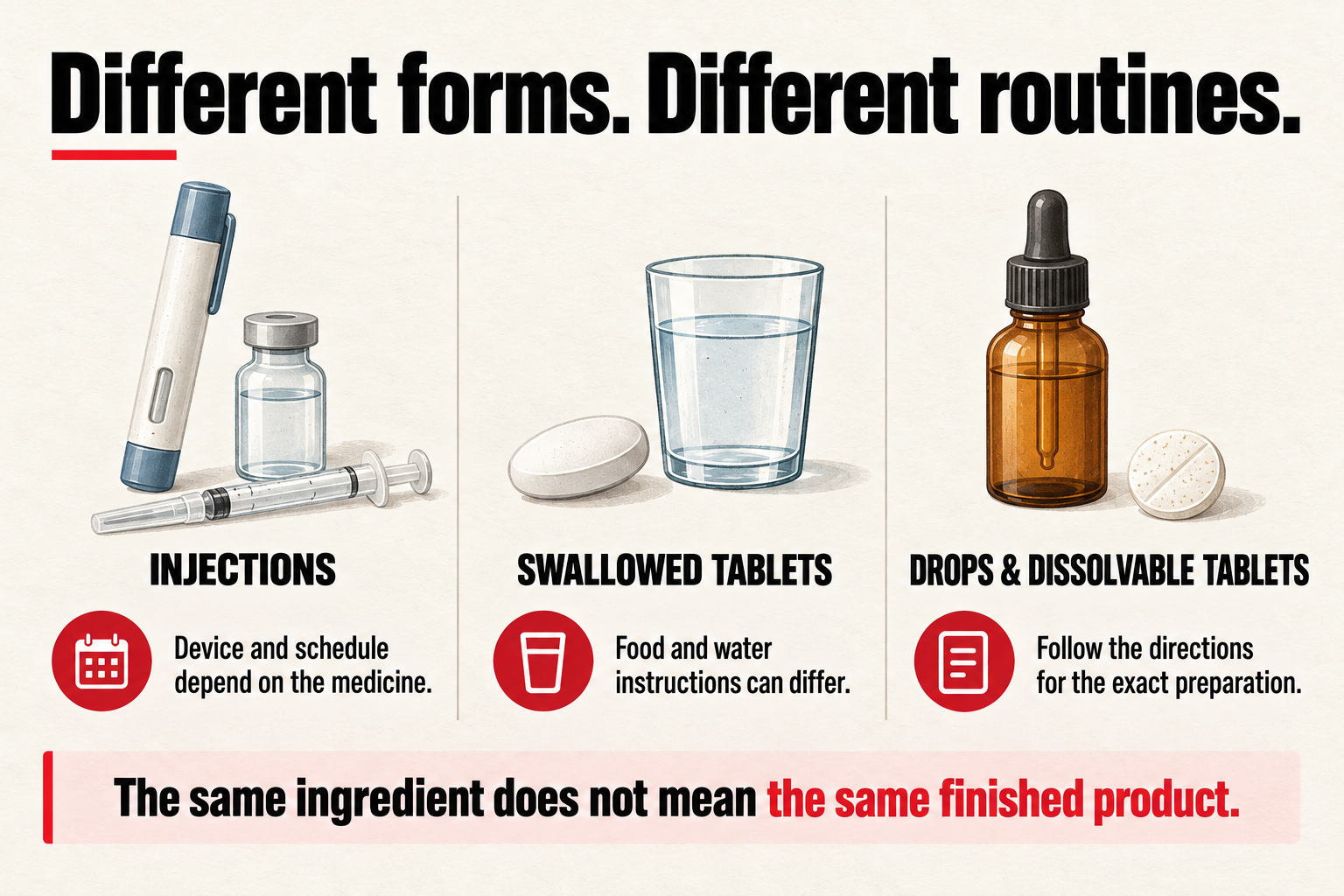
Injections go under the skin. The approved semaglutide and tirzepatide weight-management injections are taken weekly; liraglutide is daily. Depending on the product, you may use a prefilled device or draw medicine from a vial with a syringe. Ask your clinician or pharmacist to show you how to use the exact device and measure the prescribed dose. Vial concentrations and syringe markings can differ, so don't copy someone else's instructions. [2–4,6]
Swallowed tablets have their own routines. The approved semaglutide tablet is taken daily, in the morning on an empty stomach, with up to four ounces of water. Wait at least 30 minutes before food, other drinks or other oral medicines. Orforglipron is also daily but can be taken with or without food. A tablet avoids needles, but its instructions still need to fit your day. [2,5]
Dissolvable tablets and drops are different preparations. Some online programs advertise compounded tablets that dissolve in the mouth or drops placed under the tongue. Ask where and how to take the specific preparation. These are not interchangeable with an approved swallowed tablet, and that tablet's trial results do not establish how well a compounded version works. [2,6,20]
Are injections more effective than tablets?
Not automatically. The ingredient, dose and formulation matter, so “pill versus injection” is too broad a comparison.
A 2026 analysis compared results from separate trials of oral semaglutide 25 mg daily and injected semaglutide 2.4 mg weekly and suggested similar weight-loss efficacy. Because it was an indirect comparison, it does not prove the two are equivalent in a head-to-head trial. It also tells us nothing about compounded drops or dissolvable tablets. [21]
Some treatments do produce greater average weight loss than others in direct trials. The results section below includes a comparison of injected tirzepatide and injected semaglutide. Both were injections, which shows why the medicine and dose matter as well as the way you take it. [22]
Your clinician can help weigh the evidence for the exact treatment against your health history, side effects, cost and the routine you can follow. A useful question is: “What results are supported for this particular medicine and form, and why are you recommending it for me?” [1,12]
Chapter 04 / 10
Could treatment be right for you?
A common starting point for considering prescription weight-management medicine is a body mass index, or BMI, of 30 or higher, or 27 or higher with a weight-related health problem. Those numbers start the conversation. Your health history, other medicines, past efforts and treatment goals determine whether a specific prescription makes sense. [1,12]
Tell the clinician about pregnancy plans, pancreatitis, gallbladder or kidney problems, major digestive symptoms and diabetes-related eye disease. Severe delayed stomach emptying, called gastroparesis, may make some products unsuitable. The approved weight-management products named above must not be used by someone with a personal or family history of medullary thyroid carcinoma, a particular thyroid cancer, or multiple endocrine neoplasia syndrome type 2 (MEN2). A serious allergic reaction to a product also rules that product out. This does not mean every thyroid condition rules out treatment. [2–5]
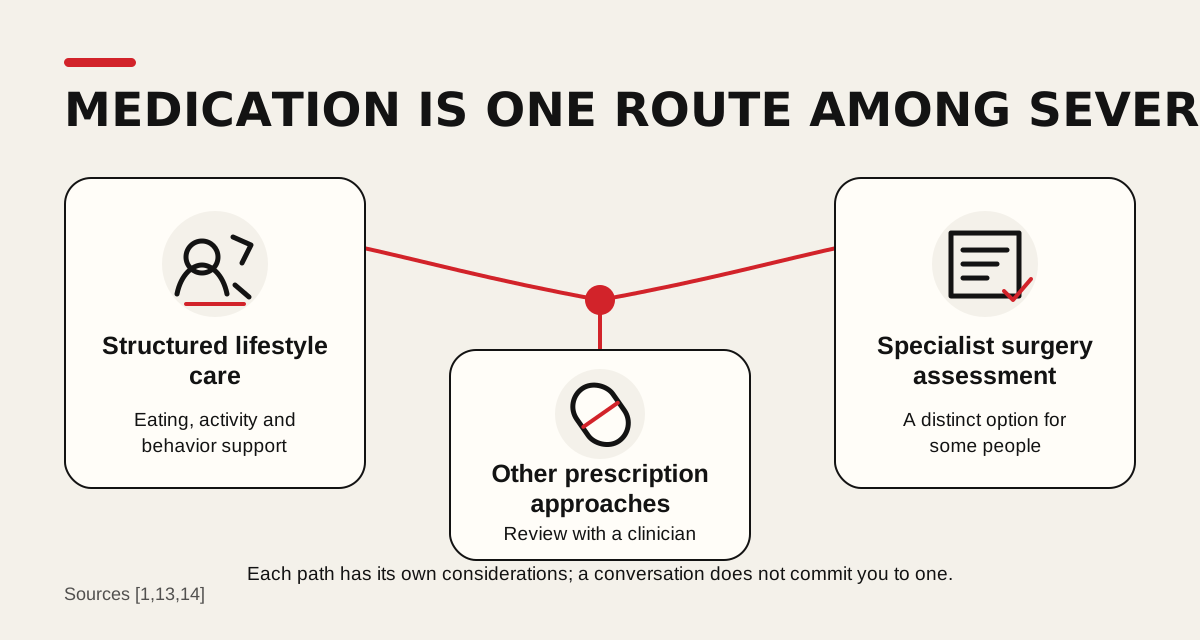
GLP-1 treatment is one option. Structured eating, activity and behavior support can help on their own or alongside medicine. Other prescription weight-management medicines or metabolic/bariatric surgery may also be relevant. Your clinician can explain which approaches fit your health and whether any medicine you already take contributes to weight gain. [1,13,14]
Chapter 05 / 10
How to get started online, step by step
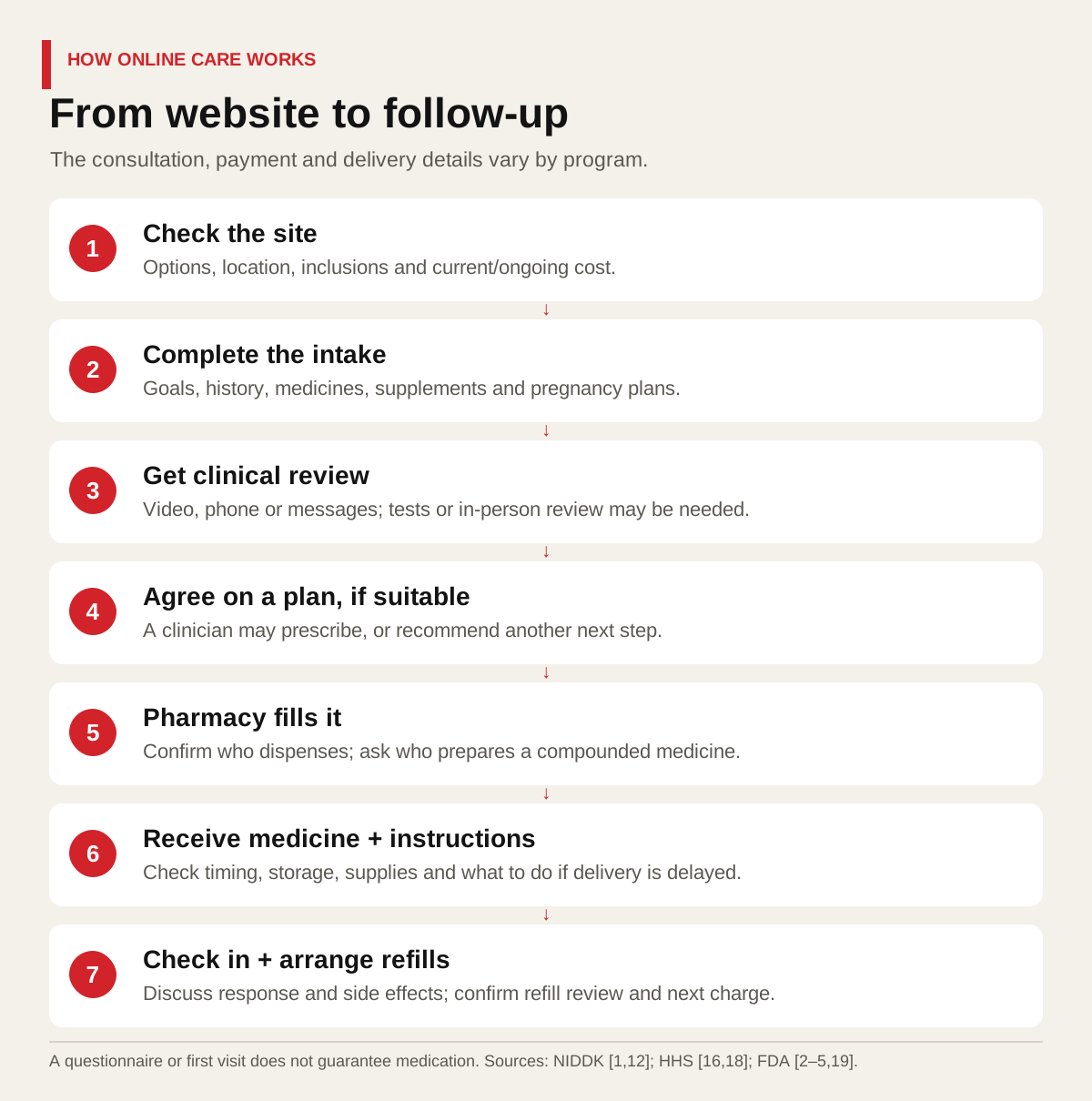
Here's how the journey can work. The consultation format, payment timing and delivery arrangements vary by program.

- Visit the provider's site and check the basics. Look at the treatment options, where the service operates, what's included and what you'll pay now and for ongoing care. Check whether a fee covers the assessment, membership, medication or a combination. [12,20]
- Complete the health intake. Share your goals, health history, medicines and supplements, pregnancy plans and past weight-management efforts. Be ready to provide information the clinician needs to assess you. The questionnaire starts that assessment; it doesn't guarantee medication. [1,12,20]
- Have the clinical review. Depending on the service and your circumstances, you may have a video or phone appointment, exchange secure messages or provide further information. A clinician reviews your health and may request tests, records or an in-person evaluation. Bring your questions about treatment and tell them what matters to you. [12,16,18]
- Agree on a treatment plan, if appropriate. The clinician decides whether to prescribe and which medicine, form and dose plan fit. You should understand how to use it, what side effects to watch for and when you'll check in. Sometimes the right next step is further evaluation or another approach. [1–5,12]
- The pharmacy fills the prescription. Confirm the dispensing pharmacy and, for a compounded medicine, who prepares it. The telehealth company coordinates care; the pharmacy handles the prescription supply. Ask about availability and any steps needed before dispensing. [15,16,19,20]
- Receive your medicine and instructions. Programs offering home delivery arrange shipment after the required clinical and pharmacy steps. Confirm the expected timing, storage instructions, supplies and whom to contact about a delayed or damaged package. Some prescriptions may instead be filled at a chosen pharmacy. Before the first dose, make sure the instructions for your exact medicine are clear. [2–5,15,16,20]
- Check in and arrange refills. Report how you're doing, including side effects and changes in appetite. Your clinician decides whether the plan should change. Find out when a refill assessment is due, how to request it and when the next charge and shipment happen. [1–5,12,16,20]
You should finish the first evaluation knowing what happens next, even if the next step is a test or another appointment. Ask where your instructions will appear and how to reach the care team. [16]
Chapter 06 / 10
What results can you reasonably expect?
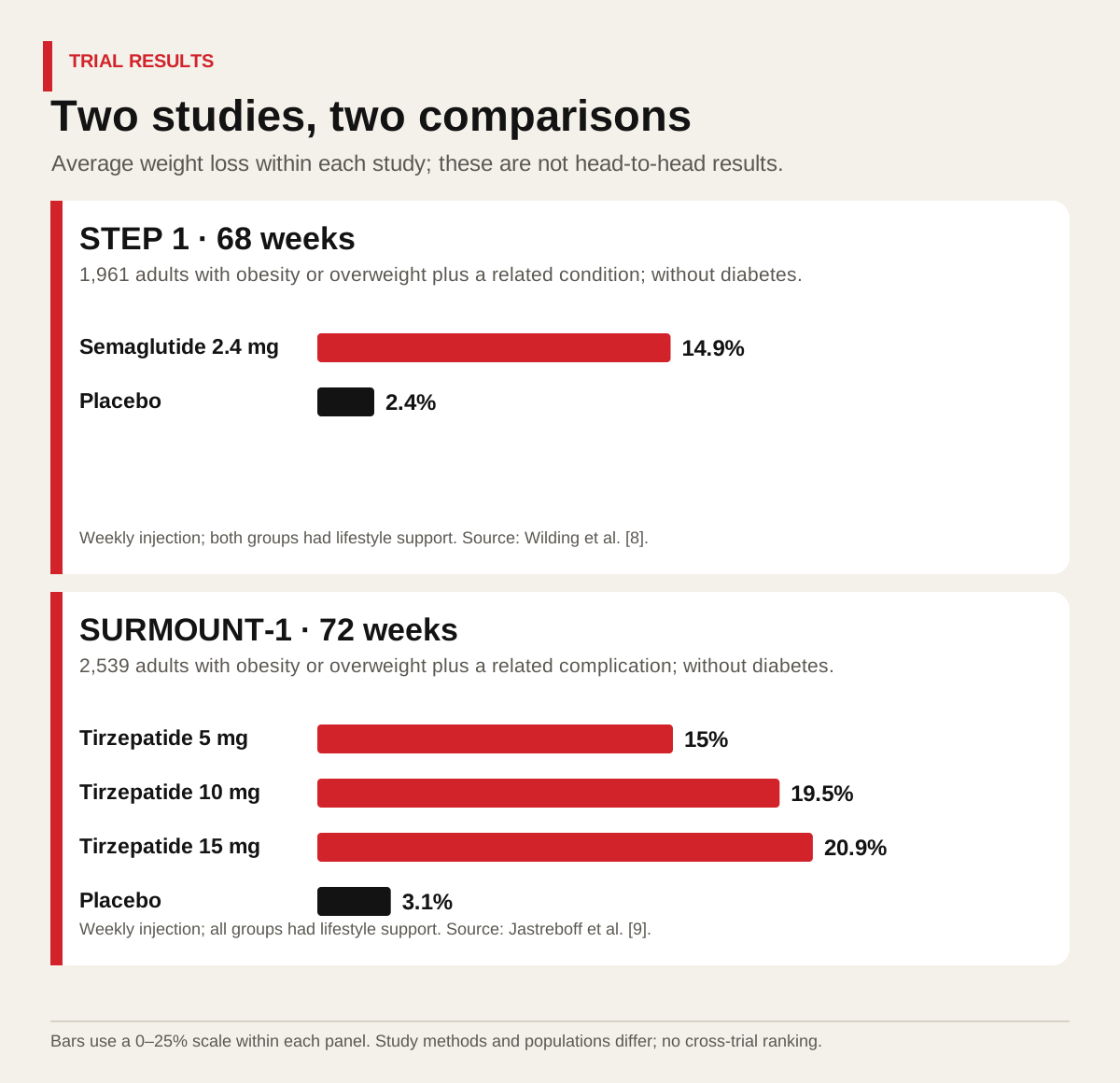
The headline percentages come from studies of specific manufactured medicines, doses and populations. Weight change unfolded over months, with dose increases and lifestyle support. They help frame a treatment conversation, but they cannot predict your own result or what any telehealth program will achieve. [8,9]
Read all 2 entries as text
Study and treatmentSTEP 1: injected semaglutide 2.4 mg weekly for 68 weeks
Who was studiedAdults with obesity, or overweight plus a related condition, without diabetes
Average weight changeAbout 15% loss, versus about 2% with placebo; both groups had lifestyle support. [8]
Study and treatmentSURMOUNT-1: injected tirzepatide 5, 10 or 15 mg weekly for 72 weeks
Who was studiedAdults with obesity, or overweight plus a related complication, without diabetes
Average weight changeAbout 15% to 21% loss across assigned doses, versus about 3% with placebo; all groups had lifestyle support. [9]
It is tempting to line those numbers up like a scoreboard. The studies had different participants, methods and durations, so they do not rank the medicines head to head. These figures also should not be presented as results established for a compounded preparation. [6,8,9]
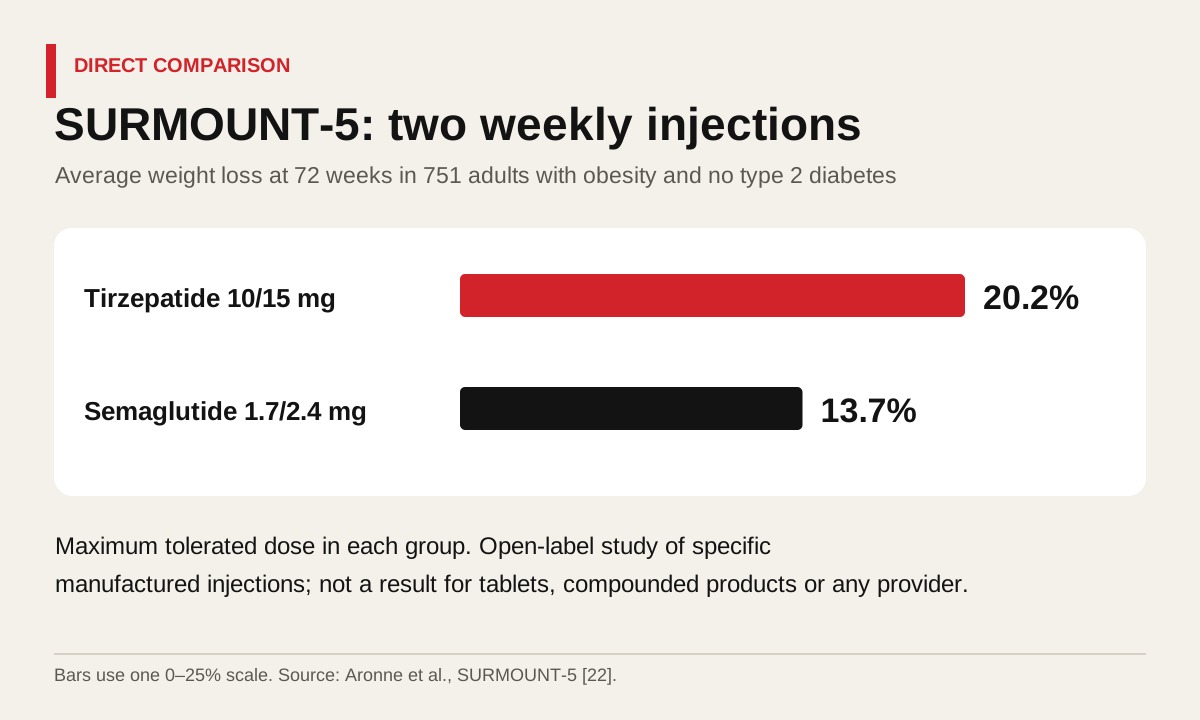
There is also a direct comparison. In the SURMOUNT-5 trial, 751 adults with obesity and without type 2 diabetes received weekly injections at their maximum tolerated dose: tirzepatide 10 or 15 mg, or semaglutide 1.7 or 2.4 mg. At 72 weeks, average weight loss was 20.2% with tirzepatide and 13.7% with semaglutide. This open-label trial supports a difference between those treatments at those doses, not a general advantage for injections over tablets or a result promised by a telehealth provider. [22]
Read this graphic as text
- SURMOUNT-5 studied 751 adults with obesity and without type 2 diabetes using weekly injections at maximum tolerated doses for 72 weeks.
- Average weight loss was 20.2% with tirzepatide 10 or 15 mg and 13.7% with semaglutide 1.7 or 2.4 mg. This open-label result applies to those injected treatments and doses, not compounded products or a telehealth provider's promised result.
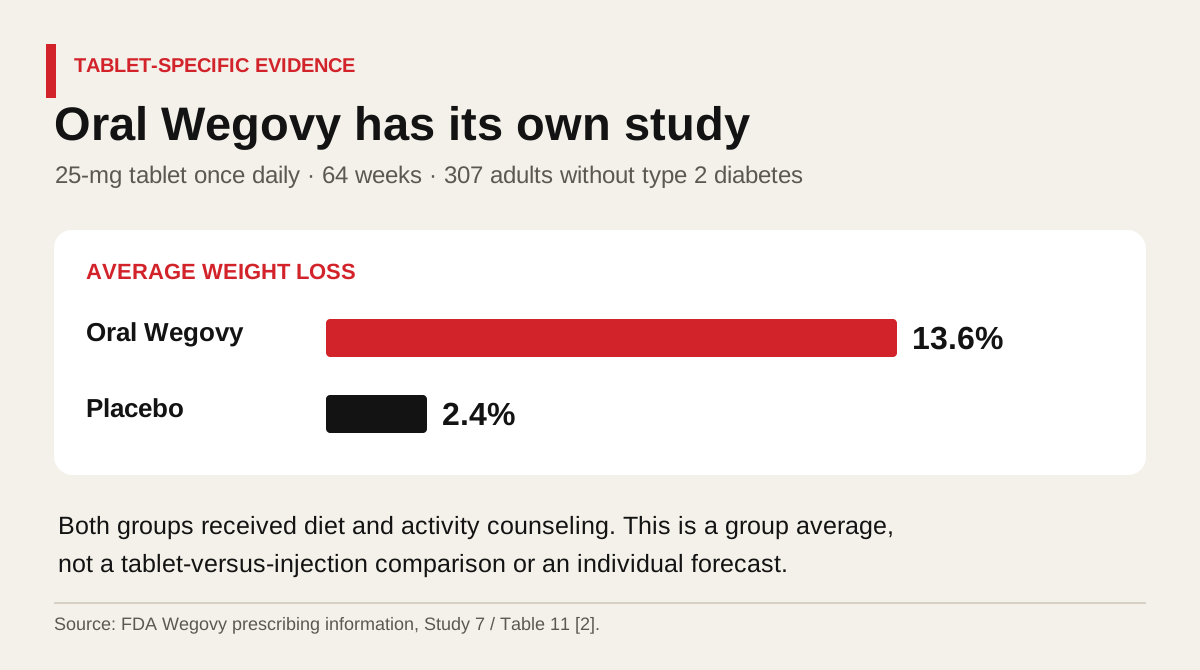
Pills need their own evidence too. In a study of the approved semaglutide tablet (Wegovy), involving 307 adults without type 2 diabetes, the 25-mg daily tablet group lost an average 13.6% of starting weight at 64 weeks, versus 2.4% with placebo; both groups received diet and activity counseling. This was not a tablet-versus-injection trial and does not describe orforglipron or a compounded oral preparation. [2]
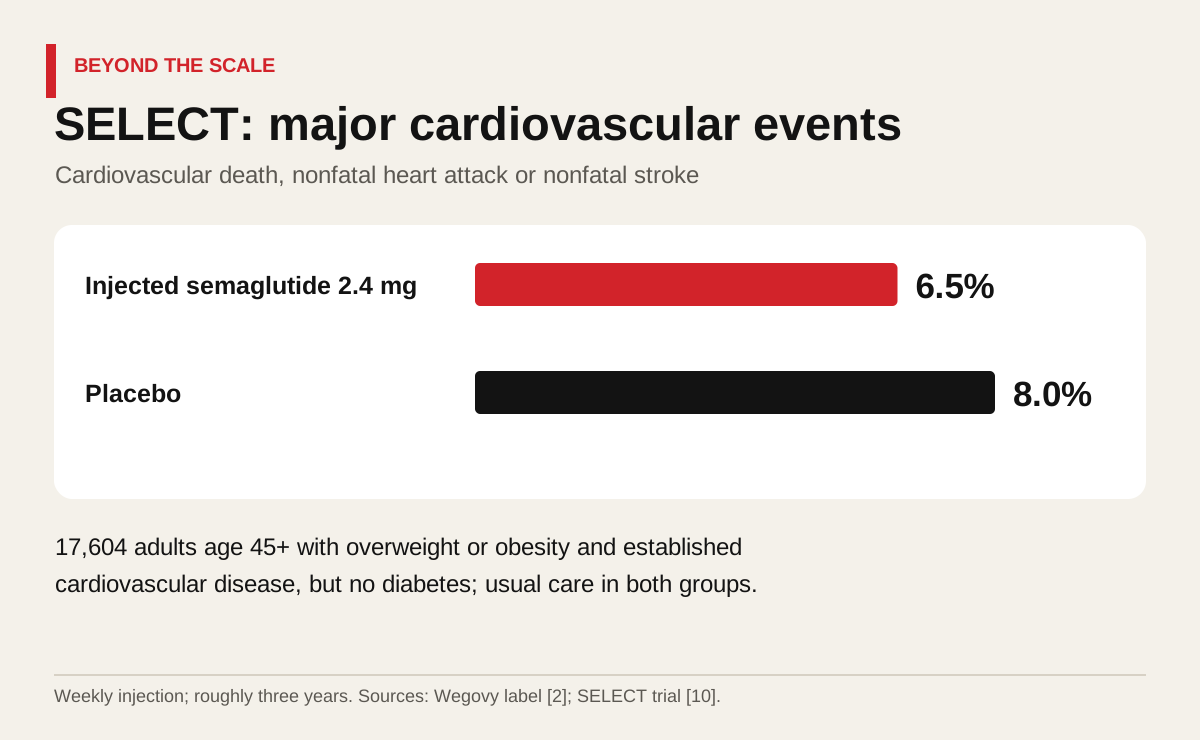
Weight is not the only outcome. In SELECT, adults 45 or older with overweight or obesity and established cardiovascular disease, but no diabetes, received injected semaglutide 2.4 mg weekly or placebo alongside usual care. Over roughly three years, cardiovascular death, nonfatal heart attack or nonfatal stroke occurred in 6.5% of the semaglutide group and 8.0% of the placebo group. If your history resembles that study group, it is a specific result to discuss with a clinician, not a benefit established for every GLP-1 product. [2,10]
Ask what you and your clinician would call meaningful progress, when you would check it and what would make treatment worth continuing. [1,12]
Chapter 07 / 10
What treatment is like once you have the medicine
Starting usually means a lower dose that increases gradually. Your prescriber sets the schedule for the exact product. A weekly injection, daily injection and daily tablet make different demands on your routine. If you're prescribed an injection, ask for a demonstration or clear instructions for the device and dose you're receiving. If you're prescribed a tablet, check its food and water rules. Say so if either routine would be hard to follow. [2–5]
The medicine does not replace eating and activity choices. As appetite changes, ask how to get enough nourishing food and keep an activity plan that fits your health and capacity. Make sure you know whom to contact about side effects, when your clinician wants an update and whether nutrition or behavior support is actually included in the service you are paying for. [1,12,13]

At follow-up, the plan may stay the same, change dose, pause an increase or move in another direction. Bring more than a weight number: tell the clinician about appetite, eating, symptoms and what taking the medicine is like in your day. [1–5,12]
Chapter 08 / 10
Safety, pregnancy and the longer view
Common effects and warning signs
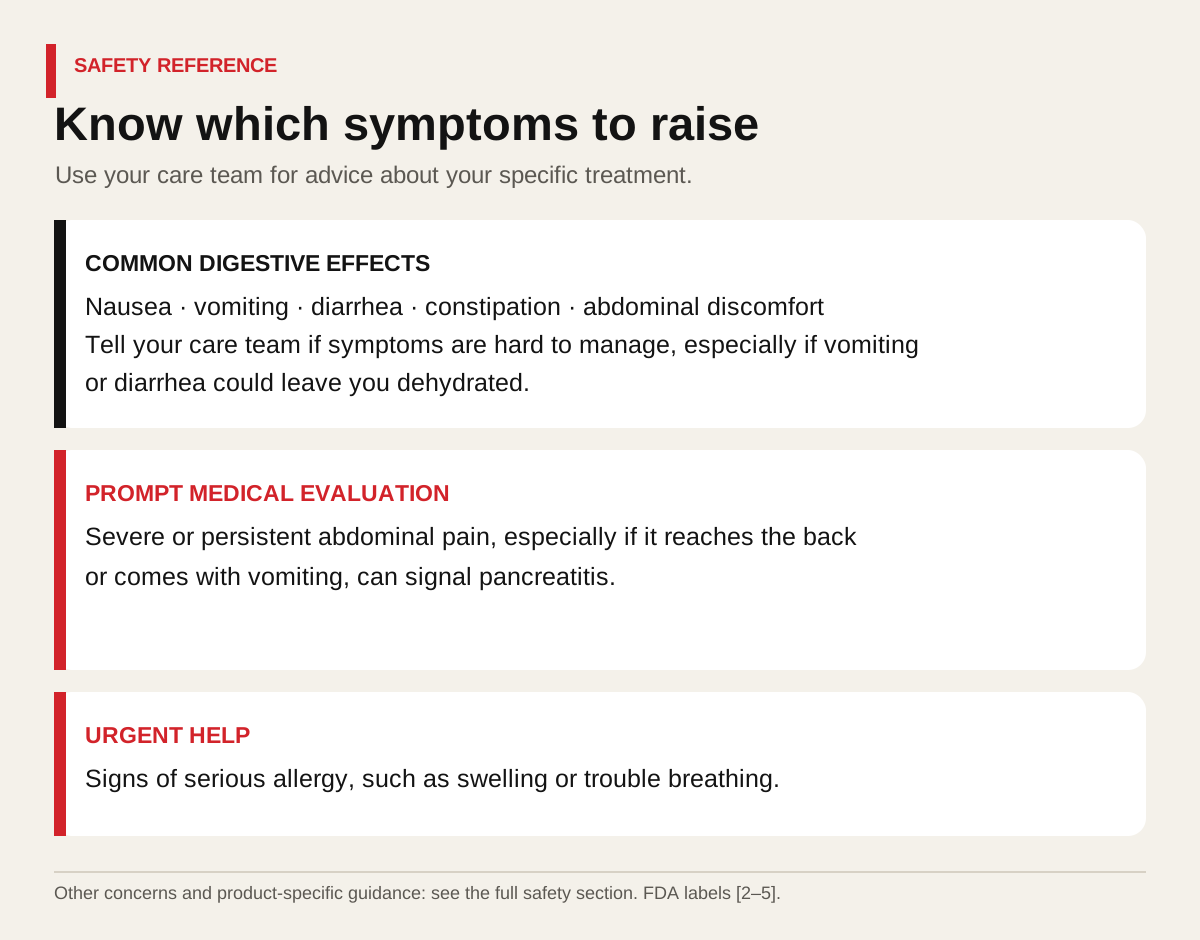
Nausea, vomiting, diarrhea, constipation and abdominal discomfort are common concerns with these products. Tell your care team if they are hard to manage, especially if repeated vomiting or diarrhea could dehydrate you. Severe or persistent abdominal pain, particularly if it reaches your back or comes with vomiting, can signal pancreatitis and needs prompt medical evaluation. Gallbladder problems and dehydration-related kidney injury are other labeled concerns. Get urgent help for signs of a serious allergic reaction such as swelling or trouble breathing. Tell a clinician about a new neck lump, persistent hoarseness or trouble swallowing or breathing. [2–5]
Read this graphic as text
- Common digestive effects include nausea, vomiting, diarrhea, constipation and abdominal discomfort. Tell your care team if they are hard to manage; repeated vomiting or diarrhea can cause dehydration.
- Severe or persistent abdominal pain needs prompt medical evaluation. Get urgent help for signs of a serious allergic reaction, such as swelling or trouble breathing. Tell a clinician about a new neck lump, persistent hoarseness or trouble swallowing or breathing.
Medicines, procedures and pregnancy plans
Bring a full medicine list. Insulin or a sulfonylurea, a type of diabetes medicine, can raise low-blood-sugar risk with these treatments, and slower stomach emptying can change how some pills are absorbed. Orforglipron has additional medicine-specific interactions. Taking one GLP-1 medicine together with another is generally not recommended; let your prescriber manage any switch. If you have type 2 diabetes and existing eye disease, ask about monitoring. Tell an anesthesia or deep-sedation team about your GLP-1 medicine; the labels describe rare reports of stomach contents entering the airway during these procedures. [2–5]
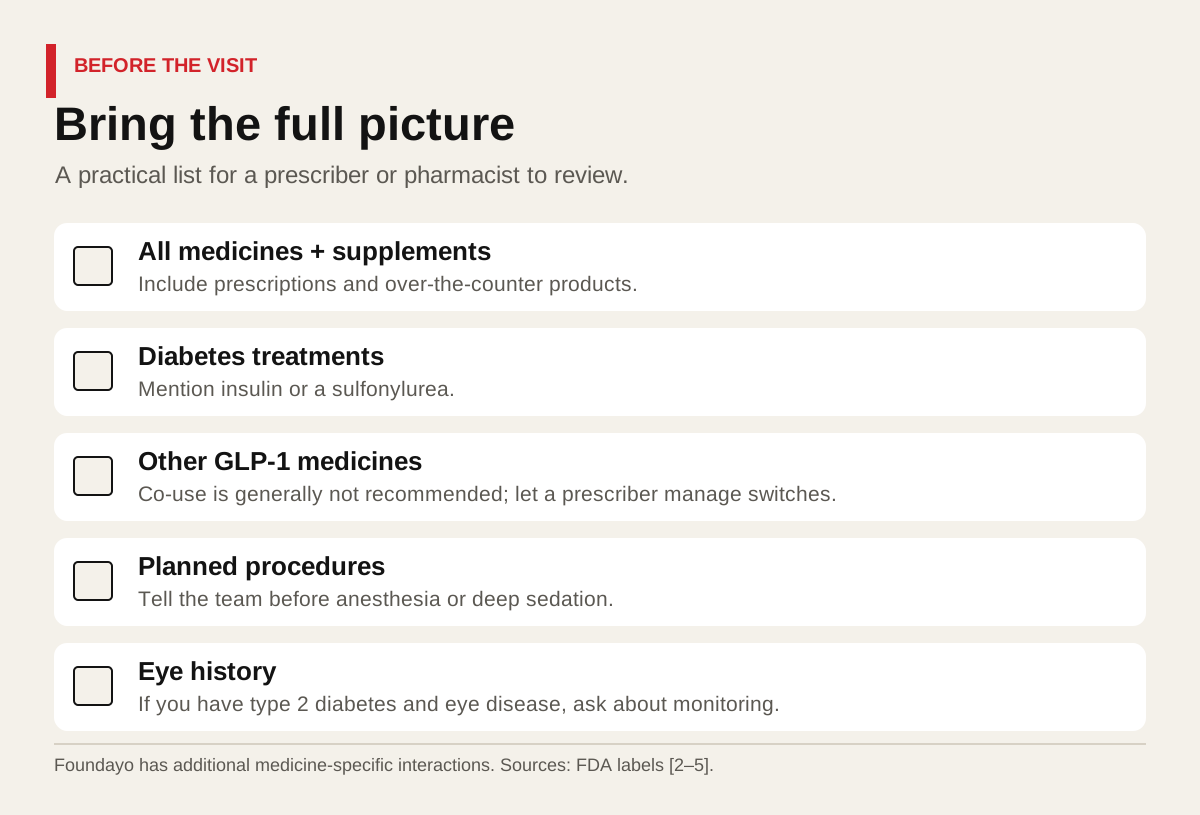
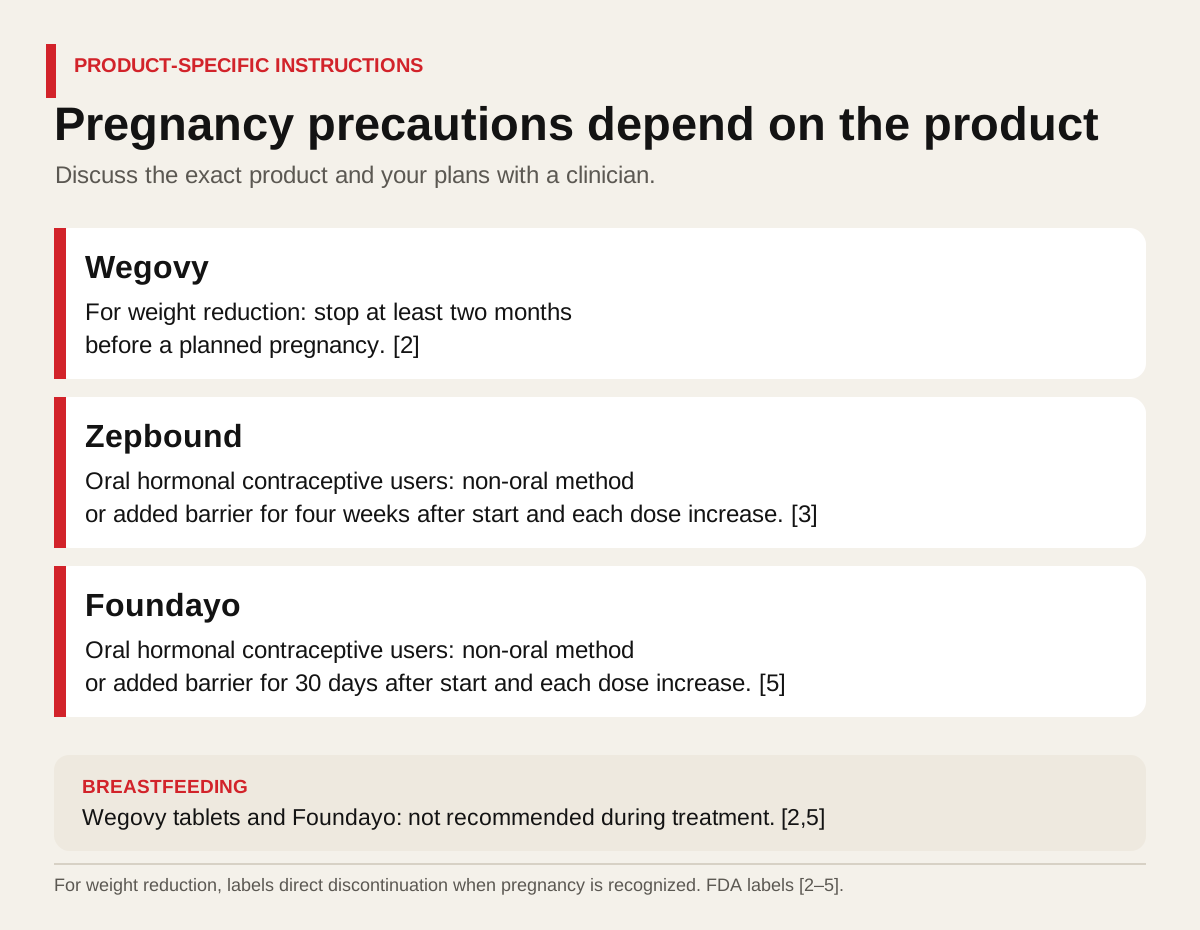
Tell your clinician if pregnancy or breastfeeding is possible. For weight reduction, these labels say to stop when pregnancy is recognized, and some products have additional planning rules: [2–5]
Read all 3 entries as text
Medicine and labeled productSemaglutide (Wegovy)
Specific instruction to discussStop at least two months before a planned pregnancy. [2]
Medicine and labeled productTirzepatide (Zepbound)
Specific instruction to discussIf using an oral hormonal contraceptive, use a non-oral method or add a barrier method for four weeks after starting and after each dose increase. [3]
Medicine and labeled productOrforglipron (Foundayo)
Specific instruction to discussIf using an oral hormonal contraceptive, use a non-oral method or add a barrier method for 30 days after starting and after each dose increase. [5]
The approved semaglutide tablet (Wegovy) and orforglipron (Foundayo) have specific recommendations against breastfeeding during treatment. Make medicine or contraception changes with your clinician. [2,5]
Continuing, stopping or switching
This may be long-term care. In SURMOUNT-4, participants first took injected tirzepatide for 36 weeks; those who reached randomization had already lost weight. Over the next 52 weeks, people switched to placebo regained substantial weight on average, while those continuing tirzepatide generally maintained or extended their loss. That is a reason to discuss a stopping plan, not a forecast for everyone. [11]
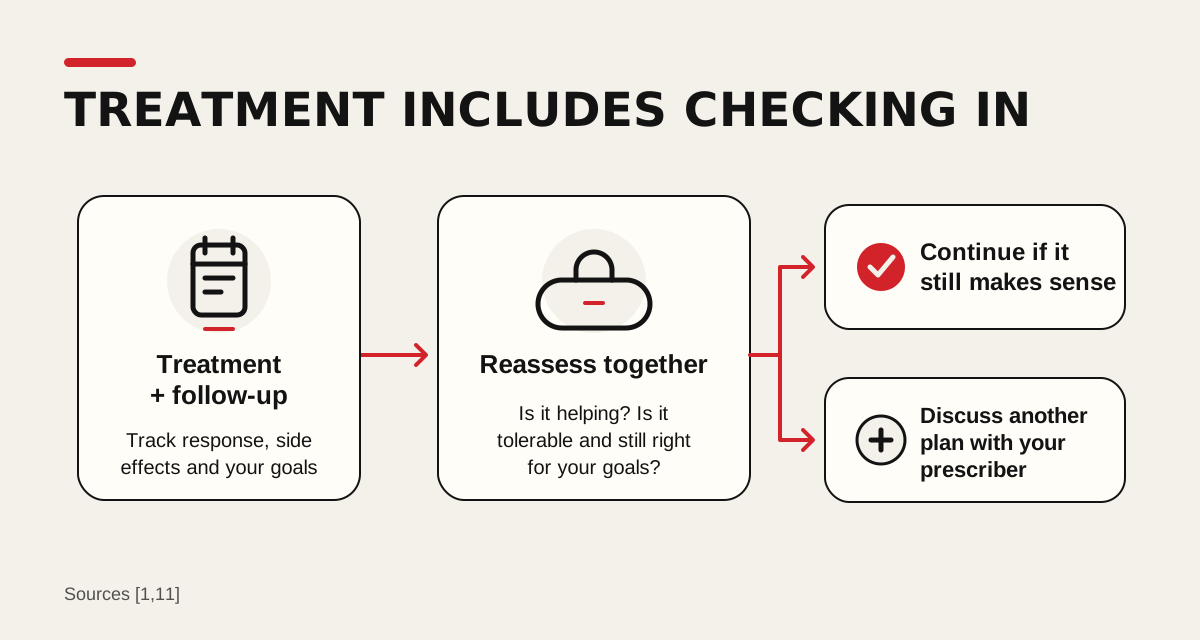
If the medicine is not helping enough, costs too much or is hard to tolerate, bring it up. Saxenda has a product-specific response checkpoint; other products have their own plans. A prescriber can help decide whether to continue, stop, change approach or switch medicines. Do not improvise an overlap or switching schedule yourself. [1–5]
Chapter 09 / 10
How to choose a telehealth provider
If online care appeals to you, look past the home page and ask what happens after the first appointment. Can you reach a clinician about side effects? How often will someone review progress? Is nutrition or behavior support included, optional or unavailable? Does a “24/7 support” promise mean a medical team can take a message, or that your prescribing physician can meet by video right away? Those are different services. [12,16]
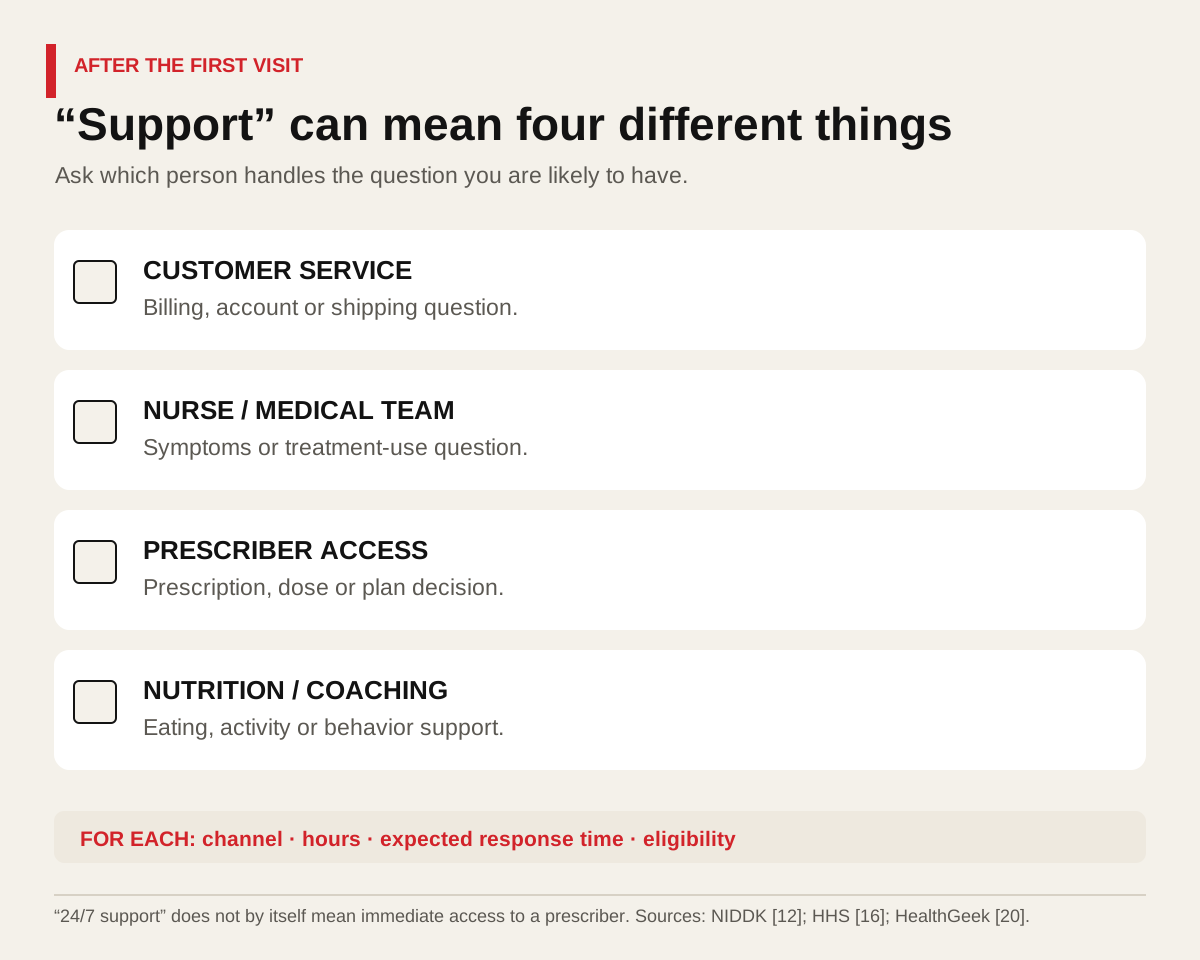
For example, HealthGeek's published Direct Meds entry describes one-on-one physician access, unlimited nurse access and 24/7 medical support. Its MEDVi entry shows how an online program can offer branded medicines alongside compounded treatment options. Ask about the channels and response times for the type of help you want. A billing question, a nutrition question and a medication side effect may go to different people. [20]
Want to see how online programs compare? Explore the treatment options, support and costs in our full provider guide.
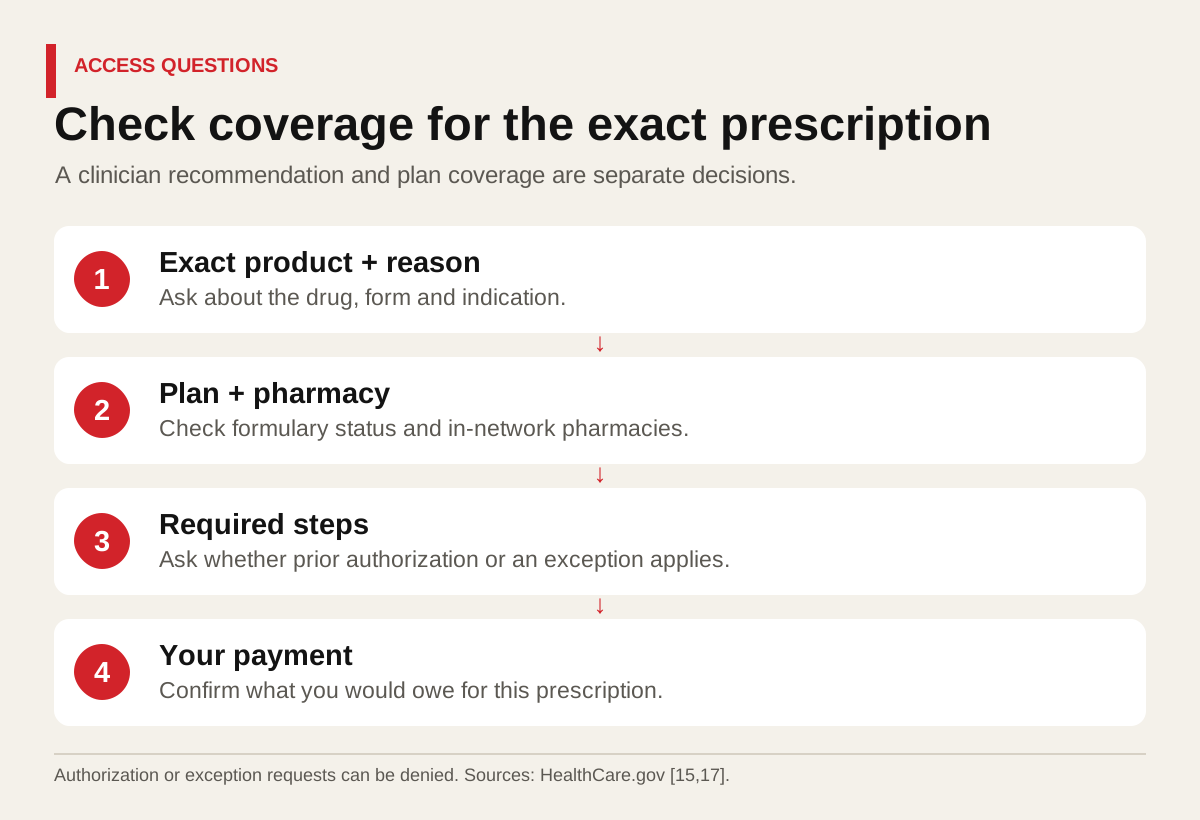
Read Our Best Online GLP-1 Providers GuideInsurance and cost deserve their own questions. A plan's formulary lists covered medicines; its pharmacy network affects where a prescription can be filled. It may require prior authorization, meaning permission before a prescription is filled as a condition of coverage. A request can be denied. Ask your insurer about the exact medicine and prescribing reason, required steps, pharmacy and your expected payment. [15,17]
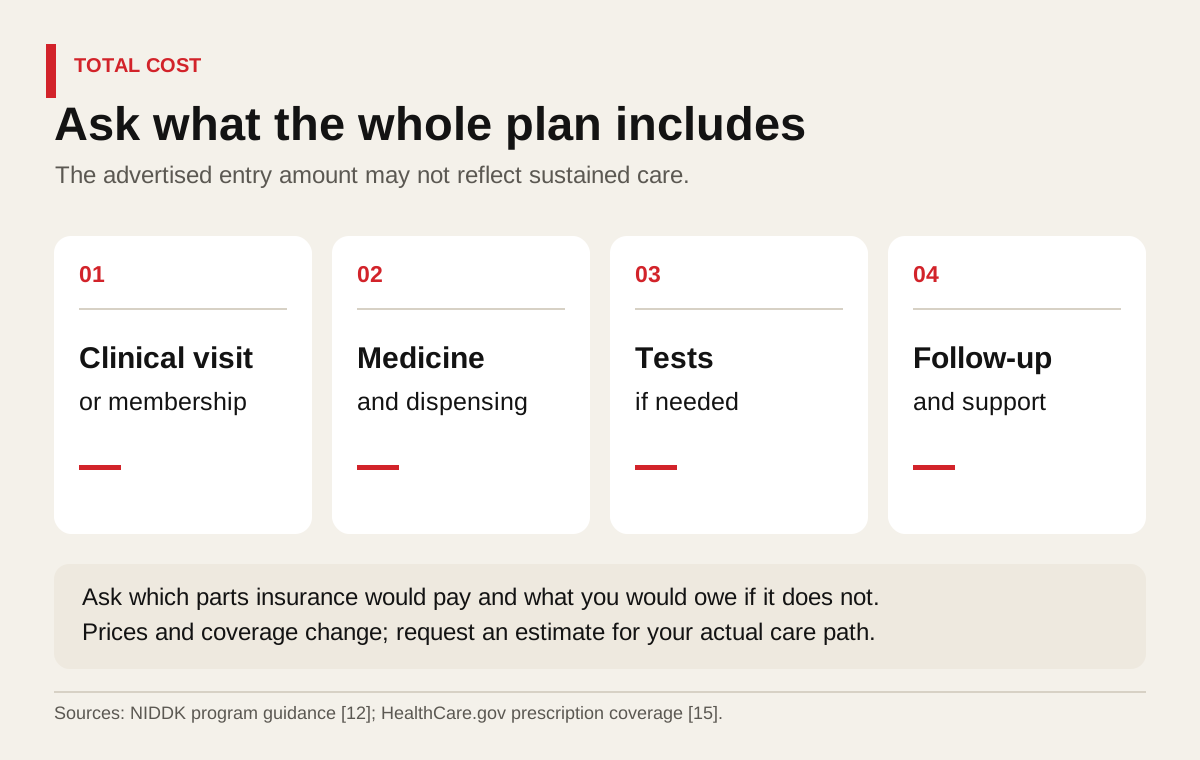
Then ask the program for the full cost picture: visits or membership, medicine and dispensing, tests if needed, and follow-up or support. Find out what insurance may pay and what you would owe without it. A low starting price says little about the cost of months of care. Check ongoing medication availability and refill costs before committing. [12,15]
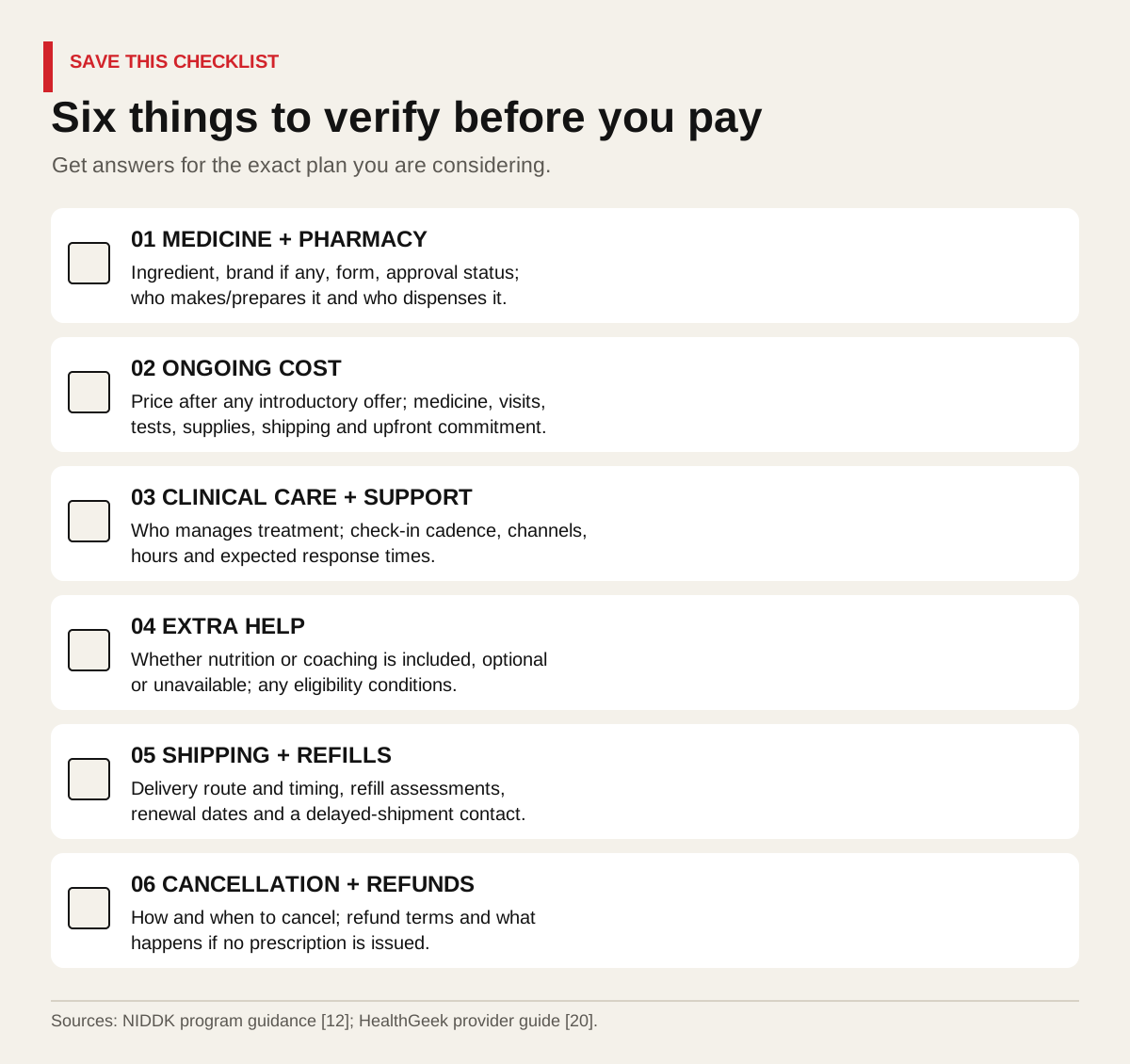
Before signing up, get clear answers to these questions:
Read all 6 entries as text
CheckMedication and pharmacy
What you need to knowExact ingredient, product, form and approval status; who prepares it and which pharmacy dispenses it.
CheckOngoing cost
What you need to knowWhat you pay after any introductory offer; medication, membership, visits, tests, supplies and shipping; any required upfront commitment.
CheckClinical care and support
What you need to knowWho manages treatment, how often you check in, which communication channels are available, hours and expected response times.
CheckExtra help
What you need to knowWhether nutrition support, coaching or other services are included and whether eligibility conditions apply.
CheckShipping and refills
What you need to knowDelivery arrangements, refill assessments, renewal dates and whom to contact if a shipment is late.
CheckCancellation and refunds
What you need to knowHow to cancel, the deadline before the next charge, any refund conditions and what happens if you're not prescribed treatment.
These are practical questions drawn from the care and offer differences in HealthGeek's provider guide. Get the answers for the plan you're considering, rather than assuming every option on a provider's site has the same terms. [12,20]
Chapter 10 / 10
Your first conversation: what to bring and ask
You do not need to start by naming a drug. A few notes will make your online assessment and clinician conversation more useful:
- Your goals and history: What would meaningful progress look like? What have you tried? Which health conditions, weight-related concerns and past side effects matter?
- Your full medicine list: Include prescriptions, over-the-counter medicines, supplements and contraception. Mention diabetes medicines, planned procedures, pregnancy plans and any digestive, gallbladder, pancreatic, kidney or eye history. [2–5,12]
- Your practical limits: Would a weekly shot, daily shot, fasting tablet or tablet taken with or without food fit your day? What follow-up and total cost could you manage? [2–5,12]
- Your care questions: Who evaluates and prescribes? What exact product and pharmacy would be involved? How will you hear the decision, get the medicine, ask about symptoms and request refills? What happens if the first plan is ineffective, unavailable or hard to tolerate? [12,16,19]
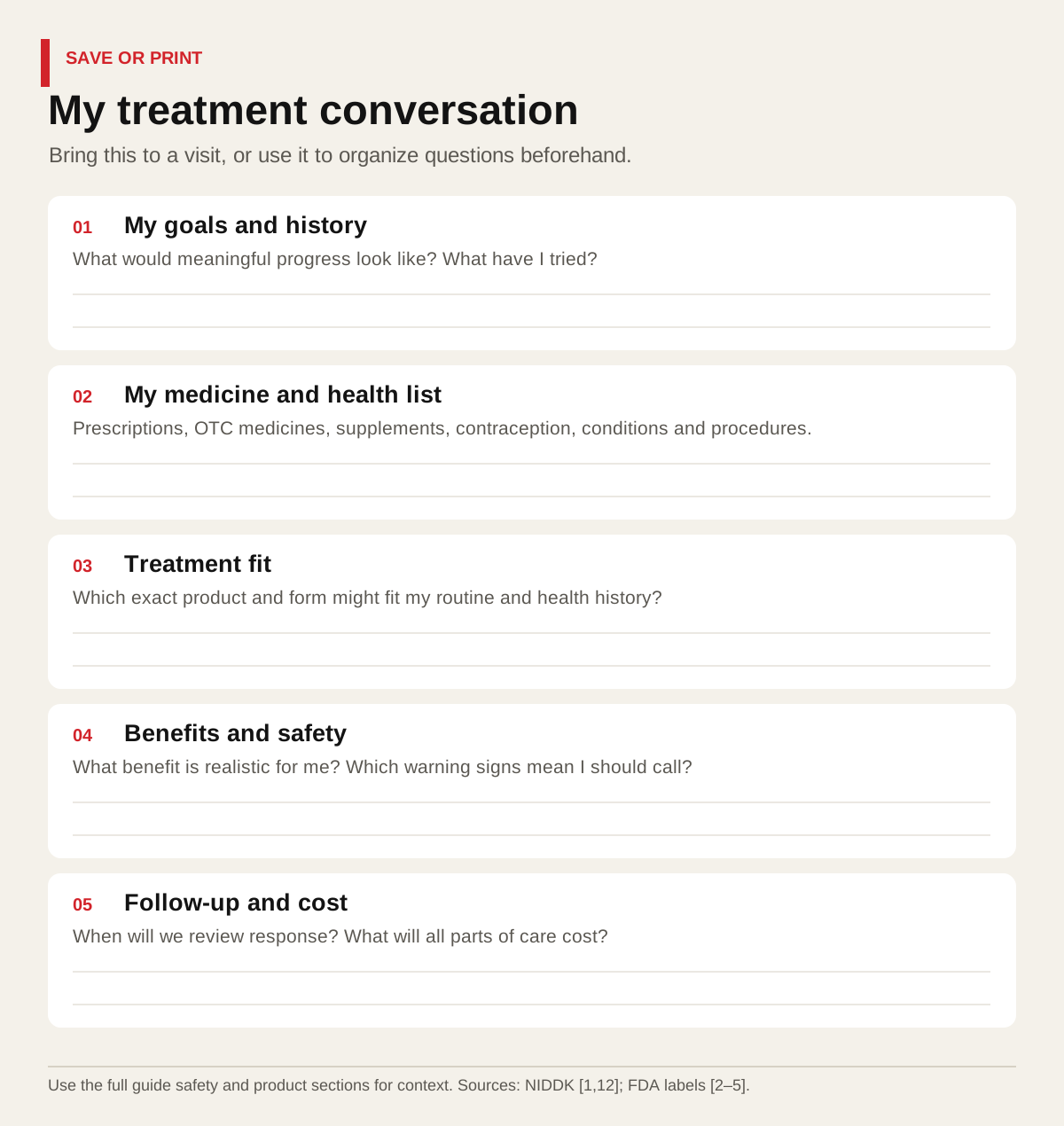
Read this graphic as text
- Write down what meaningful progress would look like, what you have tried and which health concerns matter.
- Bring prescriptions, over-the-counter medicines, supplements and contraception, along with relevant health and procedure history.
- Ask which exact product and form might fit, what benefits are realistic, which symptoms call for help and when to review progress.
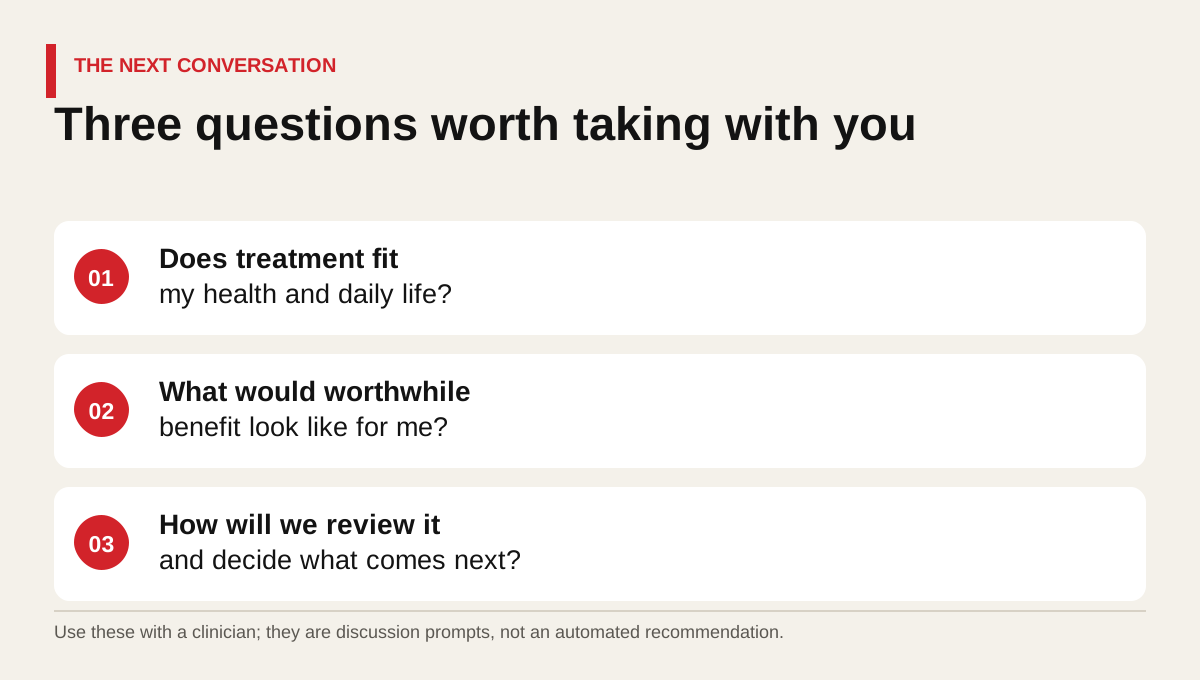
Use the conversation to decide whether treatment makes sense now and, if it does, when to check in again. Ready to explore your options? Our full guide walks you through online providers, their treatments and the support they offer.
Read Our Best Online GLP-1 Providers GuideSources
- NIDDK, Prescription Medications to Treat Overweight & Obesity ↗
- FDA, Wegovy (semaglutide) prescribing information, revised June 2026 ↗
- Lilly, Zepbound (tirzepatide) U.S. prescribing information, revised August 2026 ↗
- Novo Nordisk, Saxenda (liraglutide) prescribing information, revised February 2026 ↗
- FDA, Foundayo (orforglipron) prescribing information, revised April 2026 ↗
- FDA, Concerns with Unapproved GLP-1 Drugs Used for Weight Loss ↗
- FDA, Understanding Unapproved Use of Approved Drugs “Off Label” ↗
- Wilding et al., Once-Weekly Semaglutide in Adults with Overweight or Obesity, NEJM 2021 (STEP 1) ↗
- Jastreboff et al., Tirzepatide Once Weekly for the Treatment of Obesity, NEJM 2022 (SURMOUNT-1) ↗
- Lincoff et al., Semaglutide and Cardiovascular Outcomes in Obesity without Diabetes, NEJM 2023 (SELECT) ↗
- Aronne et al., Continued Treatment With Tirzepatide for Maintenance of Weight Reduction, JAMA 2024 (SURMOUNT-4) ↗
- NIDDK, Choosing a Safe & Successful Weight-loss Program ↗
- NIDDK, Eating & Physical Activity to Lose or Maintain Weight ↗
- NIDDK, Weight-loss (Metabolic & Bariatric) Surgery ↗
- HealthCare.gov, Getting prescription medications ↗
- U.S. Department of Health and Human Services, What happens after my telehealth visit? ↗
- HealthCare.gov, Prior Authorization ↗
- U.S. Department of Health and Human Services, Why use telehealth? ↗
- FDA, Compounding and the FDA: Questions and Answers ↗
- HealthGeek, Best Online GLP-1 Providers: Five Programs Worth a Look, updated September 2026 ↗
- Plotkin et al., Semaglutide 25 mg Oral Versus Semaglutide 2.4 mg Injectable: An Indirect Treatment Comparison of Weight Loss Outcomes, Diabetes, Obesity and Metabolism 2026 ↗
- Aronne et al., Tirzepatide as Compared with Semaglutide for the Treatment of Obesity, NEJM 2025 (SURMOUNT-5) ↗