

NAD+ is a molecule your cells use to turn food into usable energy and carry out other essential work. That role has made it a focus of research into physical function, metabolism and healthy aging. It has also become the name attached to a growing range of supplements and prescription products.[1][2]
You might be interested in having more energy for an ordinary day, staying active or understanding what healthy-aging products actually offer. Those are different goals. Each deserves a clearer answer than “NAD+ is good for your cells.”
This guide explains the molecule, the products and the human research, then walks through suitability, everyday use, cost and getting care through telehealth. You’ll understand which questions matter before choosing a form or a provider.
NAD+ at a glance
- Your body already uses NAD+. A product is an attempt to influence that biology, not a replacement for a molecule your body never had.
- The ingredient matters. NAD+, nicotinamide riboside (NR) and nicotinamide mononucleotide (NMN) are related, but they are different compounds.
- The form matters too. Oral supplements, prescribed injections, clinic infusions, nasal sprays and patches involve different routines.
- Results need a closer look. Raising a NAD-related blood measurement and improving energy, recovery or memory are different outcomes.
- Care depends on the product and your circumstances. Prescription options involve a clinician’s decision; buying a supplement does not provide that assessment.
Chapter 01 / 10
What NAD+ is and what it does
NAD stands for nicotinamide adenine dinucleotide. It is a coenzyme: a small molecule that helps enzymes carry out chemical reactions.
In energy metabolism, NAD+ accepts electrons and becomes NADH. That pair helps transfer energy through the processes your cells use to make ATP, a molecule they use to power their work. NAD also participates in processes involved in DNA repair and cell signaling.[1][3]
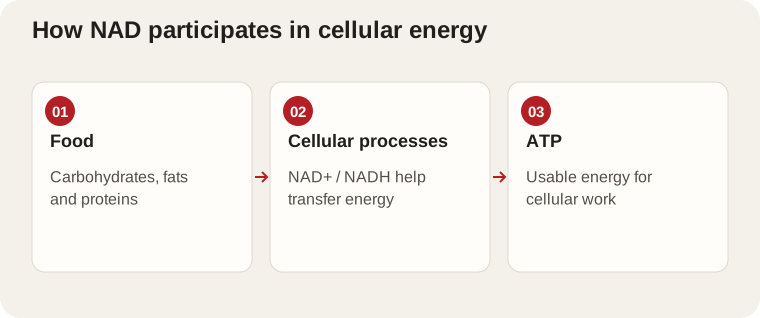
Read this graphic as text
- Food: Carbohydrates, fats and proteins
- Cellular processes: NAD+ / NADH help transfer energy
- ATP: Usable energy for cellular work
Your body makes NAD using materials that include forms of vitamin B3 and the amino acid tryptophan. It also recycles components through pathways that rebuild the molecule. A precursor is an ingredient used along the way to make something else.[1]
Age-related changes in NAD biology help explain the interest in “NAD boosters.” They do not mean everyone reaches a particular birthday and suddenly needs treatment. Being tired or recovering slowly from exercise does not, by itself, tell you your NAD level or explain the cause.[2]
The next question is what changing that biology might mean for the part of your life you want to improve or preserve.
Chapter 02 / 10
Why people consider NAD-related products
For some readers, the interest starts with the day in front of them: enough energy to finish the errands and still do something they enjoy, or clearer thinking when they sit down to work.
For others, it is physical activity. They want to keep running, return to lifting or recover comfortably enough to enjoy the next session. Performance during exercise and soreness afterward are separate questions, even when both appear under the same “energy and recovery” label.
Healthy-aging interest can be different again. You may feel well now and want to keep doing the activities that matter to you as you get older. That is a question about maintaining function, not necessarily fixing a current problem.
Men and women can bring any of these goals to the conversation. There is no need to fit a particular age group or have every concern on the list.
Start by naming the change you care about. “More energy” might mean getting through ordinary tasks. “Healthy aging” might mean continuing a valued activity. The more specific the goal, the easier it is to ask whether a study or product addresses it.
Capacity for ordinary tasks and chosen activities
Continuing a valued sport or training routine
Maintaining function, even when you feel well now
Goals are examples, not promised treatment outcomes.
If fatigue is persistent or unexplained, discuss it with a healthcare professional rather than assuming NAD is the missing piece. Sleep problems, medicines and a range of health conditions can contribute to fatigue, and addressing the cause may call for a different approach.[16]
Chapter 03 / 10
NAD+, NR, NMN and the available forms
The name on the front of a bottle or treatment page does not tell you everything inside it. First identify the ingredient, then the way it is taken.
The ingredients
- Label
- NAD+
- What it means
- The molecule itself, supplied in a particular preparation.
- Label
- NR
- What it means
- Nicotinamide riboside, a precursor the body uses in making NAD.
- Label
- NMN
- What it means
- Nicotinamide mononucleotide, another related precursor.
- Label
- NADH
- What it means
- The reduced form of NAD involved in its energy-transfer cycle.
- Label
- Niacin or nicotinamide
- What it means
- Forms of vitamin B3 involved in NAD synthesis.
These names describe related biology, not interchangeable products or doses. Many human studies discussed below used oral NR or NMN rather than NAD+ injections.[1][2][3]
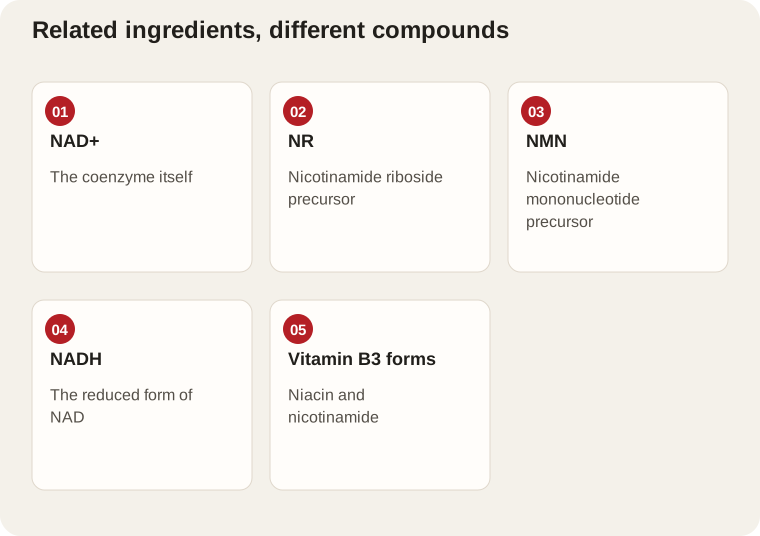
Read this graphic as text
- NAD+: The coenzyme itself
- NR: Nicotinamide riboside precursor
- NMN: Nicotinamide mononucleotide precursor
- NADH: The reduced form of NAD
- Vitamin B3 forms: Niacin and nicotinamide
Oral products
Capsules, tablets, powders and liquids are taken by mouth. Check the Supplement Facts panel for the actual ingredient, amount per serving and other ingredients. A blend marketed as a “NAD booster” may contain several compounds.[14]
A “liposomal” label describes a formulation that carries an ingredient in tiny bubbles made from fat-like molecules called lipids.[22] That tells you about the delivery system, not whether the product improves the outcome you care about. Look for evidence about the finished preparation.
Prescribed injections at home
Some telehealth services offer compounded NAD+ injections following a clinician’s assessment. AgelessRx is one current example, with pharmacy fulfillment, delivery and ongoing provider messaging.[19]
Confirm the prescribed route and the training provided. An injection under the skin and one into a muscle involve different instructions. The product’s directions should tell you how it is intended to be used; do not infer that from a photograph of the vial.
Supervised IV infusions
With an intravenous infusion, the preparation enters through a line into a vein. This involves an appointment and administration under supervision, rather than a capsule or home injection routine. Human IV research has examined metabolism and tolerability, but that is not the same as showing a reliable improvement in everyday wellbeing.[3][4]
Nasal sprays
Compounded prescription NAD+ nasal sprays are also offered through telehealth. AgelessRx’s spray is one example requiring clinician review. It offers a needle-free route.[20]
Patches
Not every patch is a simple passive sticker. AgelessRx offers prescription NAD+ patches using iontophoresis, which uses an electrical current to assist delivery through the skin. Ask what the specific system involves and follow its instructions.[21]
A delivery method can change the routine substantially. Whether it changes the benefit is a separate question, answered by relevant human outcomes rather than the route’s name.
Chapter 04 / 10
Potential benefits and what human studies show
NAD biology gives researchers good reasons to investigate several areas of health. The human results are more specific than the broad claims you may encounter on a treatment page.
A 2026 systematic review found that oral NR and NMN affected NAD-related measurements, while results for physical, metabolic and other health outcomes were mixed. Its included studies ran through October 2025. The useful distinction is between changing a measurement and changing something a person can feel or do.[2]
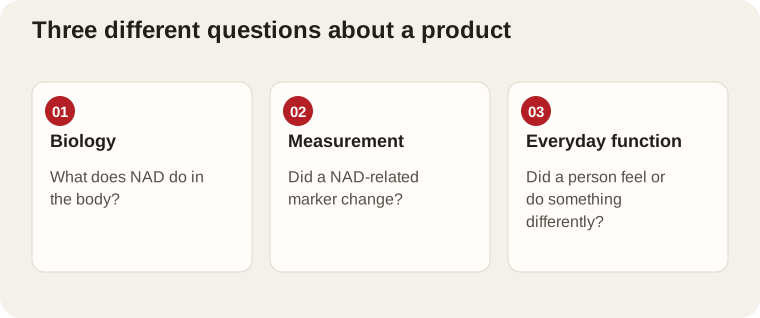
Read this graphic as text
- Biology: What does NAD do in the body?
- Measurement: Did a NAD-related marker change?
- Everyday function: Did a person feel or do something differently?
Energy and fatigue
The appeal is more usable capacity for the day. A higher blood NAD measurement does not tell you whether someone has gained that capacity.
In a trial involving people with long COVID, oral NR increased whole-blood NAD, but researchers did not find a significant advantage over the comparison group on fatigue or cognition. The study concerns a particular clinical population, rather than every adult who feels tired.[10]
When you assess an energy claim, look for fatigue or daily-function outcomes in people relevant to you, not just a graph showing increased NAD.
Mental clarity and memory
In an eight-week oral NR study involving adults with subjective cognitive decline or mild cognitive impairment, NR did not improve cognitive-test results compared with placebo. A change in a tau-related blood marker did not translate into a demonstrated improvement in thinking.[9]
“Brain health,” a laboratory marker and remembering information more easily are different outcomes. A useful explanation should say which one was measured.
Exercise, physical function and recovery
There are some encouraging findings here, with important distinctions.
In a six-week study of recreational runners doing exercise training, researchers measured ventilatory thresholds: points where breathing changes as an exercise test gets harder. Some oral NMN groups reached higher workloads at these thresholds than the placebo group. Maximal oxygen use and body composition did not differ between groups.[5]
A separate oral NMN study in older men reported exploratory improvements in walking speed and left-hand grip strength. A supplier error reduced the complete twelve-week sample, making those results more tentative.[6]
These are specific physical-function signals. They do not answer whether an NAD+ shot will make you less sore after lifting, build muscle or let you recover faster between workouts. If recovery is your goal, ask for research measuring recovery itself.
Exercise-test breathing thresholds
Exploratory walking speed and left-hand grip
Distance in a six-minute walking test
Healthy aging
Lifespan concerns how long you live. Healthspan concerns the part of life spent in good health and function. They are related, but a product can be discussed in aging research without having been shown to extend either one.
For someone who wants to keep enjoying a sport or handling everyday responsibilities, maintained function is the meaningful goal. Short trials and changes in NAD-related markers do not establish longer life or reversal of aging.[2]
Metabolic and vascular health
An oral NMN trial in postmenopausal women with prediabetes and overweight or obesity found an improvement in muscle insulin sensitivity, a measure of how muscle responds to insulin. That does not establish NMN as a weight-loss treatment or NAD+ injections as a treatment for diabetes.[7]
In an early trial involving people with peripheral artery disease, a circulation disorder, the oral NR group walked farther on a six-minute walking test after six months than the placebo group. The finding needs confirmation in larger trials. It does not establish prevention of cardiovascular disease in otherwise healthy adults.[11]
A specific improvement in muscle insulin sensitivity or a walking test should not be bundled into a general promise of better metabolism and heart health.
Sleep and other research questions
A twelve-week oral NMN study in older Japanese adults measured sleep, fatigue and how quickly participants could stand up from a chair five times. Those taking NMN in the evening became less drowsy, but so did those taking placebo in the evening. All four study groups improved their chair-test times. These results do not establish NMN as an insomnia treatment.[8]
Mood was also measured in the long COVID NR trial, without a significant between-group advantage.[10] Claims about skin, immunity, fertility or treatment of neurological disease need their own applicable clinical evidence. NAD’s involvement in cellular processes does not establish those product benefits.
How long before you notice a result?
There is no single timeline that applies across these ingredients, forms and goals. A study lasting six or twelve weeks tells you when researchers assessed an outcome, not when every user should feel a change.
Before starting, agree with your clinician on what you hope to change, when to reassess and what would make continued use worthwhile. Lack of a meaningful benefit or an unwanted effect is a reason to discuss whether to continue.
Chapter 05 / 10
Suitability, side effects and product quality
Suitability depends on your health, the product and the route. Share your medications, supplements, medical history and any pregnancy, breastfeeding or pregnancy plans before discussing an option. Supplements can interact with medicines, and many have not been adequately studied during pregnancy or breastfeeding.[15]
For its NAD+ injection product, AgelessRx excludes pregnancy, breastfeeding and plans for either, and identifies local irritation as a commonly reported side effect. Those are that product’s instructions, not a complete safety profile for every NAD-related preparation.[19]
Infusion discomfort and sterile quality
A small retrospective 2026 comparison of IV NAD+ and IV NR recorded substantial discomfort during NAD+ infusions, including nausea and abdominal symptoms. Its size and design do not establish how often reactions occur across all clinics.[4]
Product quality is a separate issue. FDA has cautioned compounders about unsuitable food-grade NAD+ ingredients in sterile preparations and reported reactions consistent with excessive exposure to endotoxins, some requiring medical treatment. Endotoxins are bacterial toxins that can cause serious reactions if injected.[12][23] This makes the identity and quality practices of the dispensing compounder important questions.
What compounded and supplement status mean
Compounded medicines are prepared for prescribing needs rather than going through FDA approval as finished drugs. FDA does not verify their safety, effectiveness or quality before marketing. A prescription or a licensed pharmacy therefore does not mean the product has FDA approval for energy or healthy aging.[13]
Dietary supplements are regulated under a different framework and also are not approved by FDA before sale. Manufacturers still have responsibilities for quality and accurate labeling. A nasal spray or patch is not a dietary supplement simply because its ingredient also appears in oral products.[14]
Ask who prepares the product, what quality checks apply, what instructions accompany it and whom to contact about a reaction. The aim is to understand the preparation you would actually use.
Which ingredient, preparation and route?
Who supplies it and what quality checks apply?
Who answers questions about an unwanted effect?
Chapter 06 / 10
Why consider telehealth

For a suitable prescription option, telehealth brings the assessment and follow-up closer to your ordinary routine. You can discuss your history from home instead of arranging travel and time away from work. A private space may also make it easier to have an uninterrupted conversation.[17]
Home delivery and remote follow-up can reduce repeated trips for a home-use product. Some services also include provider messaging, giving you a way to ask about the plan between check-ins.[19][20]
Compare that with your local clinician, especially if the first question is why you feel unwell. An office visit allows an in-person assessment; your clinician may arrange tests or other care as needed. Telehealth may also lead to local testing, another appointment or referral.[17]
Assessment and follow-up from home when suitable
In-person assessment, testing or other care when needed
Supervised IV treatment still involves a different commitment from receiving a home-use product. Choose the care setting for the assessment and treatment you need, rather than treating an online program as automatically better.
Chapter 07 / 10
How getting started online works
Buying an oral supplement and obtaining a prescribed preparation are different processes. For prescription products, the sequence generally looks like this:
- Check the service and complete its intake. Identify the product offered, availability where you live and how clinical review works. Provide your goals, health history, medications and relevant concerns.
- Have the clinician assessment. Depending on the service and circumstances, this may involve review of submitted information, messaging, phone or video. Ask what is required for your visit.[17]
- Receive a treatment decision. The clinician decides whether prescribing is appropriate. An intake submission is not an approval. Another evaluation or a different approach may be recommended.
- Review the prescription, cost and instructions. Establish what you are getting and any ongoing commitment before proceeding.
- Receive pharmacy fulfillment and delivery. The dispensing pharmacy prepares or dispenses the prescribed product. The platform coordinating care is not necessarily the compounder.
- Continue with the agreed follow-up. Know how to ask questions, arrange reassessment and obtain refills when appropriate.
Coordinates the service
Assesses and makes prescribing decisions
Prepares or dispenses the prescription
AgelessRx’s public prescription pages illustrate clinician review, pharmacy fulfillment, delivery and continuing support. The exact requirements of another service may differ.[20][21]
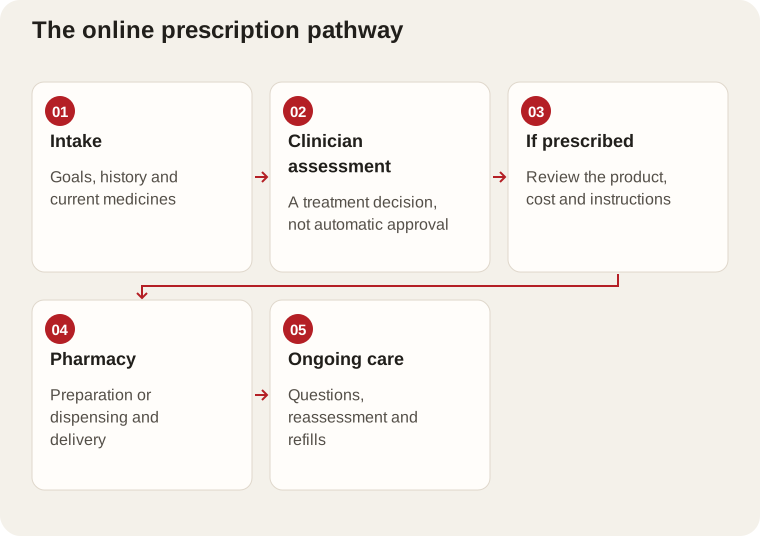
Read this graphic as text
- Intake: Goals, history and current medicines
- Clinician assessment: A treatment decision, not automatic approval
- If prescribed: Review the product, cost and instructions
- Pharmacy: Preparation or dispensing and delivery
- Ongoing care: Questions, reassessment and refills
Chapter 08 / 10
Everyday use and follow-up
Before the first use, make sure the instructions answer the practical questions: how to use the product, where to store it, how long it remains usable and what to do if something goes wrong. Ask the prescriber or pharmacy to explain anything unclear.
- Form
- Oral product
- What to establish before starting
- Actual ingredients, serving directions and compatibility with your other medicines or supplements.
- Form
- Home injection
- What to establish before starting
- Prescribed route, administration training, supplies, storage and disposal of used sharps.
- Form
- IV infusion
- What to establish before starting
- Appointment requirements, who administers and monitors it, and what to do about symptoms during the visit.
- Form
- Nasal spray
- What to establish before starting
- Product-specific use, storage and handling instructions.
- Form
- Iontophoresis patch
- What to establish before starting
- How the delivery system works, application instructions and how to respond to skin irritation.
These are questions to resolve, not a dosing protocol. Products vary, so follow the instructions for the preparation you receive.[14][19][20][21]
Keep follow-up tied to your goal
Use the goal you started with when you reassess. If you wanted more capacity for normal tasks, discuss changes in that part of the day. If training or recovery mattered, discuss that experience. Include unwanted changes, such as sleep disruption, rather than considering only the benefit you hoped for.
A simple note of what you used, what you noticed and any problems can make that conversation more useful. It does not prove the product caused a change. Your clinician should help decide whether to continue, adjust, stop or consider another approach.
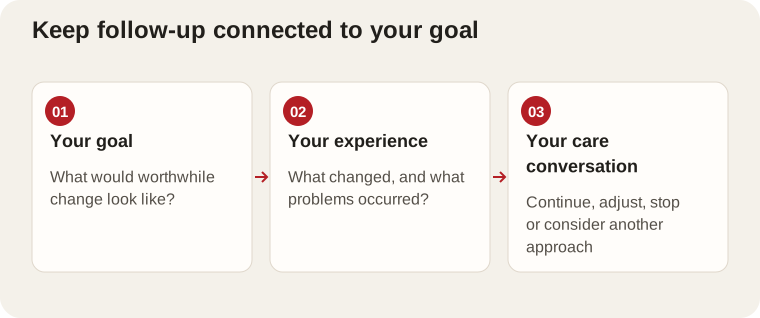
Read this graphic as text
- Your goal: What would worthwhile change look like?
- Your experience: What changed, and what problems occurred?
- Your care conversation: Continue, adjust, stop or consider another approach
Confirm the follow-up schedule and support contact before a refill is due. Included messaging does not tell you how quickly a clinician will respond, so ask about response times and the appropriate contact for urgent problems.
Chapter 09 / 10
Choosing a provider and understanding total cost
Once you know the form you are considering, compare the care around it. A quality provider should make the important details understandable before you commit.
The actual product. Get the ingredient, route, quantity and instructions. “NAD program” is not enough to identify what you will use.
Clinical assessment. Establish who reviews your history and makes prescribing decisions, what the assessment involves and how availability applies where you live.
The dispensing pharmacy. Ask which pharmacy supplies the product and how to verify its licensing. This matters especially with compounded prescriptions, where the platform name may not identify the compounder.[13]
Instructions and ongoing help. Find out who answers questions about administration, unwanted effects, adjustments and refills. Distinguish customer-service support from access to a prescribing professional.
Look at the amount billed, not just the monthly headline
A displayed monthly figure may be an average for a longer period charged upfront. A kit price may cover a different quantity from another provider’s monthly supply. Compare the actual billing period and what is included.[19][21]
Before paying, establish:
- What is charged today and what is charged at renewal?
- Are consultation, medicine, supplies, testing and shipping included or separate?
- How much product does each purchase provide under the prescribed instructions?
- Is it a one-time purchase or subscription?
- What are the cancellation, refill and refund terms?
Then decide whether that commitment makes sense for your budget and the result you are pursuing. Included care and transparent terms can make a program easier to use; they do not establish that its medicine works better.
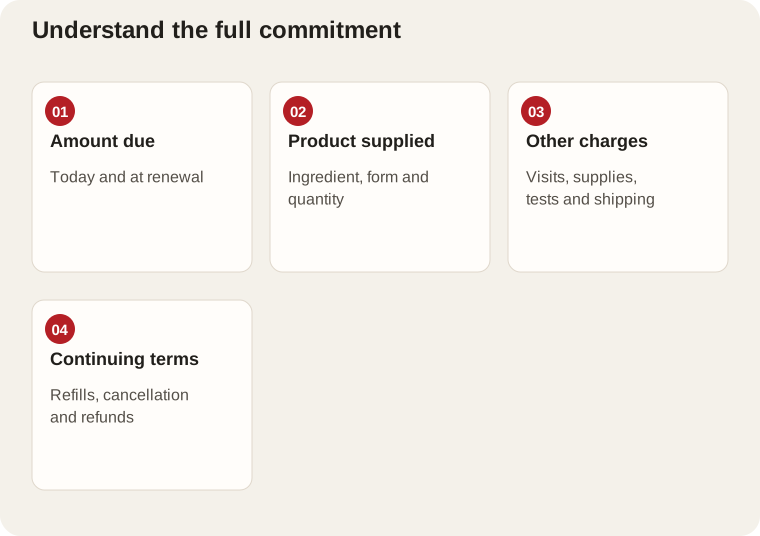
Read this graphic as text
- Amount due: Today and at renewal
- Product supplied: Ingredient, form and quantity
- Other charges: Visits, supplies, tests and shipping
- Continuing terms: Refills, cancellation and refunds
Chapter 10 / 10
Prepare for the conversation and choose your next step

You do not need to arrive knowing which product to request. Arrive knowing what you want to discuss.
Bring your medication and supplement list, relevant medical history, symptoms if present, previous product experiences and the questions that matter to you. For a remote appointment, arrange the privacy and technology needed for its format.[18]
These questions can help:
- What evidence addresses my goal? Ask about the actual ingredient, route and outcome, not NAD biology alone.
- Is another assessment more relevant first? Especially when symptoms are persistent, changing or unexplained.
- What would everyday use involve? Include storage, administration, appointments and ongoing support.
- What safety considerations apply to me? Discuss medicines, supplements, health conditions and reproductive plans.
- When would we reassess? Agree on what would make continued use worthwhile or prompt a change.
- What would the full commitment cost? Include the amount billed and the continuing terms.
Your goal might be more capacity for an ordinary day, continued participation in an activity you love or maintaining function as you get older. Keep that goal at the center of the conversation. The next step should address it with relevant evidence and appropriate care.
Compare at-home programs when you are ready
For readers considering prescribed home injections, HealthGeek’s comparison of Direct Meds, AgelessRx and Coby looks at three at-home NAD+ programs and their care arrangements. It is a sponsored comparison, with a paid partnership with Direct Meds.
Sources
- NIH Office of Dietary Supplements: Niacin Health Professional Fact Sheet
- Gallagher and Emmanuel: NAD supplementation for anti-aging and wellness, 2026 systematic review
- Grant et al.: Human NAD+ metabolome during a six-hour IV infusion
- Reyna et al.: Retrospective comparison of IV NAD+ and NR
- Liao et al.: NMN supplementation during exercise training
- Igarashi et al.: Oral NMN and physical function in older men
- Yoshino et al.: NMN and muscle insulin sensitivity in women with prediabetes
- Kim et al.: NMN, sleep, fatigue and physical performance in older adults
- Oral NR trial in subjective cognitive decline or mild cognitive impairment
- Wu et al.: NR trial in long COVID
- NICE trial: NR and walking performance in peripheral artery disease
- FDA: Ingredients suitable for sterile compounding
- FDA: Compounding questions and answers
- FDA: Dietary supplement questions and answers
- NCCIH: Using Dietary Supplements Wisely
- MedlinePlus: Fatigue
- HHS: Introducing Patients to Telehealth
- HHS: Helping Patients Prepare for Their Telehealth Appointment
- AgelessRx: NAD+ Injection
- AgelessRx: NAD+ Nasal Spray
- AgelessRx: NAD+ Patches
- FDA: Liposome Drug Products, background definition
- FDA: CGMP questions and answers, endotoxin definition in question 8