

Chapter 01 / 11
What magnesium is and what it does
Magnesium is an essential mineral, a nutrient your body needs to function normally. You get it from food, and it takes part in processes happening throughout your body every day.
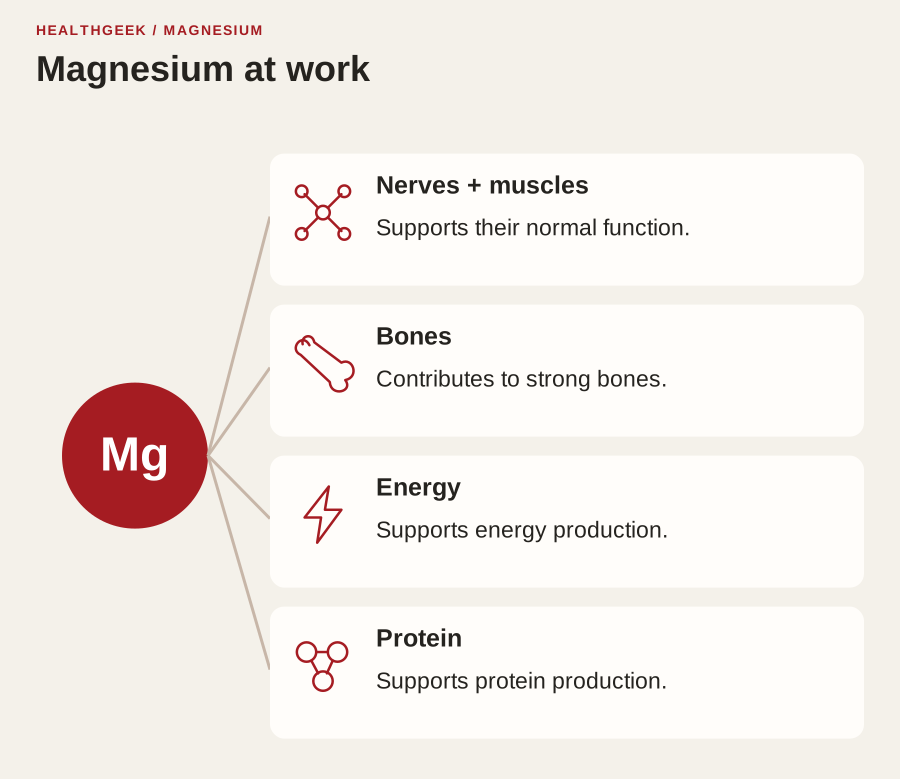
It helps your nerves and muscles work, contributes to strong bones and supports the production of energy and protein. These are ongoing needs, whether you're taking a walk, making dinner or resting. MedlinePlus: magnesium in your diet
Read this graphic as text
- Nerves + muscles: Supports their normal function.
- Bones: Contributes to strong bones.
- Energy: Supports energy production.
- Protein: Supports protein production.
Magnesium is also an electrolyte, a mineral that carries an electrical charge when dissolved in body fluids. Electrolytes help maintain fluid balance and support normal body function. Most magnesium in your body is stored in bones and other tissues; only a small amount circulates in your blood. MedlinePlus: magnesium and electrolytes
Why this matters before you look at supplements
When you read that magnesium supports muscle function, you're learning about a normal nutritional role. Whether a supplement will ease your particular muscle cramps is a further question, one that needs studies of people with that problem.
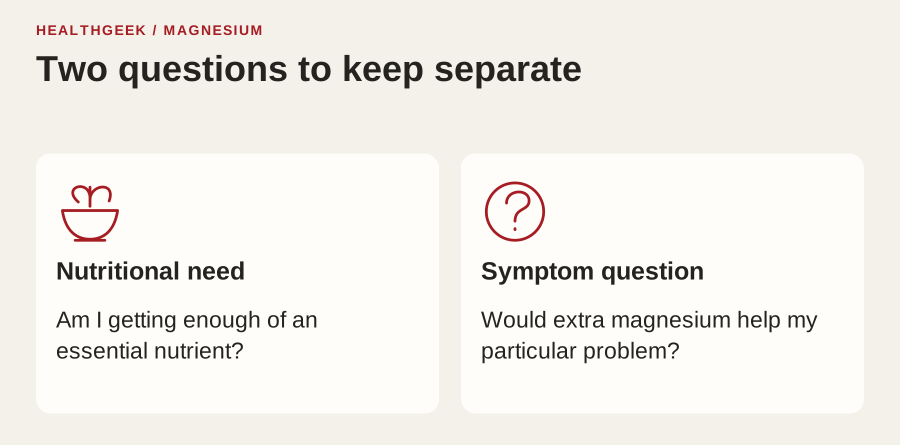
Keeping those two questions separate makes the subject much easier to understand: getting enough of an essential nutrient, and taking extra in the hope of a specific result.
Read this graphic as text
- Nutritional need: Am I getting enough of an essential nutrient?
- Symptom question: Would extra magnesium help my particular problem?
First, it helps to know what “enough” means.
Chapter 02 / 11
What getting enough magnesium means
Recommended daily intakes give you a reference for nutrition. They vary by age and life stage, and include magnesium from your diet. We'll work through the numbers in chapter 6.
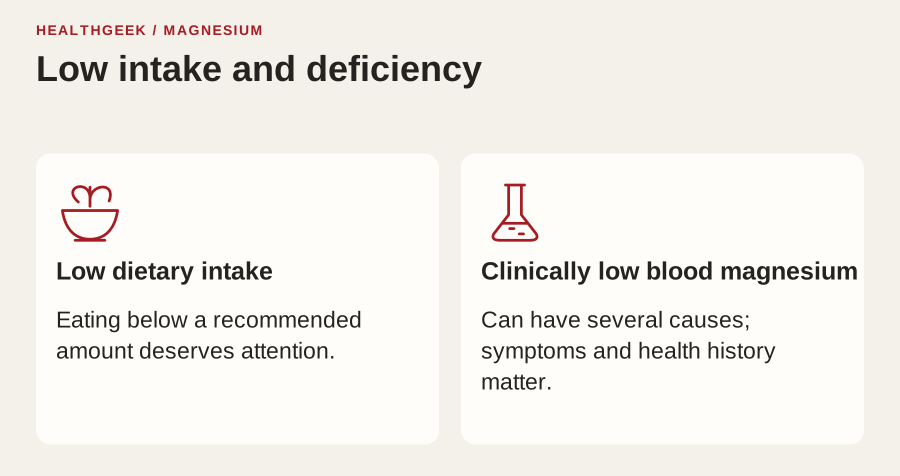
A diet that regularly falls short deserves attention. But eating less than a recommended amount doesn't, by itself, diagnose magnesium deficiency.
Low intake and deficiency need different attention
Clinically low blood magnesium is called hypomagnesemia. It can develop for several reasons, including ongoing diarrhea, problems absorbing nutrients, some medicines and certain health conditions. Food intake is one part of the picture.
Read this graphic as text
- Low dietary intake: Eating below a recommended amount deserves attention.
- Clinically low blood magnesium: Can have several causes; symptoms and health history matter.
Fatigue, weakness or cramps can occur with low magnesium, but recognizing one of these symptoms doesn't tell you its cause. A clinician looks at the symptoms and your health history and may order blood or other tests. MedlinePlus: magnesium deficiency
If a symptom keeps returning, is worsening or is getting in the way of your day, describe that problem directly. “My legs keep cramping at night” gives a clinician something to investigate. Arriving convinced that you need a particular supplement can narrow the conversation too soon.
What a blood test can tell you
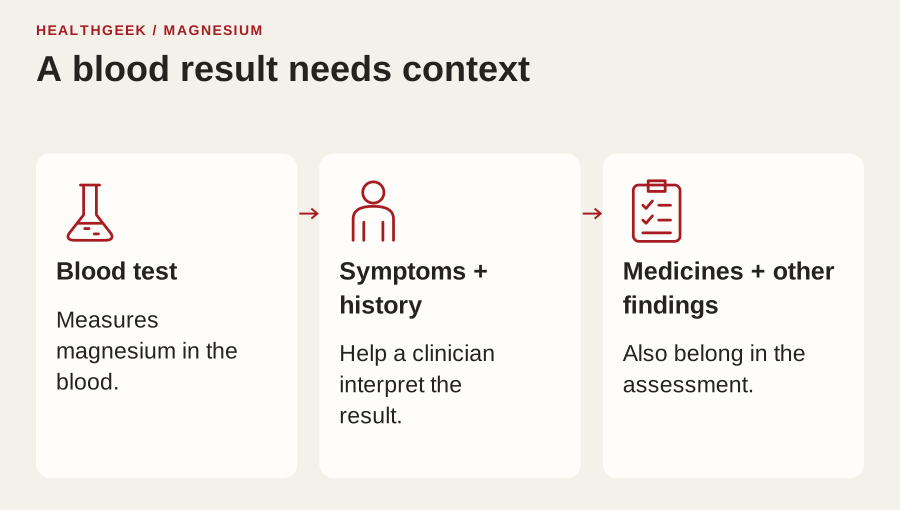
A magnesium blood test measures the amount in your blood. Because most magnesium is elsewhere in the body, the result needs to be considered alongside symptoms, medicines and other findings. A normal result doesn't always rule out low magnesium in body tissues. That limitation doesn't make the test pointless; it explains why interpretation matters. MedlinePlus: magnesium blood testing
Read this graphic as text
- Blood test: Measures magnesium in the blood.
- Symptoms + history: Help a clinician interpret the result.
- Medicines + other findings: Also belong in the assessment.
For an everyday intake question, the next place to look is your food.
Chapter 03 / 11
Where magnesium comes from
Start with familiar foods
Magnesium is found in nuts, seeds, beans, whole grains and leafy greens. Milk, tofu and several fruits also contribute. MedlinePlus: food sources
You can work these foods into meals you already eat: add beans to a soup, sprinkle seeds over breakfast, or serve brown rice and greens with dinner. A handful of nuts can be a simple snack if they suit your diet.
Think about the pattern across your meals rather than finding one “magnesium food” to eat every day. If whole food groups are difficult for you to eat, a dietitian can help you explore alternatives that fit your preferences and needs.
Supplements and medicines serve different purposes
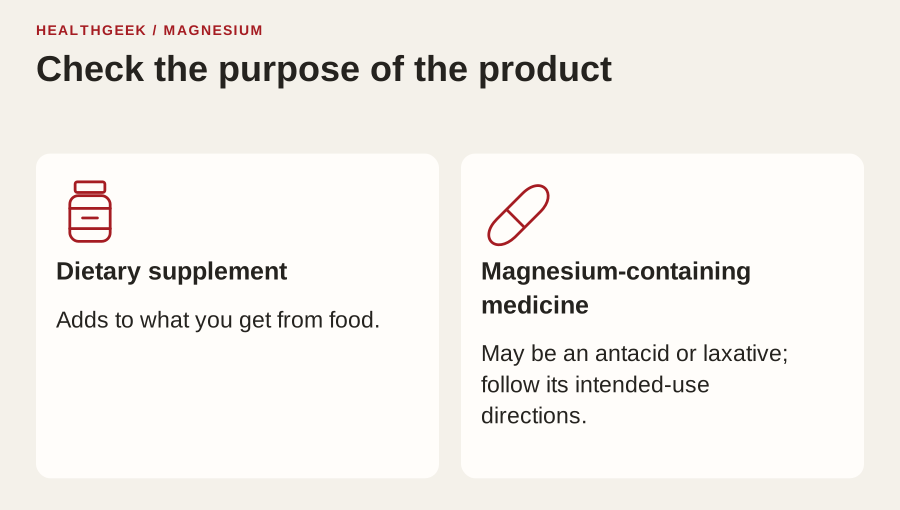
A dietary supplement adds to what you get from food. Magnesium can appear in a multivitamin or a separate product, in tablets, capsules, powders or liquids. Some fortified foods contain added magnesium too. NIH: magnesium sources
Magnesium also appears in medicines. Magnesium oxide, for example, can be used as a supplement, an antacid or a laxative. The intended use changes the directions and how long the product should be used. Check the actual product rather than assuming that every magnesium-containing bottle belongs in the same daily routine. MedlinePlus: magnesium oxide
Read this graphic as text
- Dietary supplement: Adds to what you get from food.
- Magnesium-containing medicine: May be an antacid or laxative; follow its intended-use directions.
What about sprays, creams and infusions?
Products applied to the skin are a different category from dietary supplements, which are intended to be swallowed. This guide focuses on food and oral use. It doesn't compare the effectiveness of topical products or clinician-administered injections and infusions. FDA: what counts as a dietary supplement
Once you know where magnesium comes from, the next question is what extra magnesium might accomplish.
Chapter 04 / 11
What magnesium may help with
The reason you're interested matters. Evidence about constipation doesn't answer a sleep question, and a nutrient's role in normal muscle function doesn't settle whether it treats cramps.
Getting enough in your diet
If your intake is low, food changes or an appropriate supplement can help you meet your nutritional needs. Whether you also notice a change in sleep, energy or another symptom is a separate question. A supplement's value for filling a dietary gap shouldn't be judged only by whether you feel different the next morning. NIH: dietary supplements and nutritional needs
Sleep
Magnesium has been studied for sleep, but the evidence remains limited. NCCIH describes earlier studies as too few and inconsistent to establish a clear answer. NCCIH: sleep and complementary approaches
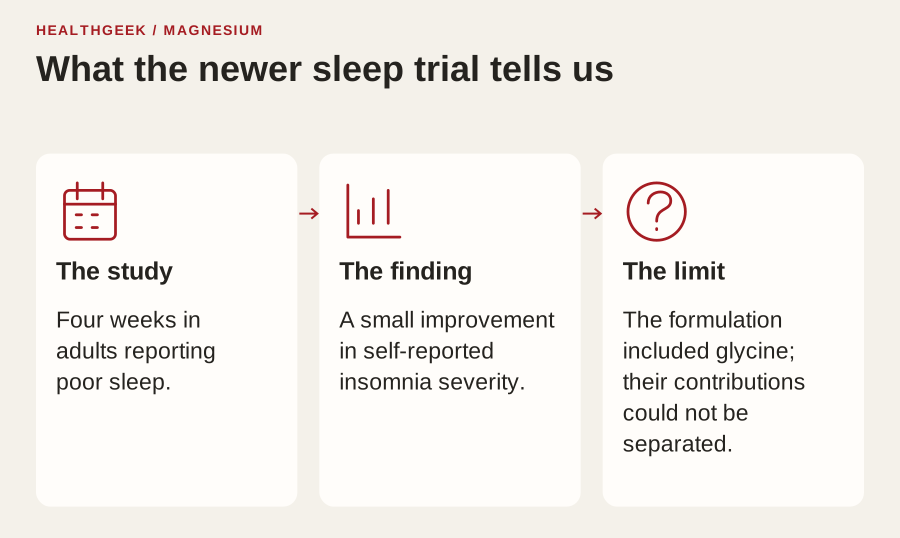
A newer, four-week trial published in 2025 included 155 adults who reported poor sleep. The group receiving magnesium bisglycinate had a small improvement in self-reported insomnia severity compared with placebo. The daily formulation supplied 250 mg of elemental magnesium and about 1.5 g of glycine.
That is a promising finding to investigate further. It was a short study using participants' own reports, and it couldn't separate magnesium's contribution from glycine's. It doesn't tell us that every magnesium product will improve sleep or establish the right amount for you. 2025 magnesium bisglycinate sleep trial
Read this graphic as text
- The study: Four weeks in adults reporting poor sleep.
- The finding: A small improvement in self-reported insomnia severity.
- The limit: The formulation included glycine; their contributions could not be separated.
If poor sleep is continuing to affect your days, include that in a healthcare conversation rather than relying on successive supplement trials.
Constipation
Some magnesium products act as laxatives. In its 2023 guideline, the American Gastroenterological Association and American College of Gastroenterology conditionally recommended magnesium oxide for adults with chronic idiopathic constipation, a form of ongoing constipation. The certainty of evidence was very low, so the recommendation leaves room for individual circumstances and preferences. AGA/ACG constipation recommendations
This is a specific treatment question. A bottle promoted for sleep or general nutrition isn't automatically an appropriate constipation treatment. A pharmacist or clinician can help you identify the intended product and directions.
Migraine prevention
There is limited evidence that magnesium may reduce migraine frequency. This concerns prevention over time, rather than taking a supplement to stop a headache that has already begun.
Amounts used for migraine prevention can exceed the general supplemental upper limit. NCCIH advises using magnesium for this purpose under a healthcare professional's supervision. Bring it up as one possible part of a migraine plan, rather than borrowing a dose from someone else's experience. NCCIH: magnesium for migraine
Muscle cramps
The findings are mixed. A 2020 Cochrane review concluded that magnesium was unlikely to provide a meaningful benefit for older adults with cramps of no clear cause. Evidence in pregnancy was inconsistent. Cochrane review
A later trial, published in 2021, found a benefit for nighttime leg cramps after 60 days of magnesium oxide monohydrate. It received industry funding and relied on self-reported symptoms; the trial was also registered after it had been conducted. 2021 nighttime leg-cramp trial
Together, these findings leave uncertainty. They don't support treating every cramp, or exercise recovery in general, as a reason to take magnesium.
Read this graphic as text
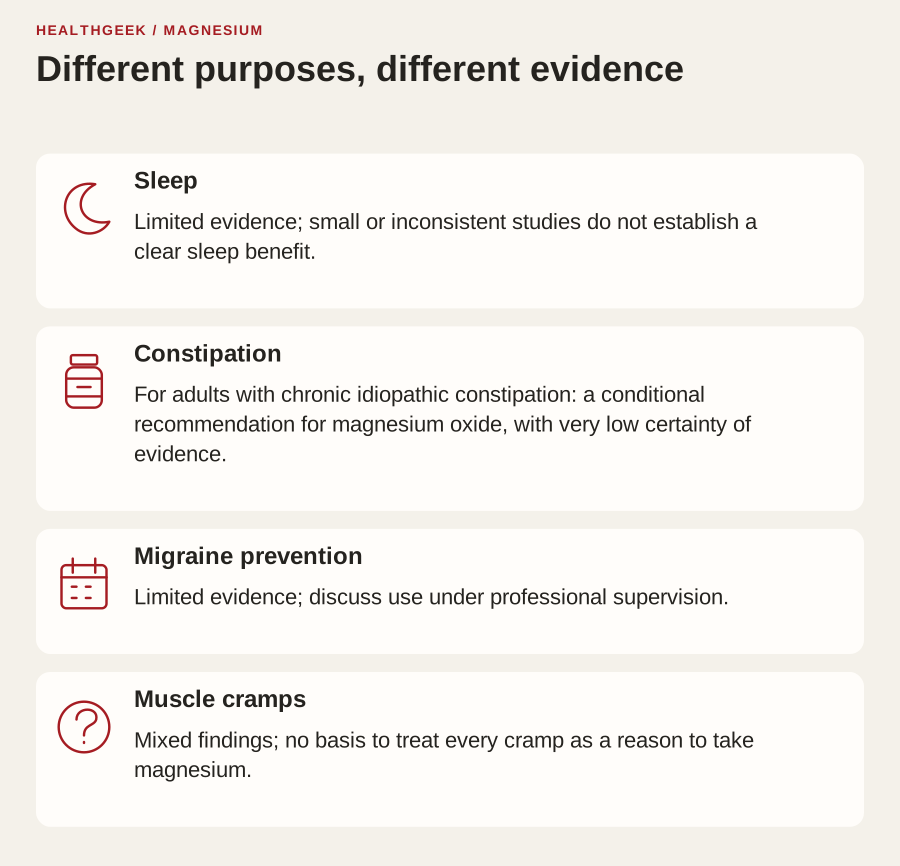
- Sleep: Limited evidence; small or inconsistent studies do not establish a clear sleep benefit.
- Constipation: For adults with chronic idiopathic constipation: a conditional recommendation for magnesium oxide, with very low certainty of evidence.
- Migraine prevention: Limited evidence; discuss use under professional supervision.
- Muscle cramps: Mixed findings; no basis to treat every cramp as a reason to take magnesium.
Chapter 05 / 11
Deciding whether a supplement makes sense
Before choosing a bottle, finish this sentence: “I'm considering magnesium because…”
Your answer gives the decision a purpose.

Read this graphic as text
- A dietary gap: Look at your usual foods and what may be missing.
- A persistent symptom: Describe the problem to a clinician.
- No clear purpose yet: Work out what taking magnesium would accomplish for you.
“I rarely eat the foods that supply it” leads toward a look at your diet and whether there's a gap to address. “I've been sleeping badly for months” points to a symptom that deserves its own attention. “Someone said everyone should take it” leaves an important question unanswered: what would taking it accomplish for you?
Then consider what you already use. A multivitamin, another mineral supplement or a medicine may already contain magnesium. Bring that information into the decision before adding a new product.
If you have kidney disease, take medicines that may interact, or are considering magnesium to treat a condition, check personal suitability first. Chapter 10 explains the main issues. NIH also recommends discussing supplements with your healthcare providers and keeping a record of what you take. NIH: discussing supplements
You may decide that a food change is enough for now. You may have a specific question for a clinician or pharmacist. You may be ready to consider a supplement. Each is a useful outcome when it answers the reason you started looking.

Chapter 06 / 11
Understanding the amount you need
Three numbers can appear in a magnesium discussion: your daily nutritional requirement, the amount in a product and the supplemental upper limit. Each answers a different question.
Your daily nutritional requirement
These U.S. recommendations cover total daily magnesium intake, including food. They are not instructions to take the full amount as a supplement.
| Adults | Ages 19–30 | Ages 31 and older |
|---|---|---|
| Men | 400 mg | 420 mg |
| Women | 310 mg | 320 mg |
| Pregnancy* | 350 mg | 360 mg |
| Breastfeeding* | 310 mg | 320 mg |
*Pregnancy and breastfeeding values shown are for adults ages 19–50. These are nutritional reference values; individual advice may differ. NIH: recommended magnesium intakes
The amount in the product
Look for elemental magnesium, the magnesium itself rather than the weight of the entire compound. On Supplement Facts, the magnesium amount is the elemental amount. NIH: magnesium supplement labels
For example, imagine a label that says:
| Illustrative label excerpt | Amount |
|---|---|
| Serving size | 2 capsules |
| Magnesium per serving | 200 mg |
Two capsules supply 200 mg, so one supplies 100 mg. This is a reading example, not a recommended dose.
Check the serving size every time. A large number on the front of a bottle can be easy to misread if you assume it refers to one capsule.
The supplemental upper limit
For adults, the general upper limit is 350 mg a day from supplements and medicines. Magnesium naturally present in food and beverages is excluded. That is why a total daily nutritional recommendation can be higher than the supplemental limit. NIH: magnesium upper limits
The limit is not a target to work toward. Higher treatment doses need professional guidance, and a lower amount isn't automatically appropriate for someone with kidney disease or a relevant interaction.
Chapter 07 / 11
Getting to know the different forms
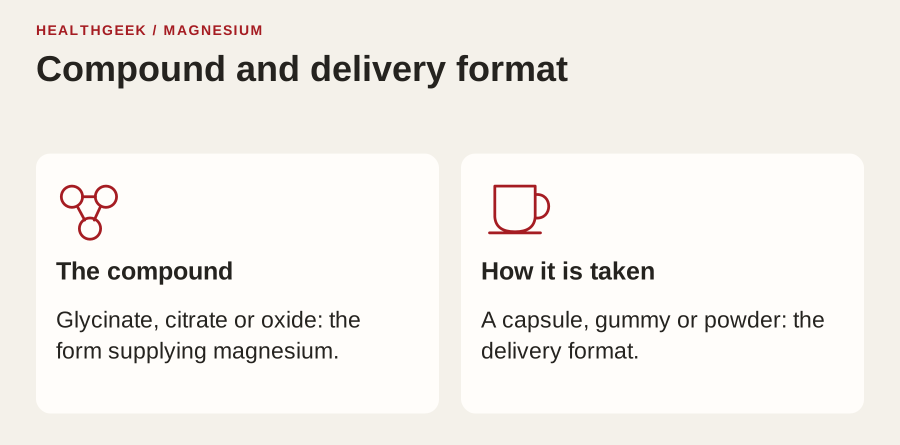
Names such as citrate and glycinate identify the compound supplying magnesium. A capsule, gummy or powder describes how the product is taken. You can therefore encounter the same compound in different delivery formats.
Read this graphic as text
- The compound: Glycinate, citrate or oxide: the form supplying magnesium.
- How it is taken: A capsule, gummy or powder: the delivery format.
Here are the main names you're likely to compare:
- Form
- Glycinate or bisglycinate
- What to understand
- Magnesium combined with glycine. The sleep trial discussed earlier studied a bisglycinate formulation. That result doesn't establish that glycinate is the best choice for everyone seeking better sleep.
- Form
- Citrate
- What to understand
- One of the forms NIH identifies as more readily absorbed than oxide. Absorption is one consideration; the product's purpose and amount still matter.
- Form
- Oxide
- What to understand
- Used in supplements and some antacid or laxative products. Its lower absorption relative to some forms doesn't make it useless; its constipation evidence addresses a particular use.
NIH: forms and absorption; bisglycinate trial; magnesium oxide uses
You may also see chloride, lactate and aspartate, which NIH includes among more readily absorbed forms. Absorption describes how magnesium gets into the body; it doesn't, on its own, establish a better sleep or symptom result. NIH: supplement forms
It helps to resist the appeal of a simple “one form for each problem” list. Instead, connect the form to the evidence for your purpose, then check the actual serving and ingredients. Paying more for a name you recognize won't resolve an unclear reason for taking it.
Chapter 08 / 11
Reading a label and judging a product
Once you understand the form and amount, the label becomes much easier to use.
Start with these details:
- Serving size: How many capsules, gummies or measured scoops make one serving?
- Magnesium amount and form: What does that serving supply?
- Other ingredients: Is magnesium the only active ingredient? Are there ingredients you need to avoid?
- Directions and warnings: Do they fit the way you intend to use the product?
- Servings per container: How long would the bottle last at the labelled serving?
Supplement Facts provides ingredient and serving information. It cannot tell you how you personally will respond. FDA: supplement labels
Understand what a quality claim means
FDA does not approve dietary supplements for safety and effectiveness before they are sold. “Natural” also doesn't establish safety. FDA: supplement regulation
Independent quality testing can help address questions about what a product contains and whether harmful levels of contaminants are present. Organizations such as USP and NSF offer quality programs, but a seal doesn't guarantee that a supplement is safe or effective for you. Check the specific certification rather than assuming that any testing claim means the same thing. NIH: supplement quality

Read this graphic as text
- Product quality: Testing can address contents and harmful levels of contaminants.
- Personal suitability: A seal does not guarantee safety or effectiveness for you.
Compare the amount you're actually buying
If two bottles have different serving sizes, comparing capsule counts alone can be misleading. A 60-capsule bottle lasts 30 days at two capsules a day, or 20 days at three. Those are arithmetic examples, not suggested routines.
Compare cost per labelled serving alongside the amount and ingredients. A cheaper serving only helps if the product fits the purpose you've identified.
Chapter 09 / 11
Making sense of everyday use
Choose a routine around the applicable product directions and any advice from your clinician or pharmacist. If those directions are unclear or conflict, ask before taking it. FDA advises using supplements as directed and checking combinations with medicines. FDA: using supplements
A bedtime routine may sound appealing when sleep brought you here, but the studies discussed earlier don't establish one best time for every magnesium product or user. Timing can also depend on other medicines.

Keep track of the purpose
A short record can include the product, amount, start date, reason for taking it and any changes you notice. NIH provides a supplement-and-medicine record you can share with a healthcare professional. NIH: keeping a record

Read this graphic as text
- Product + amount: Record exactly what you take.
- Start date + purpose: Note when you began and why.
- Changes noticed: Bring the record to your follow-up conversation.
This gives a follow-up conversation something concrete to work with. “I took this amount for this reason, and this is what happened” is more useful than trying to remember which bottle you used several weeks ago.
Pay attention to tolerability
Supplemental magnesium can cause diarrhea, nausea or abdominal cramping. An unpleasant effect is a reason to reconsider the use and seek advice, rather than keep increasing the amount. NIH: magnesium side effects
If you feel no benefit, return to the original purpose. Were you addressing an intake gap or hoping to change a symptom? Continuing symptoms deserve assessment; changing forms repeatedly may leave the underlying question unanswered.
Chapter 10 / 11
Checking safety and personal fit
Kidney health matters
Your kidneys help remove excess magnesium. Reduced kidney function can allow it to accumulate, increasing the risk of toxicity. If you have kidney disease, discuss magnesium-containing supplements, antacids and laxatives with your clinician before using them. Poison Control: magnesium safety

Read this graphic as text
- Kidney disease: Discuss supplements, antacids and laxatives with your clinician before use.
- Medicines: Check the exact product and your medicine list with a pharmacist.
- Pregnancy or breastfeeding: Discuss the intended use with your healthcare professional.
Medicines can change the decision
Magnesium can reduce absorption of certain antibiotics and oral osteoporosis medicines called bisphosphonates. Some diuretics and long-term proton pump inhibitor use can affect magnesium levels. NIH: medicine interactions
Show a pharmacist your medicine list and the exact product you're considering. Ask whether they interact and, if so, what timing or monitoring applies. A single spacing rule won't cover every medicine. Keep taking prescribed treatment as directed while you get advice.
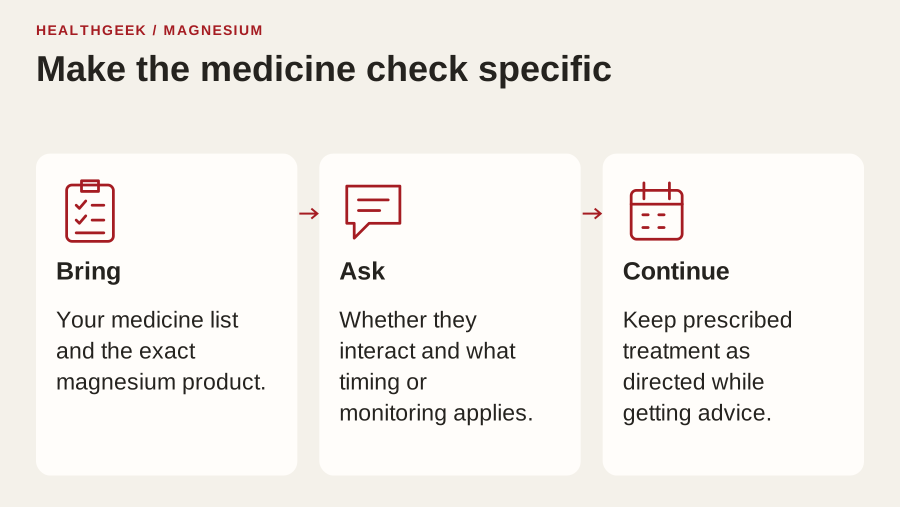
Read this graphic as text
- Bring: Your medicine list and the exact magnesium product.
- Ask: Whether they interact and what timing or monitoring applies.
- Continue: Keep prescribed treatment as directed while getting advice.
Life stage and medical use need context
If you're pregnant, breastfeeding or taking magnesium for a diagnosed condition, discuss the intended use with your healthcare professional. Nutritional reference numbers aren't a substitute for an individual plan, and this adult guide doesn't provide children's doses. NIH: supplement safety and special circumstances
For a suspected overdose in the U.S., contact Poison Control at 1-800-222-1222 for immediate guidance. Don't wait to see whether changing the routine helps. Poison Control: magnesium overdose
Chapter 11 / 11
Choosing your next step
You now have a way to put the magnesium advice you encounter into context: what your body needs, what the evidence addresses and what a particular product actually supplies.
Choose the next step that answers your reason for reading:
- If your question is about food intake, look at your usual meals and choose a realistic place to add a magnesium-containing food. A dietitian can help if restrictions make that difficult.
- If a symptom is affecting your life, describe it to a clinician. Bring its timing, how long it has been happening and what you've already tried.
- If you're considering a supplement, use the amount, form and label chapters to assess it, then resolve any personal safety questions before starting.
- If you still don't have a clear reason to take one, you can leave the bottle on the shelf while you answer that question.
For a clinical or pharmacy conversation, bring your medicine and supplement list and a photo of the product label. You can ask: “Does this make sense for what I'm trying to address, and what would we use to judge whether it's helping?”
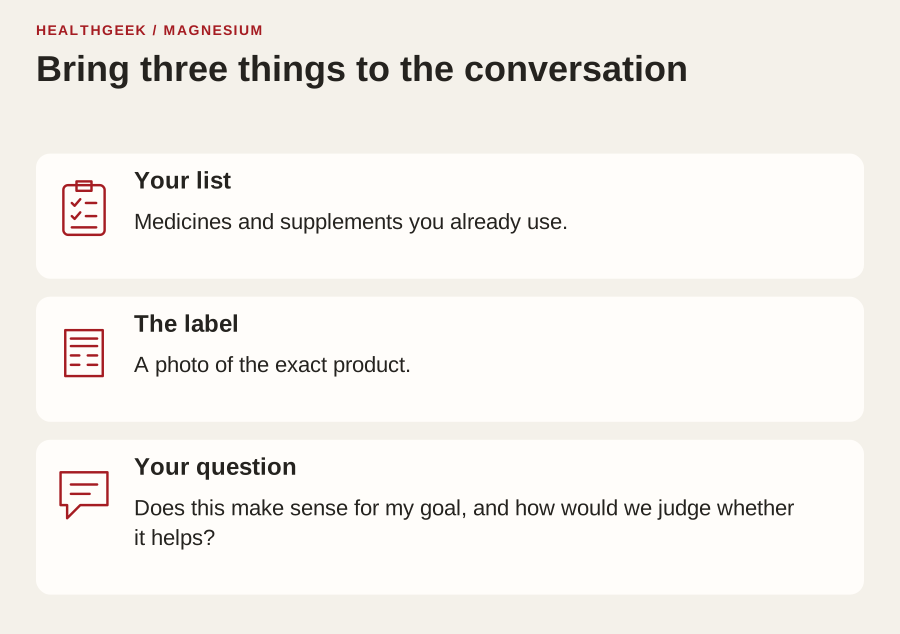
Read this graphic as text
- Your list: Medicines and supplements you already use.
- The label: A photo of the exact product.
- Your question: Does this make sense for my goal, and how would we judge whether it helps?
The useful next step is one you can explain in terms of your own needs.
Sources
- MedlinePlus: Magnesium in diet.
- MedlinePlus: Magnesium blood test.
- MedlinePlus: Magnesium deficiency.
- NIH Office of Dietary Supplements: Magnesium, consumer fact sheet.
- NIH Office of Dietary Supplements: Magnesium, health professional fact sheet.
- MedlinePlus: Magnesium oxide.
- FDA: Questions and answers on dietary supplements.
- NIH Office of Dietary Supplements: Dietary supplements, what you need to know.
- NCCIH: Sleep disorders and complementary health approaches.
- Magnesium bisglycinate supplementation in adults reporting poor sleep, 2025 trial.
- AGA/ACG: Chronic idiopathic constipation recommendations, 2023.
- NCCIH: Headaches, what you need to know.
- Cochrane: Magnesium for muscle cramps, 2020 review.
- Magnesium oxide monohydrate for nighttime leg cramps, 2021 trial.
- FDA: Dietary supplements.
- National Capital Poison Center: Magnesium overdose.