

Chapter 01 / 10
How hair grows and why it sheds
A hair grows from a follicle, a small structure in the skin. The strand you can see is only part of the picture. What happens in the follicle determines how that hair grows.
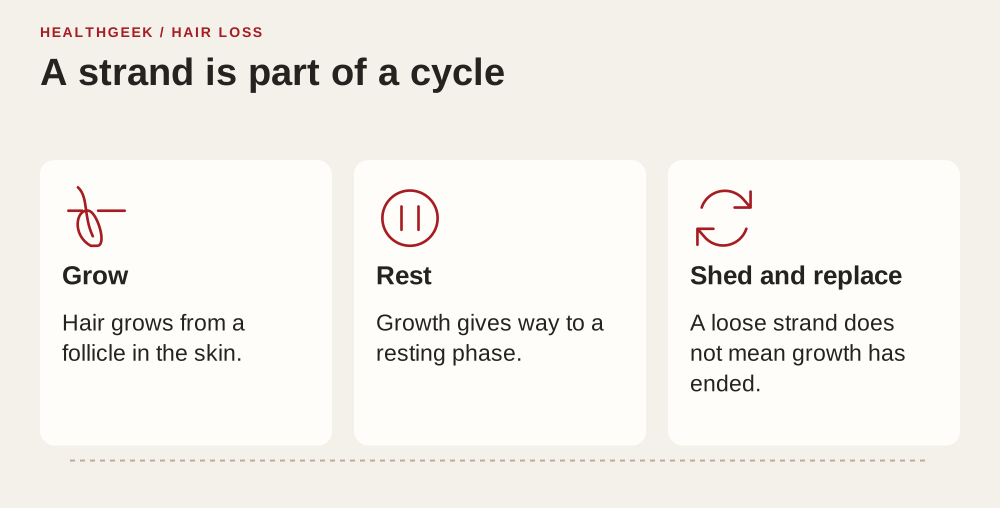
Hair follows a repeating cycle. It spends a period growing, then rests before it sheds and is replaced. Finding a loose hair doesn't, by itself, mean that the follicle has stopped producing hair. Shedding is part of that cycle. MedlinePlus Genetics
Read this graphic as text
- Grow: Hair grows from a follicle in the skin.
- Rest: Growth gives way to a resting phase.
- Shed and replace: A loose strand does not mean growth has ended.
Shedding describes strands coming out. Thinning describes less coverage.
You might notice hair in the shower or on your brush. Or you might notice that more scalp shows through the top of your hair, even without an obvious change in the number of loose strands. Those are different observations, and both are useful to describe.
Ordinary shedding happens as hair renews itself. Excess shedding can also follow an event such as an illness, surgery or major stress. And excess shedding can happen alongside another form of hair loss. One doesn't rule out the other. American Academy of Dermatology: shedding and hair loss
Read this graphic as text
- Shedding: Strands coming out
- Thinning: Less visible coverage
It helps to separate what you've seen from what you think it means. “The top looks thinner than it used to” describes a change. “It must be stress” supplies a cause that still needs checking.
You don't have to count every strand to bring that change up. A description of where you're noticing it and how it has developed gives you a place to start. The next part is understanding what could be changing the growth process itself.
Chapter 02 / 10
What happens in male-pattern hair loss
Male-pattern hair loss is also called androgenetic alopecia. The name describes the involvement of inherited factors and androgens, a group of hormones that includes testosterone and dihydrotestosterone, usually shortened to DHT.
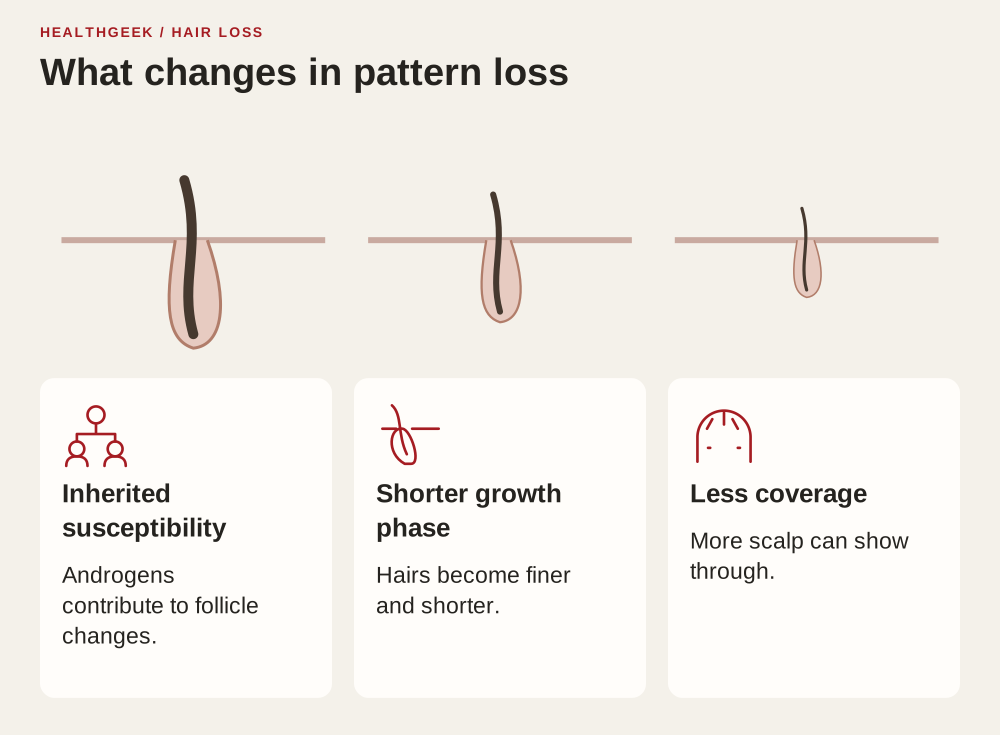
DHT is made from testosterone. In people with an inherited susceptibility, androgens contribute to changes in hair follicles. The growth phase becomes shorter, and the hairs become finer and shorter. With less substantial hair growing from those follicles, the scalp has less coverage. This is a gradual change in what grows, not simply a matter of more full-sized hairs falling out. MedlinePlus Genetics
Read this graphic as text
- Inherited susceptibility: Androgens contribute to follicle changes.
- Shorter growth phase: Hairs become finer and shorter.
- Less coverage: More scalp can show through.
That explanation matters because it shifts the question from “How do I stop seeing hairs in the shower?” to “What's happening to the hair that's growing back?” It also doesn't mean that thinning proves you have too much testosterone.
Male-pattern loss often involves a receding hairline or thinning on top. The pattern is a clue, but a familiar-looking hairline isn't enough to settle the cause. American Academy of Dermatology: causes of hair loss
Other causes need a different conversation
Medicine effects, scalp conditions and physical damage to hair can also contribute to hair loss. An illness or stressful event may help explain a period of increased shedding. These possibilities are reasons to discuss your history, rather than assume that every change calls for the same treatment. American Academy of Dermatology: causes of hair loss
Read this graphic as text
- Health and stress: Illness or a stressful event
- Medicines: Your current medicine list
- Hair and scalp: Scalp conditions or physical damage
For example, mention a recent illness even if you've also noticed gradual thinning for longer. You don't have to choose one explanation before the appointment. A clinician can consider whether more than one process is involved.
Understanding male-pattern loss gives you a useful possibility to discuss. An assessment connects that general explanation to your own hair and scalp.
Chapter 03 / 10
Finding out what's happening to your hair
You can start with your primary care clinician or a dermatologist, who specializes in skin, hair and scalp conditions. Explain the change you've noticed and ask what could be causing it.
An assessment usually starts with your history and an examination. A clinician asks when the change began, how quickly it developed and about relevant health and medicines. They examine your scalp and may check other areas or look for hair breakage. Blood tests or a scalp biopsy, which takes a small tissue sample, are used when a suspected cause calls for them. Everyone doesn't need the same tests. American Academy of Dermatology: diagnosis and treatment

Describe the change before trying to name it
Compare these two ways to begin:
- “I think I need a hair-loss pill.”
- “The top has gradually become thinner, and I'd like to understand why and what I can do about it.”
The second leaves room to discuss both the cause and treatment. If you've seen a particular medicine advertised, bring that up too. It can be part of the conversation without being its starting assumption.
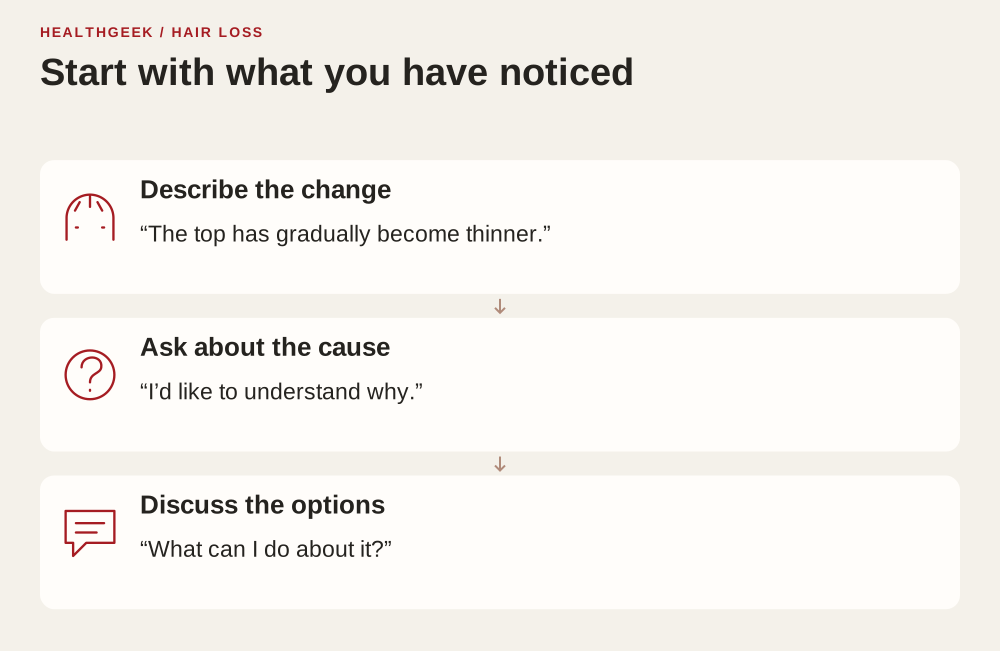
Read this graphic as text
- Describe the change: “The top has gradually become thinner.”
- Ask about the cause: “I’d like to understand why.”
- Discuss the options: “What can I do about it?”
Some changes deserve assessment before self-treatment
For sudden, patchy or unexplained hair loss, or a painful, red or irritated scalp, seek assessment before self-treatment. The 5% minoxidil solution below excludes these uses. Minoxidil solution label
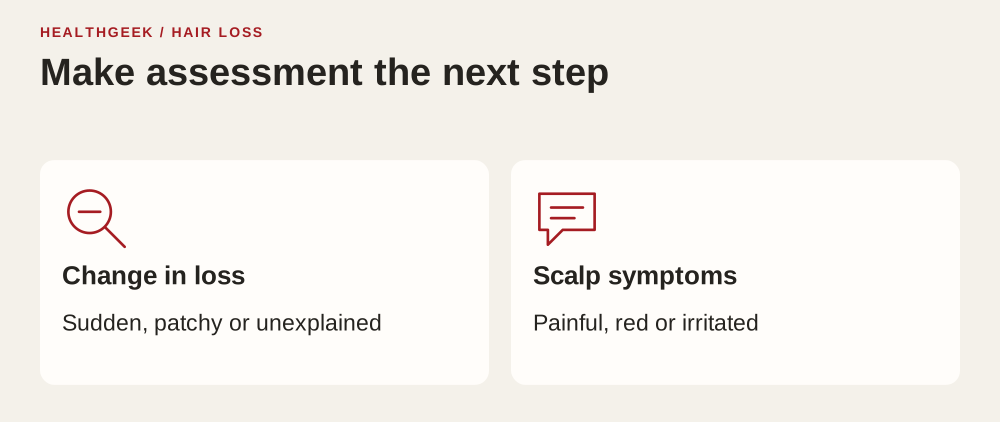
Read this graphic as text
- Change in loss: Sudden, patchy or unexplained
- Scalp symptoms: Painful, red or irritated
The point of the visit is to leave with an explanation and a next step. That might be treatment, further examination or testing, or a referral. Before choosing a treatment, it also helps to say what kind of result would matter to you.
Chapter 04 / 10
Deciding what you want treatment to achieve
Keeping the hair you have and growing more hair are different goals. Treatment for male-pattern loss may reduce further loss, and some men also see improved growth. A useful result doesn't always mean returning to the density you once had. American Academy of Dermatology: male-pattern hair-loss treatment
There are three ways to think about the change you're hoping for:
- Goal
- Slow further loss
- What you mean by it
- You want the thinning to progress less.
- Goal
- Maintain existing hair
- What you mean by it
- Keeping your current coverage would be worthwhile.
- Goal
- Improve growth or visible coverage
- What you mean by it
- You hope the thinning area will look fuller.
These goals can overlap, but they aren't interchangeable. If you're hoping for a fuller top, a discussion that stops at “this helps with hair loss” leaves an important question unanswered. Ask which goal the proposed treatment is meant to support in your situation.
Then explain why it matters. Perhaps you'd like more choice about how long to wear your hair. Perhaps you're happy with your current style and mainly want to preserve the coverage you still have. Those are useful goals to bring into the decision, even though no treatment can promise a particular haircut or your former hairline.
Decide what would make the commitment worthwhile
Talk about the result you're hoping for alongside the routine, risks and ongoing cost. Ask how you and the clinician would judge a response and when it would be reasonable to review it. Different treatments have different response windows; the next chapter explains two specific examples.
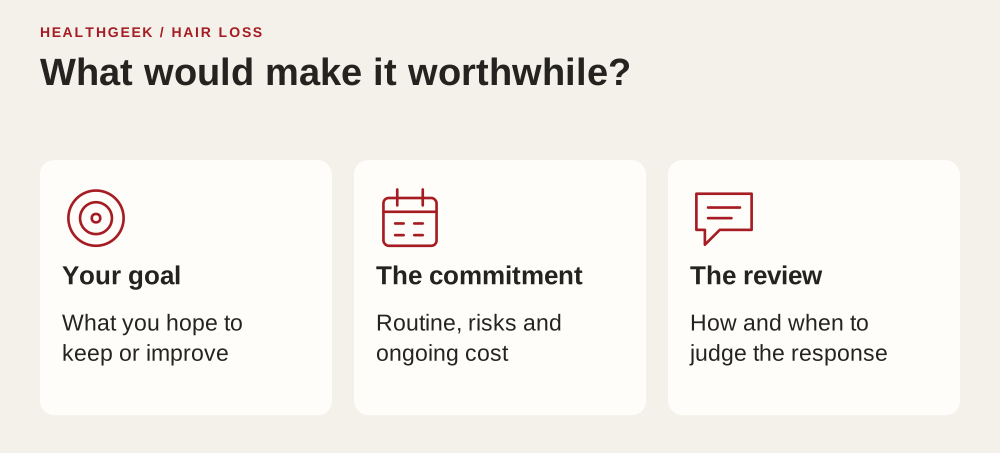
Read this graphic as text
- Your goal: What you hope to keep or improve
- The commitment: Routine, risks and ongoing cost
- The review: How and when to judge the response
You can also decide that medication isn't something you want to pursue. Choosing a hairstyle you like, including wearing your hair very short, is a choice about appearance. You don't have to take treatment to justify caring about your hair, or stop caring about it to decide against treatment.
Chapter 05 / 10
Understanding the main treatment options
Two core medicines you'll encounter are topical minoxidil, which goes on the scalp, and oral finasteride, which is taken as a tablet. “Topical” and “oral” describe how a medicine is used. They matter because a change in form can change the approved use, practical routine and safety considerations.
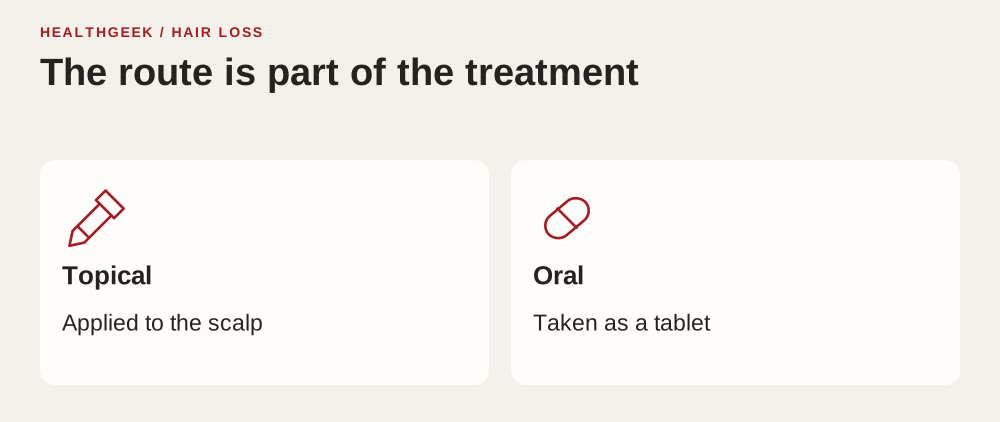
Read this graphic as text
- Topical: Applied to the scalp
- Oral: Taken as a tablet
Topical minoxidil: a medicine applied to the scalp
Topical minoxidil is available over the counter, meaning you can buy it without a prescription. It is used to help regrow hair. The exact product's instructions matter, including the area it is intended to treat and when to seek advice.
The 5% minoxidil solution for men linked here is labeled for gradual thinning at the top (vertex), not frontal baldness or a receding hairline. Results may begin at two months; some men need four. With no regrowth at four months, stop and ask a doctor. This timeline is specific to this solution. 5% minoxidil solution label
Match that description to the change you want help with. Ask what evidence and instructions apply to the area you want to treat.
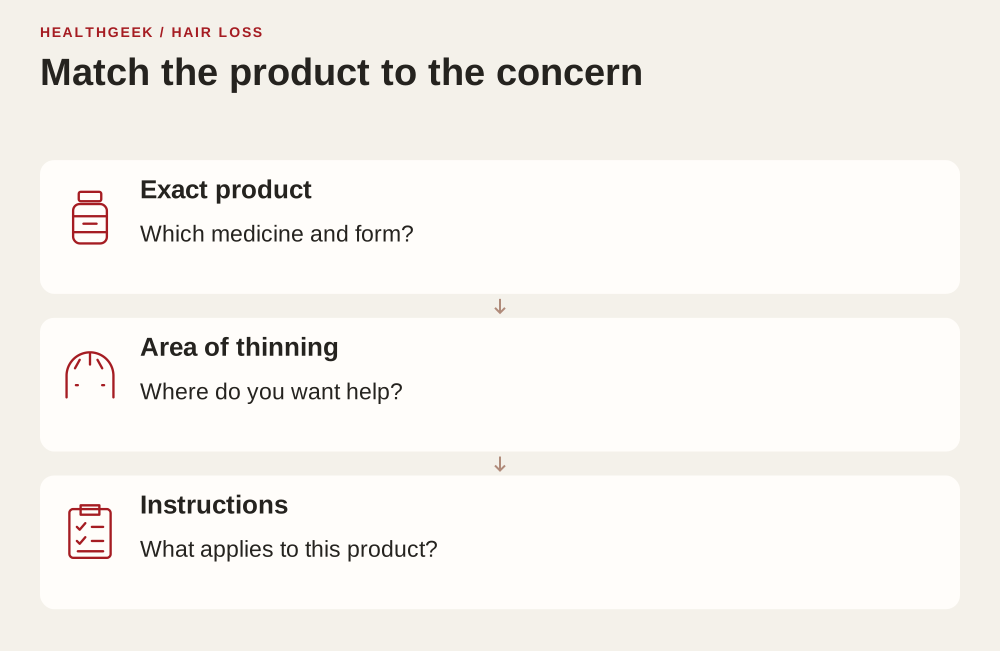
Read this graphic as text
- Exact product: Which medicine and form?
- Area of thinning: Where do you want help?
- Instructions: What applies to this product?
Oral finasteride: a prescription medicine that lowers DHT
Finasteride blocks type II 5-alpha-reductase, the enzyme that converts testosterone into DHT. Lowering DHT addresses part of the male-pattern hair-loss process.
Propecia, an oral finasteride product approved for male-pattern hair loss in men, has evidence for preserving hair and increasing hair counts. Benefit generally takes at least three months. Effectiveness at receding temples has not been established. Propecia prescribing information
Finasteride requires a prescription, so a clinician needs to assess whether it is appropriate for you. Its mechanism explains why it is an option; it doesn't tell you in advance how much visible change you will get or whether its risks are acceptable to you.
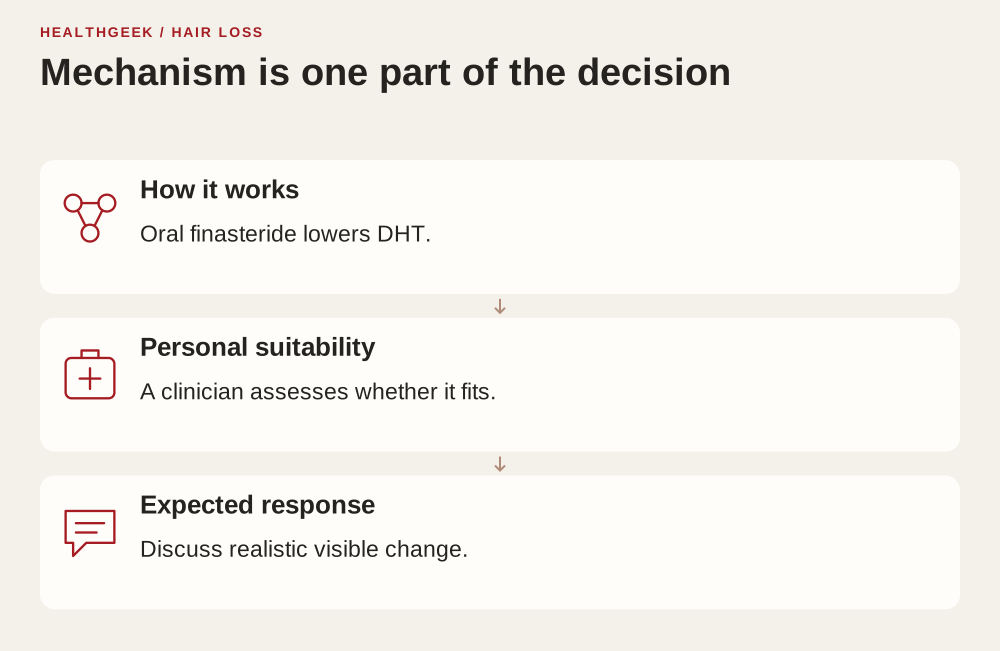
Read this graphic as text
- How it works: Oral finasteride lowers DHT.
- Personal suitability: A clinician assesses whether it fits.
- Expected response: Discuss realistic visible change.
When the same name appears in a different form
An advertisement for oral minoxidil or a finasteride spray may sound familiar after reading about these two medicines. The form still needs its own explanation.
Oral minoxidil is approved for severe high blood pressure in a specific medical setting. Prescribing it for hair loss is an off-label use, meaning that use is outside its FDA-approved indication. Oral use has different risks from scalp application, including serious heart-related warnings in the tablet label. A clinician considering it for hair loss needs to explain the reasons for that choice and the assessment it requires. Oral minoxidil label
Topical finasteride has no FDA-approved form in the United States. Products offered through compounding are not FDA-approved finished medicines. Compounding prepares a medicine for a patient's needs; the FDA does not review a compounded product's safety, effectiveness and quality before it is marketed. The presence of a familiar ingredient doesn't make the finished product equivalent to an approved tablet. FDA compounding questions and answers, FDA topical-finasteride alert
Those distinctions give you better questions to ask: which exact product is being proposed, why that form, and what evidence and precautions apply to it? A treatment name alone doesn't answer them.
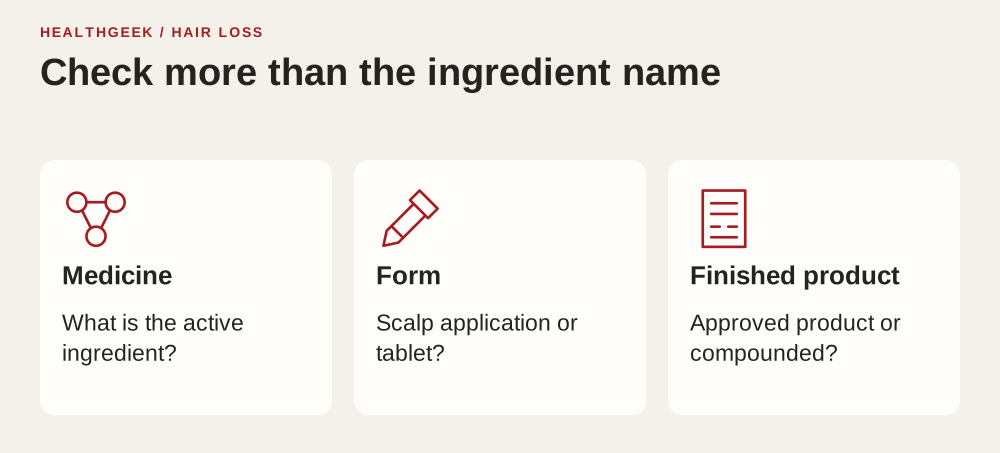
Read this graphic as text
- Medicine: What is the active ingredient?
- Form: Scalp application or tablet?
- Finished product: Approved product or compounded?
Chapter 06 / 10
Safety questions to settle before starting
Tell the clinician or pharmacist about your medical history, medicines and supplements, and bring up any risk that would affect your willingness to use treatment. You should understand what to watch for and whom to contact before starting.
The main safety questions differ by treatment. This guide highlights important issues; read the complete leaflet supplied with your own medicine.
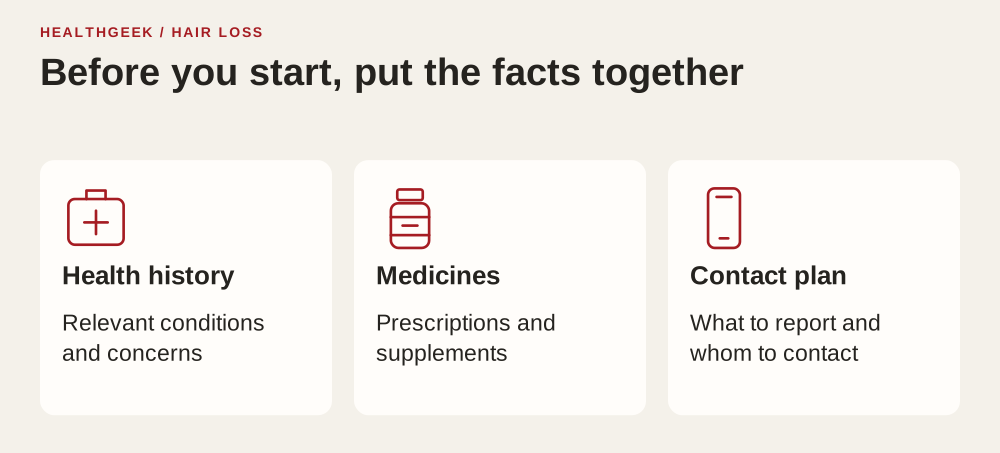
Read this graphic as text
- Health history: Relevant conditions and concerns
- Medicines: Prescriptions and supplements
- Contact plan: What to report and whom to contact
For topical minoxidil
Before using this solution, ask a doctor if you have heart disease. Its label also excludes use without a family history or alongside other scalp medicines. Minoxidil solution warnings
With topical minoxidil, chest pain, a rapid heartbeat, lightheadedness, unexplained weight gain or swelling require immediate doctor contact. MedlinePlus: topical minoxidil
The solution label also says to stop use and ask a doctor for these symptoms, faintness or dizziness, scalp redness or irritation, or unwanted facial hair. Minoxidil solution warnings
Severe or urgent symptoms need immediate medical help, rather than a wait for an online message response.
Read this graphic as text
- Medicine instructions: Follow the product-specific warnings above.
- Urgent symptoms: Get immediate medical help.
For oral finasteride
Possible side effects include reduced sex drive and problems with erections or ejaculation. MedlinePlus: finasteride
Reports received after Propecia was marketed include sexual problems continuing after stopping, poor semen quality or infertility, depression, suicidal thoughts or behavior, breast changes and allergic swelling. Reports cannot establish how often these effects occur or whether the medicine caused every case. Propecia safety information
Discuss bothersome sexual changes promptly with the prescriber. Contact a clinician immediately for new or worsening depression or suicidal thoughts or behavior. Seek emergency help for a severe allergic reaction or immediate danger to yourself. You don't need to wait for a scheduled hair-progress review to raise a new problem. MedlinePlus: finasteride precautions and side effects
Before prescribing, discuss relevant prostate or liver issues and any fertility concerns. MedlinePlus: finasteride precautions
If you have a prostate-specific antigen, or PSA, blood test, tell the clinician you take finasteride: it lowers PSA and affects how the result should be interpreted. Propecia patient information
There is also an important handling precaution. Women who are pregnant or could become pregnant must not handle broken or crushed finasteride tablets. The intact coating prevents contact with the active ingredient during normal handling. FDA: finasteride handling precautions
Read this graphic as text
- Changes to report: Sexual symptoms and mood changes
- Your health: Prostate, liver and fertility concerns
- Tests and handling: PSA interpretation and tablet precautions
For compounded topical finasteride
Applying finasteride to the skin does not mean it stays only on the skin. The FDA expects absorption into the bloodstream and has received reports of sexual and mood effects, some continuing after treatment stopped. Those reports don't establish a rate of risk.
Local irritation and accidental transfer to another person also matter, especially exposure of someone who is pregnant or could become pregnant. Ask the prescriber and dispensing pharmacy for handling instructions specific to the product, including how to avoid transferring it to others. FDA topical-finasteride alert
A useful safety conversation ends with clear instructions for your medicine, including what should prompt contact, what needs urgent care and how your own history affects the choice.
Read this graphic as text
- Your exposure: Skin application can lead to bloodstream absorption.
- Other people: Ask how to avoid accidental transfer.
Chapter 07 / 10
Living with a treatment routine
Once a treatment is suitable, there is another practical question: can you see yourself using it as directed over time?
A scalp treatment needs a place in your grooming routine. Apply topical minoxidil to a dry scalp and follow the exact package instructions. Using more will not produce faster or greater growth. MedlinePlus: topical minoxidil use Allow this solution to dry after application. Minoxidil solution instructions
Oral finasteride means taking a medicine according to the prescription rather than applying a treatment to your scalp. That may fit differently into your day, but convenience is only one part of the choice. Use the directions for the exact medicine you've been prescribed.

Continuing treatment is part of maintaining its benefit
Continued use of this solution is needed; regained hair is lost within three to four months after stopping. Minoxidil solution label Continued Propecia use maintains benefit; withdrawal reverses its effect within 12 months. Propecia label
These are separate product timelines. Neither medicine is a short course that permanently settles male-pattern hair loss.
That makes ongoing effort and cost worth discussing from the start. If you want to stop, ask what to expect for your treatment and how to handle the decision.
Read this graphic as text
- Use as directed: Fit the prescribed routine into your day.
- Review the response: Agree on treatment-specific follow-up.
- Discuss stopping: Ask what to expect before changing the plan.
Know what to report between reviews
This solution can initially increase shedding for up to two weeks. If the increase continues beyond two weeks, contact a doctor. Minoxidil solution questions and answers “Early shedding happens” isn't a reason to dismiss every change or ignore symptoms.
Agree on how progress will be reviewed, using the response expectations for your specific treatment. If the routine is hard to follow, explain which part is getting in the way. If you're disappointed with the result, describe what has or hasn't changed. That gives the clinician something concrete to reassess.
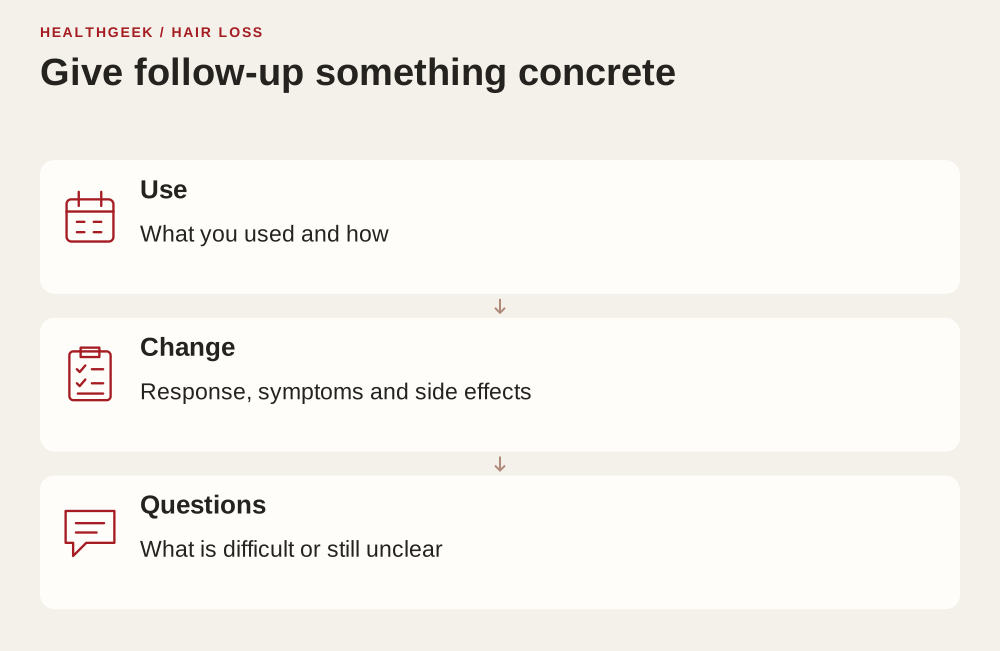
Follow-up is also where you raise new symptoms, ask about instructions and discuss whether more evaluation is needed. Find out how that contact works before you need it. HHS: after a telehealth visit
Read this graphic as text
- Use: What you used and how
- Change: Response, symptoms and side effects
- Questions: What is difficult or still unclear
Chapter 08 / 10
Getting help online or in person
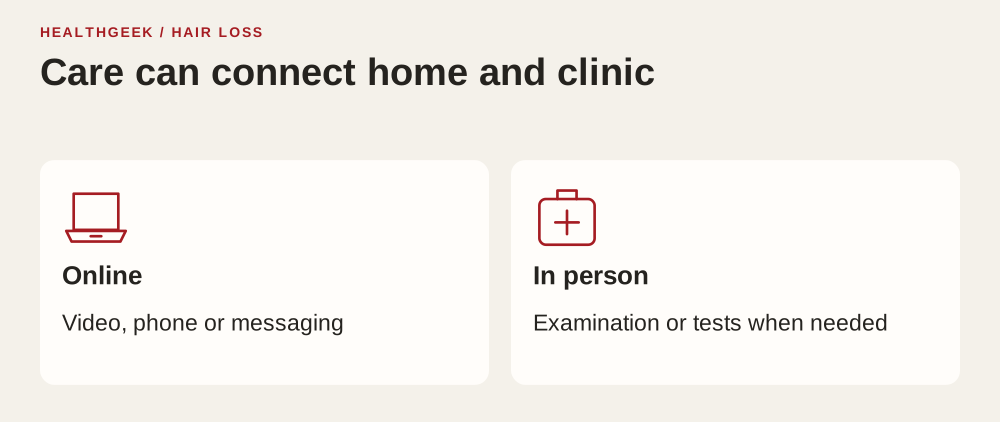
Online care lets you start a health conversation from home. Avoiding travel can make room for an appointment that would otherwise mean getting across town and back. Depending on the service, the conversation may happen by video, phone or messaging. Some concerns still need an in-person examination or tests. HHS: why use telehealth
For hair loss, the useful question is whether the service can assess your concern and arrange the next step if more information is needed.
Read this graphic as text
- Online: Video, phone or messaging
- In person: Examination or tests when needed
What an online care path may involve
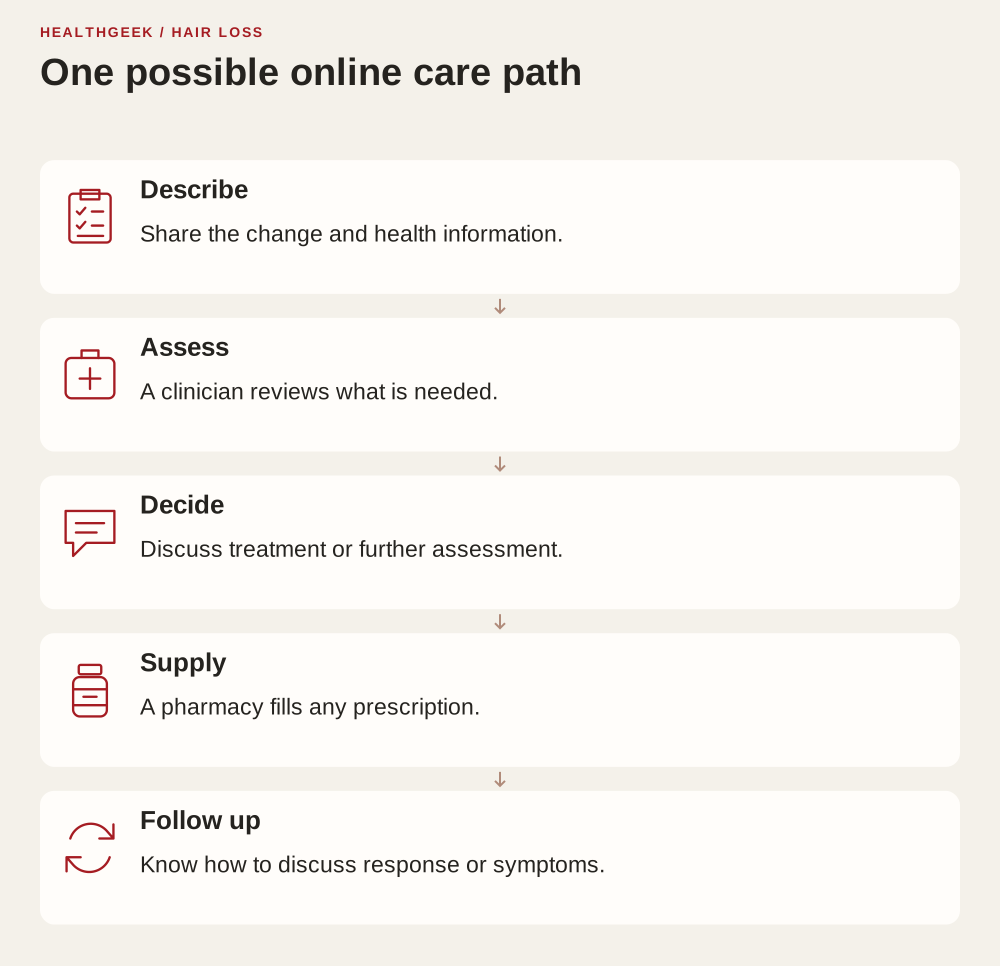
Check how the particular service works. A possible sequence is:
- You describe the change. You provide health and medicine information, and photos if requested.
- A clinician assesses it. They may ask questions or decide that an in-person examination is needed.
- You discuss the next step. Treatment might be appropriate, or the next step might be testing, referral or further assessment. Completing an intake doesn't guarantee a prescription.
- A pharmacy supplies any prescribed medicine. Confirm which pharmacy, how you receive the medicine and where to get its instructions.
- You have a route for follow-up. Ask how to discuss response, side effects, new symptoms and changes to the plan. HHS: follow-up after telehealth
Read this graphic as text
- Describe: Share the change and health information.
- Assess: A clinician reviews what is needed.
- Decide: Discuss treatment or further assessment.
- Supply: A pharmacy fills any prescription.
- Follow up: Know how to discuss response or symptoms.
Online and local care can work together. A remote clinician may ask you to arrange an examination or testing locally. A local practice may also offer remote follow-up. Ask who coordinates any additional care so you know which appointment to make next.
The website, clinician and pharmacy have different jobs
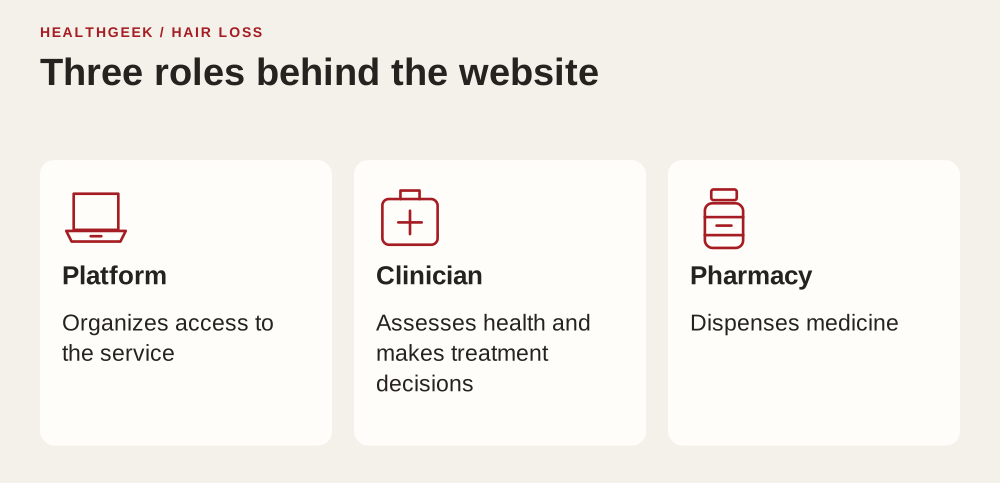
The platform organizes access to a service. The clinician assesses your health and makes treatment decisions. The pharmacy dispenses medicine. They may be presented together on one website, but you still need to know who handles each part.
Read this graphic as text
- Platform: Organizes access to the service
- Clinician: Assesses health and makes treatment decisions
- Pharmacy: Dispenses medicine
For an online pharmacy, the FDA advises checking for a valid prescription requirement for prescription medicines, a U.S. address and phone number, state pharmacy licensing and access to a licensed pharmacist. These checks concern dispensing. They don't, on their own, tell you how thorough the clinical assessment or follow-up will be. FDA: buying medicines safely online
That is why comparing care involves more than finding a site that sells the treatment you've read about.
Chapter 09 / 10
Comparing care and the full cost
Start with what you would actually receive: the assessment, the exact medicine if one is prescribed, and the opportunity to ask questions afterward.
Before committing to a service, ask:
- Who assesses me, and how does the consultation work?
- Which treatment and form would we discuss? Is the finished product FDA-approved or compounded?
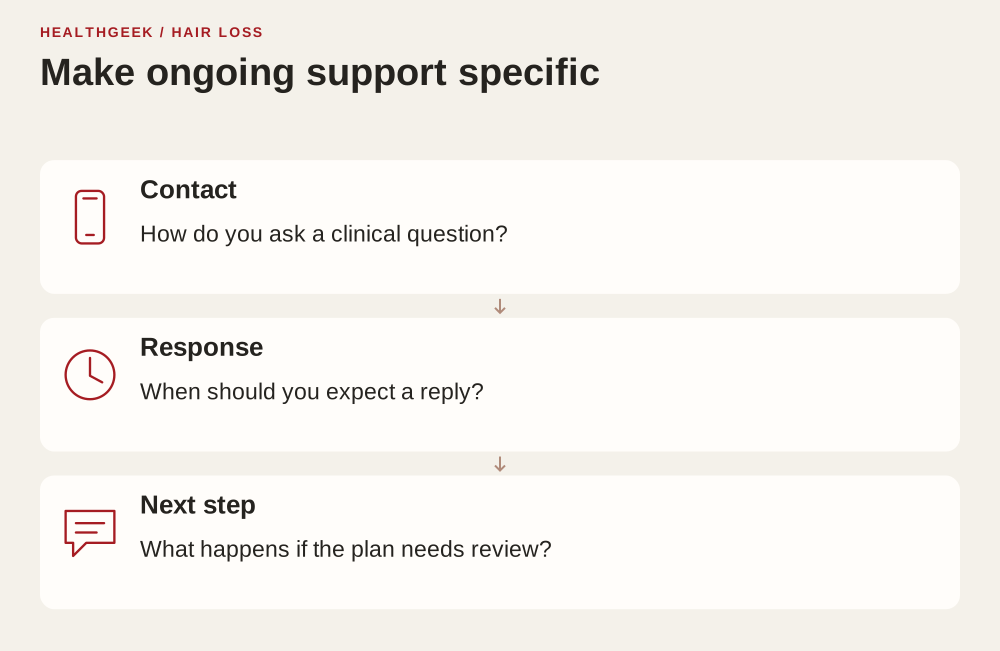
- How do I ask a clinical question, and what response time should I expect?
- How are progress, side effects and treatment changes handled?
- Which pharmacy dispenses the medicine?
- What happens if I need an examination, tests or care the service doesn't provide?
These questions give phrases such as “ongoing support” a practical meaning. You want to know what happens when you send a question about a new symptom or when the initial plan needs review.
Read this graphic as text
- Contact: How do you ask a clinical question?
- Response: When should you expect a reply?
- Next step: What happens if the plan needs review?
Turn the advertised price into an actual bill
A monthly figure isn't enough to show what you will pay today or over time. Ask for the charges and terms together:
- Detail to confirm
- Initial assessment or consultation
- Why you need it
- Establishes what you pay to discuss care.
- Detail to confirm
- Exact medicine, form and quantity
- Why you need it
- Shows what the medicine charge buys.
- Detail to confirm
- Shipping
- Why you need it
- Identifies any separate delivery cost.
- Detail to confirm
- Refills and clinical reviews
- Why you need it
- Clarifies which ongoing services cost extra.
- Detail to confirm
- Billing interval and renewal price
- Why you need it
- Shows when money is taken and whether later charges differ.
- Detail to confirm
- Cancellation and refund terms
- Why you need it
- Explains how to stop future orders and what is refundable.
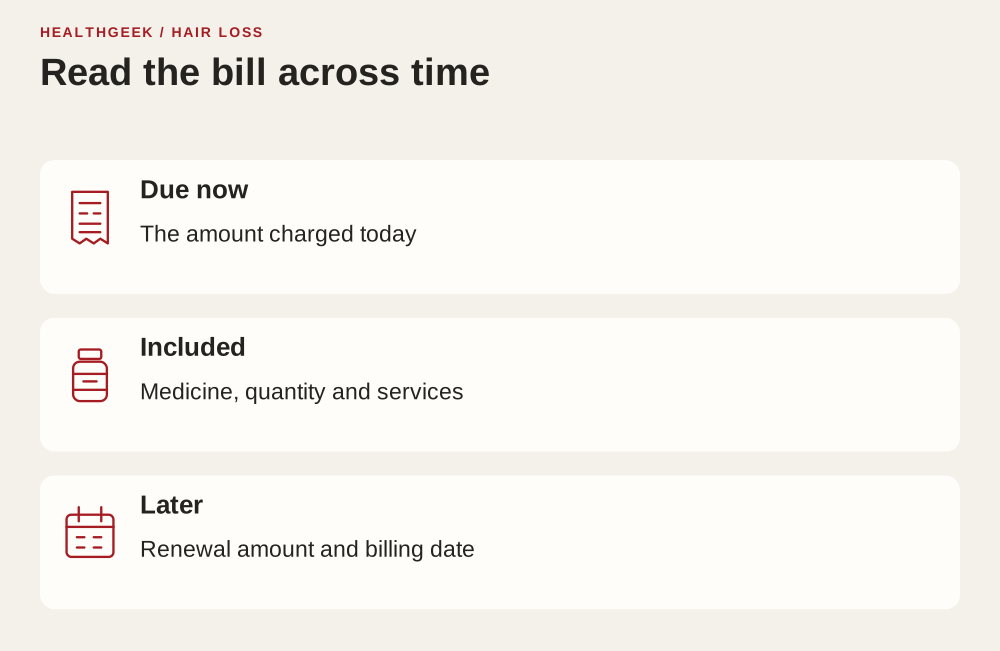
For example, if a price is expressed per month but billed for several months at once, ask for the amount charged now. Then confirm what that payment includes and when the next one is due. The number on the bill should be understandable before you agree to it.
Read this graphic as text
- Due now: The amount charged today
- Included: Medicine, quantity and services
- Later: Renewal amount and billing date
Consider the routine over that same period. A lower medicine price may matter to you, but you also need to understand how you will get clinical advice and what that advice costs. Once the treatment, care and payment terms are clear, you can decide whether the commitment fits your priorities.
Chapter 10 / 10
Take your questions to a clinician
You can begin with a simple explanation: “I've noticed my hair getting thinner, and I'd like to understand what's causing it and what I can do.”

You don't need to arrive with a diagnosis or a preferred prescription. Bring a few notes so the conversation starts with your experience:
- What changed: the areas that look thinner, any increased shedding and any scalp symptoms.
- When it changed: when you first noticed it and whether it happened gradually or suddenly.
- Relevant background: health changes, family history and the medicines or supplements you use, including anything applied to your scalp.
- What you want to keep or improve: preserving current coverage, improving a thinning area or having more choice about your hairstyle.
- What you still need answered: suitable options, important risks, daily use, follow-up and full cost.
Take those notes to your primary care clinician, a dermatologist or an appropriate online assessment. If the change is sudden, patchy, painful or unexplained, make getting it assessed the next step.
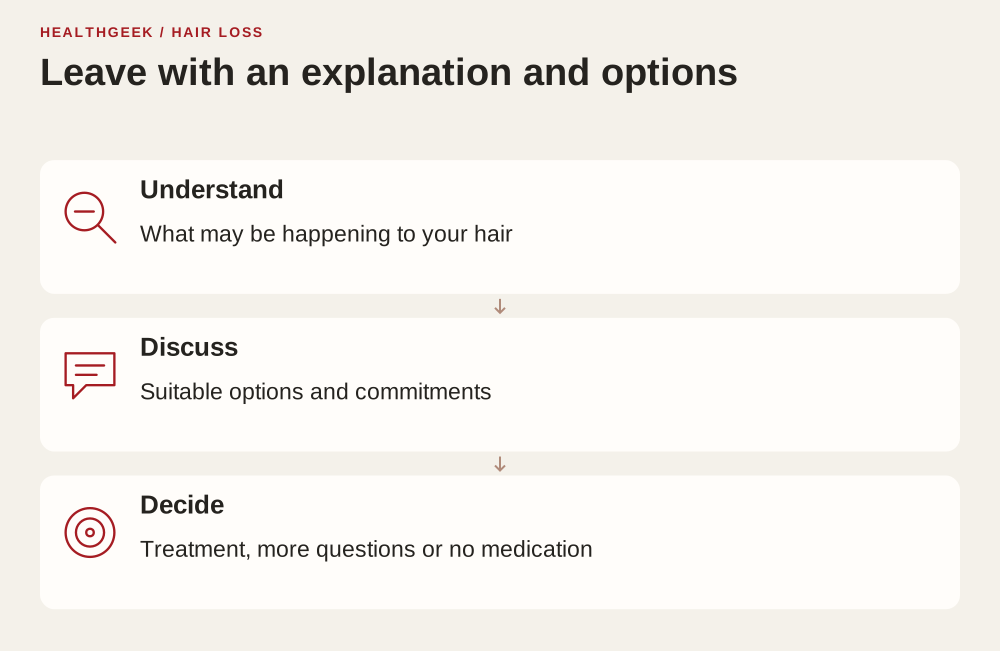
Then decide what you want to do with the explanation and options you receive. You may choose treatment, ask more questions or decide against medication. What matters is being able to connect that choice to your own hair, the result you're hoping for and the commitment you're willing to make.
Read this graphic as text
- Understand: What may be happening to your hair
- Discuss: Suitable options and commitments
- Decide: Treatment, more questions or no medication
Your next appointment doesn't have to begin with a product name. Begin with what you've noticed and what you'd like to change.
If you're ready to explore treatment to help keep the hair you have, you can now look at online plans with a clearer idea of what matters: the medicines offered, the daily routine, the support and the full cost.
Our sponsored comparison of Keeps, Ro and Happy Head puts those details side by side and explains why Keeps is our recommendation. Use it to see how the plans differ and decide which one you'd like to discuss with a clinician.
The comparison is a paid partnership with Keeps.
Sources
- MedlinePlus Genetics: Androgenetic alopecia.
- American Academy of Dermatology: Do you have hair loss or hair shedding?.
- American Academy of Dermatology: Hair loss causes.
- American Academy of Dermatology: Male-pattern hair-loss treatment.
- American Academy of Dermatology: Hair loss diagnosis and treatment.
- DailyMed: Minoxidil 5% topical solution, product label.
- DailyMed: Propecia, oral finasteride prescribing and patient information.
- DailyMed: Oral minoxidil product label.
- FDA: Compounding and the FDA, questions and answers.
- FDA: Potential risks associated with compounded topical finasteride.
- HHS: Why use telehealth?.
- HHS: What happens after my telehealth visit?.
- FDA: How to buy medicines safely from an online pharmacy.
- MedlinePlus / ASHP: Finasteride medication information.
- MedlinePlus / ASHP: Topical minoxidil medication information.