

01 / 10
If you're having symptoms now
| What you notice | What to do |
|---|---|
| An erection that lasts more than four hours (priapism), even if it doesn't hurt | Get emergency medical help immediately. |
| Sudden loss of sight in one or both eyes | Stop taking Viagra and get medical help right away. |
| New blurred vision | Call a doctor right away. If you suddenly lose any of your sight, follow the row above. |
| Your hearing suddenly drops or goes away, with or without ringing in your ears or dizziness | Stop taking Viagra and seek medical attention right away. |
| Chest pain, dizziness or nausea during sex | Stop having sex and get medical help immediately. Tell emergency providers when you last took Viagra. |
| Trouble breathing or sudden swelling of your tongue or throat | Call 911. These can be signs of a severe allergic reaction. |
| A side effect that bothers you or won't go away, such as headache, flushing, indigestion or a stuffy nose | Contact your prescriber. The checklist below gives you a few details to have handy. |
Table sources: [1–3]
02 / 10
What are the common side effects of Viagra?
Headache, flushing, indigestion and a stuffy nose are among the most common. Flushing is a sudden rush of warmth, usually in your face. Indigestion can feel like heartburn or an upset stomach. Some men also get back pain, sore muscles, nausea, a rash or dizziness. [1, 2]
Most of these are a nuisance rather than an emergency. But a pounding head or a hot, red face isn't what you want in the middle of sex, so it's fair to want them gone. If one keeps showing up, your prescriber has options, and the section on repeat side effects covers what to bring them. Dizziness is the one to keep an eye on. If you get dizzy during sex, stop and follow the table.
Some men in the Viagra trials saw colors differently for a while, often with a blue tint. Others found bright light harder to look at or had blurry vision. A color tint isn't the same as losing your sight. For newly blurry vision or any sudden loss of sight, follow the table above. [1, 2]
If you take generic sildenafil for ED, the same side effects and warnings apply. FDA-approved generics have the same active ingredient as the brand and carry the same risks and benefits. Sildenafil is also sold as Revatio, for high blood pressure in the lungs. Don't take Viagra alongside Revatio or another sildenafil product. [1, 4]
03 / 10
How long do Viagra side effects last?
There's no set clock. The color changes men noticed in the trials went away, but there's no standard time for a headache or flush to clear. [1]
If you wake up with a headache the next morning, jot down when you took the tablet and when the pain started. If the headache is still bothering you, won't go away or keeps coming back after each dose, that pattern is worth taking to your prescriber. [1]
04 / 10
Does the dose change your risk?
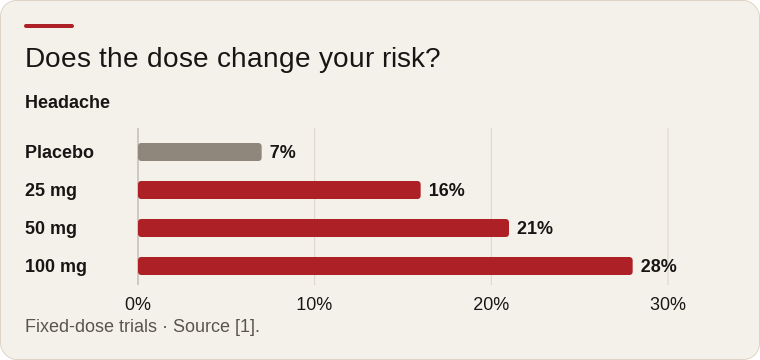
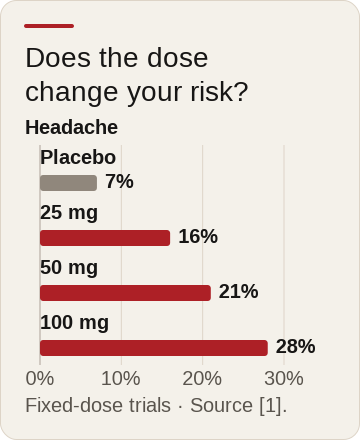
It can. In trials where men took a fixed dose or a placebo, 16% of men on 25 mg reported a headache, compared with 21% on 50 mg and 28% on 100 mg. On the placebo, it was 7%. So if headaches keep getting in the way, a lower dose is one thing your prescriber can look at. Don't take more than one dose a day, and don't take more than you were prescribed. If you take too much by accident, call your doctor or go to the nearest emergency room right away. [1]
05 / 10
Does Viagra lower blood pressure? What it means for your heart
Viagra lowers your blood pressure a little on its own. In healthy volunteers, a single 100 mg dose lowered it by about 8 points on the top number and 5 on the bottom, on average, and the drop was temporary. The bigger risk is when something else lowers it too. [1]
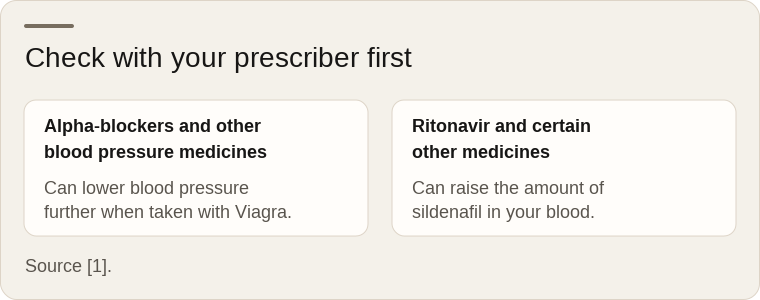
That's why some combinations are off the table at any dose. Do not combine Viagra with nitrate medicines such as nitroglycerin, with nitrite poppers, or with riociguat (Adempas). Together, they can make your blood pressure drop to an unsafe level. Other medicines need a check with your prescriber first. Alpha-blockers, which some men take for prostate symptoms or blood pressure, and other blood pressure medicines can lower it further when taken with Viagra. Ritonavir and certain other medicines can raise the amount of sildenafil in your blood. A list of everything you take helps your prescriber pick a safe dose. [1]


Alcohol is a common question, and the label doesn't set a safe amount. If you drink, it's worth asking your prescriber what makes sense for you. [1]
Your heart matters here too. Heart attacks have been reported rarely in men taking Viagra. Most, but not all, already had heart problems. It isn't known whether Viagra caused the heart attacks. Sex itself puts some extra strain on your heart. That's why your prescriber asks about heart problems such as a past heart attack, an irregular heartbeat or chest pain (angina) before prescribing Viagra, and why it generally isn't used in men whose heart health makes sex unsafe. [1]
06 / 10
Viagra side effects in older men
If you're over 65, your prescriber may consider starting you at 25 mg. As men get older, the body tends to take longer to clear sildenafil, so more of it stays in the blood. Even so, in the clinical trials, men 65 and older did about as well as younger men overall, with similar safety. [1]
It helps to mention any heart problems, low blood pressure, or kidney or liver problems, even if a different doctor looks after those. Together with your medicine list, that helps your prescriber decide whether Viagra is a good fit and where to start. [1]
07 / 10
Viagra side effects in younger men
Being in your 20s or 30s doesn't make you immune. You can still get a headache, a flushed face or a stuffy nose. In a pooled look at four sildenafil trials, those were among the most common side effects across the age groups studied, including men 45 and under. The warning signs above and the rule against mixing Viagra with poppers apply at any age. [1, 5]
If you keep having trouble getting or keeping an erection, that's worth bringing up with a doctor, whatever your age. It helps to say when it started, whether it happens more in some situations than others, and whether anything changed around that time, like a new medicine. Those details help the doctor work out what might be behind it. [6]
08 / 10
What if side effects keep happening?
A headache that comes back dose after dose is easier to sort out when you can tell your prescriber exactly what's going on. A quick note on your phone does the job.
- What you took. The name on the bottle and the dose in milligrams.
- When you took it. The time of your last dose and any recent change your prescriber made.
- What happened. The symptom, when it started, whether it eased or came back, and what it got in the way of.
- What else you took. Other prescriptions, over-the-counter medicines, supplements or recreational drugs.
With those details, your prescriber can check for another cause, lower your dose, or talk with you about a different ED medicine. Talk with them before changing your dose yourself. And if you need help right away, follow the table, even if you haven't written anything down. [1]
09 / 10
Are there long-term side effects of Viagra?
In a four-year study of 979 men with ED taking sildenafil as needed, fewer than 4 in 100 changed their dose or stopped, even for a while, because of side effects researchers linked to the medicine. That study mostly counted serious problems and side effects bad enough to change treatment, so it can't say how often milder ones, like headaches, kept coming back. [7]
Sources
- Pfizer, Viagra (sildenafil citrate) U.S. prescribing information and Patient Information. Also available on DailyMed.
- MedlinePlus, Sildenafil
- MedlinePlus, Anaphylaxis
- FDA, Generic Drug Facts
- Kaminetsky et al., pooled analysis of sildenafil trials by age group
- American Urological Association, Erectile Dysfunction guideline
- McMurray et al., long-term safety and effectiveness of sildenafil citrate in men with erectile dysfunction